
Papain vs Bromelain: Source, Cost, Applications & How to Choose
WEHENGFOOD supplies bulk food-grade Papain and Bromelain for meat processors, seasoning and flavor makers, and protein-hydrolysate manufacturers. For product specifications, samples, pricing, or bulk orders, please contact us at nancy@wehengfood.com.
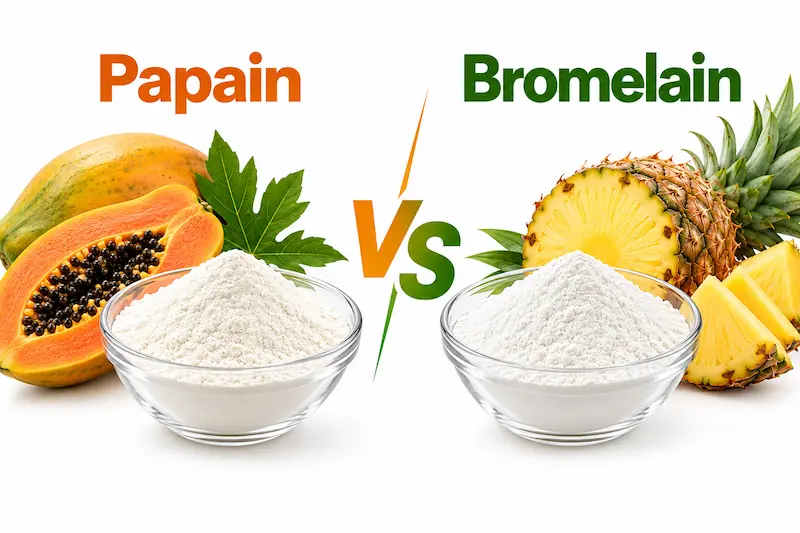
Papain and bromelain are the two best-known plant-derived protein-cutting enzymes in the food industry, and buyers often ask whether one can simply stand in for the other. On paper they look alike: both are cysteine proteases, both hydrolyze proteins under mild conditions, and both are used to tenderize meat and to break proteins into smaller, more useful fragments. In practice, they are chosen for very different reasons. The deciding factor is usually not activity but economics: papain's simple production route gives it a clear cost advantage for large-volume food use, while bromelain's more demanding purification keeps it concentrated in higher-value, lower-volume applications[1][2]. This guide compares the two side by side so you can match the enzyme to your process and your budget.
What Are Papain and Bromelain?
Two Plant Proteases, Two Different Fruits
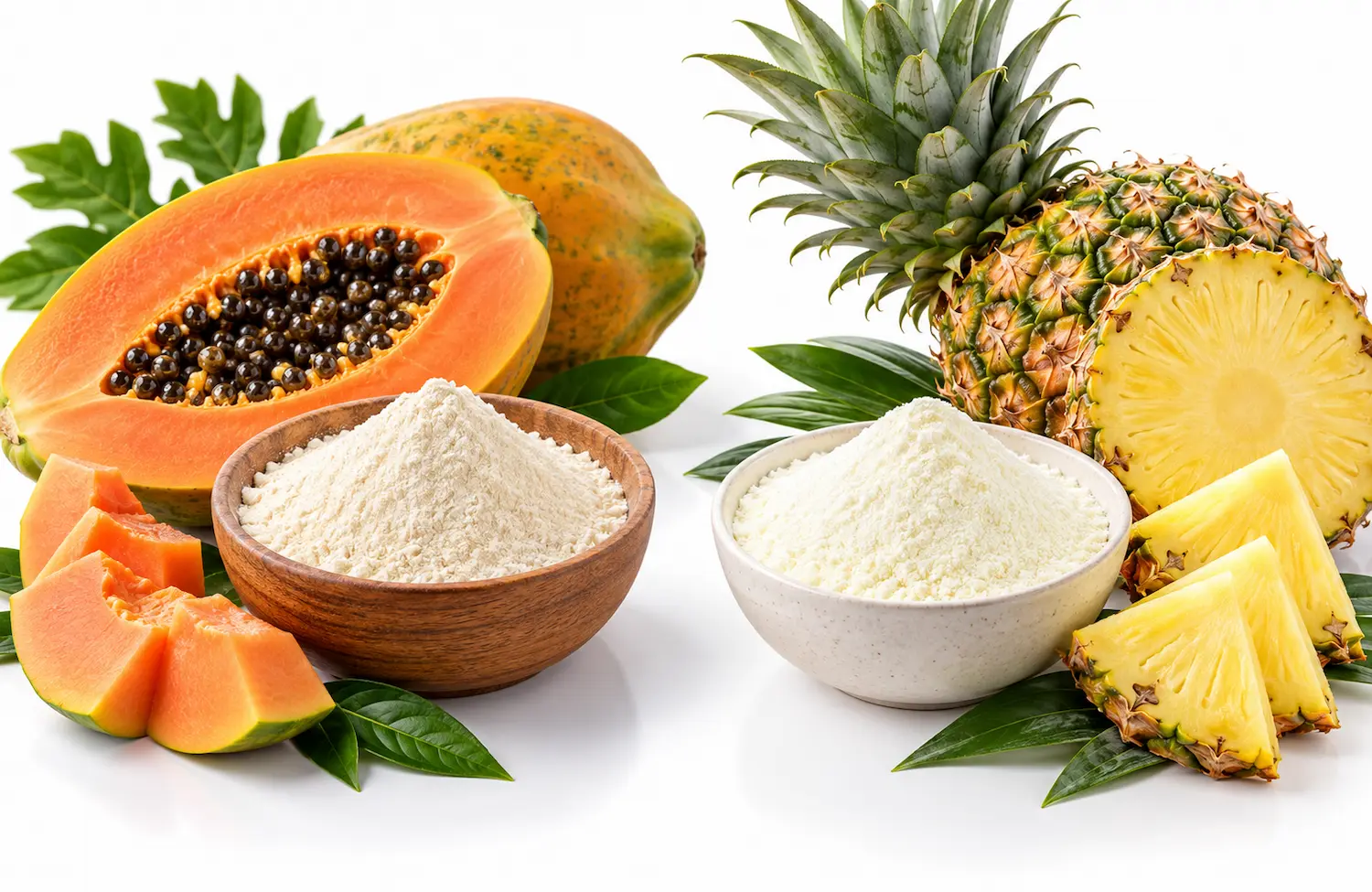
Papain is a protease extracted from the milky latex of unripe papaya (Carica papaya) fruit. Bromelain is a group of proteases extracted mainly from the stem (and, to a lesser degree, the fruit) of the pineapple plant (Ananas comosus). Both belong to the cysteine-protease family, which means they rely on a cysteine residue in the active site to cut peptide bonds, and both have broad substrate specificity, so they work on a wide range of animal and plant proteins[2][3].
The enzymes are therefore functionally similar. What separates them commercially is the raw material, the work required to turn it into a usable powder, and the price that results.
Papain
Sourced from unripe papaya latex. Simple collection and processing, low cost, and a wide working range make it the workhorse enzyme for large-scale food processing.Bromelain
Sourced from pineapple stem or fruit. Needs more extensive purification, costs more, and is used where purity, consistency and added value justify the price[1][4].How Each Enzyme Is Produced
The production route is the single biggest difference between the two. Papain can be captured as a crude enzyme preparation with very little processing, whereas bromelain has to be separated from a much messier plant matrix before it is usable.
| Stage | Papain | Bromelain |
|---|---|---|
| Raw material | Latex tapped from unripe papaya fruit | Pineapple stem or fruit, pressed or macerated to release the enzyme |
| Primary recovery | Centrifugal separation of the latex | Extraction and clarification of the pineapple juice or stem extract |
| Impurity removal | Minimal for a crude preparation | Polysaccharides, pigments and other plant impurities must be removed |
| Purification | Optional; higher purity is reachable without complex equipment | Multiple purification steps, including chromatography and filtration, to keep activity stable |
| Drying | Low-temperature drying gives a crude enzyme powder | Gentle drying of the purified concentrate to protect activity |
| Process complexity | Relatively simple | Multi-step and more equipment-intensive |
Cost Comparison: Why Papain Is Cheaper
Because crude papain can be produced with centrifugation and low-temperature drying, and because any further purification does not need complex equipment, producers typically put its overall production cost at roughly one-third to one-half of bromelain. That gap is what makes papain viable for the large-volume, low-unit-price economics of the food industry.
Bromelain sits at the opposite end. Its multi-step purification is justified when the enzyme has to meet strict purity and activity standards and the end product can carry a higher price, which is why it is found mainly in pharmaceutical and nutraceutical formulations such as oral preparations, topical gels and digestive-enzyme tablets[1][4]. The logic is a simple cost-to-value match: papain wins on cost-performance and batch suitability, bromelain wins where a high cost can be absorbed by high added value.
Papain vs Bromelain: Side-by-Side Comparison
| Attribute | Papain | Bromelain |
|---|---|---|
| Botanical source | Unripe papaya latex | Pineapple stem or fruit |
| Enzyme class | Cysteine protease | Cysteine protease |
| Production cost | Low (roughly one-third to one-half of bromelain) | Higher, due to multi-step purification |
| Purification burden | Light; simple equipment | Heavy; chromatography and filtration |
| Typical price position | Volume-friendly, low unit price | Premium |
| Hydrolysis conditions | Mild; no high temperature or pressure needed | Mild; activity must be protected during processing |
| Main food use | Meat tenderizing, seasoning and flavor bases, yeast extract, protein peptides | Selected food and nutraceutical uses where higher purity is needed |
| Main non-food use | Limited compared with bromelain | Pharmaceutical: oral preparations, topical gels, digestive-enzyme tablets |
| Best fit | Large scale, cost-sensitive processing | High added value, strict purity and activity standards |
Working temperature and pH windows also differ somewhat between grades, so confirm activity and stability data for the specific grade you are evaluating rather than assuming the two enzymes behave identically[3].
Where Papain Is the Mainstream Choice
Papain's cost advantage makes it the default enzyme for food applications that run in large volumes and at low unit prices. Three uses account for most of that demand.
Meat Tenderizing
Papain hydrolyzes muscle fibers and connective-tissue proteins, loosening tough cuts and improving the bite of sliced, marinated, tumbled or injected meat. It is widely used in meat processing because it gives a reliable tenderizing effect at a cost that scales to industrial throughput[2][3]. Bromelain can tenderize in the same way, but papain is the more common commercial choice for volume work.
Savory Flavors and Yeast Extract
Papain plays the core protein-hydrolysis role in savory flavor production. Acting on animal or plant proteins such as chicken or beef protein, it releases amino acids and small peptides, which are the main source of a flavor's meaty character and help give it richness and authenticity. In yeast extract production it breaks down proteins inside the yeast cell wall, releasing flavor-active nucleotides and amino acids, reducing extract viscosity and improving purity. Its low cost is what makes tonnage-scale yeast extract production practical.
Protein Peptide Preparation
Papain can hydrolyze soy protein, whey protein and other large proteins into smaller peptides that are more easily absorbed and can carry some physiological activity, making them suitable as raw materials for health foods and nutritional fortifiers, including in infant-formula-type products subject to the relevant regulations. Compared with many other proteases, its hydrolysis conditions are mild (no high temperature or pressure) and its cost is low, so it suits food companies producing peptide ingredients at scale.
Where Bromelain Earns Its Price
Bromelain's purification steps, which remove polysaccharides, pigments and other impurities and use chromatography and filtration to keep activity stable, are what make it suitable for demanding applications. Its use concentrates in pharmaceutical and nutraceutical formats, including oral preparations and topical gels, and in digestive-aid products such as enteric-support enzyme tablets, all of which must meet strict purity and activity standards[4]. In these markets the ingredient cost is a small part of the finished product's value, so the higher price of bromelain is acceptable.
Bromelain is also a legitimate option in food processing when a process needs its specific activity profile, or when a pineapple-derived enzyme is preferred for positioning reasons. It is simply less commonly chosen where price per kilogram of finished product is the dominant constraint.
Working Dosage Starting Points
Dosage depends on the enzyme's activity (units per gram), the substrate, temperature, pH and contact time, so the ranges below are only indicative starting points for lab and pilot trials, not specifications for any particular grade.
| Application | Indicative Starting Range | Notes |
|---|---|---|
| Meat tenderizing (papain or bromelain) | Low fractions of a percent of meat weight, adjusted to activity | Control contact time and temperature; over-treatment gives a mushy texture |
| Savory flavor base hydrolysis | Approx. 0.1%–2% of substrate protein | Hydrolysis degree drives flavor intensity; stop with a heat inactivation step |
| Yeast extract production | Approx. 0.1%–1% of yeast solids | Also lowers viscosity and supports easier downstream concentration |
| Protein peptide preparation | Approx. 0.5%–2% of substrate protein | Mild conditions; validate degree of hydrolysis and bitterness on your substrate |
How to Choose Between Papain and Bromelain
A simple way to decide is to start from the application and its price tolerance:
| If your priority is... | Lean toward | Why |
|---|---|---|
| Large-volume meat tenderizing at low cost | Papain | Low production cost and mild working conditions fit industrial throughput |
| Tonnage-scale savory flavor or yeast extract | Papain | Efficient protein hydrolysis at a cost that scales |
| Cost-effective protein peptide raw materials | Papain | Mild hydrolysis and low cost suit large-batch peptide production |
| Pharma or nutraceutical formats with strict purity and activity standards | Bromelain | Purified grades justified by higher added value |
| A pineapple-derived enzyme or a specific activity profile | Bromelain | Fits positioning or formulation needs that papain does not |
Supplier & Sourcing Insights for Bulk Procurement
With enzymes, the label on the bag says less than the data behind it. Use the following checks when you qualify a supplier of papain or bromelain.
| Supplier Attribute | What to Verify | WEHENGFOOD Standard |
|---|---|---|
| Enzyme Activity | Activity in units per gram, with the assay method stated | Activity reported on the batch COA |
| Batch Consistency | Batch-specific COA covering activity, moisture and appearance | COA provided with every shipment |
| Safety Parameters | Heavy metals and microbiological results for the intended grade | Food-grade testing data available on request |
| Storage & Packaging | Dry, sealed packaging to protect activity during transit and storage | Moisture-resistant packaging |
| Minimum Order Quantity | Flexibility for trial batches vs. full-container runs | Trial orders available up to full bulk supply |
| Technical Support | Help matching grade and dosage to your substrate | Dedicated technical support for application trials |
Conclusion
Papain and bromelain do similar biochemical work, but they are not interchangeable on the balance sheet. Papain's simple production route, centrifugation plus low-temperature drying with optional light purification, puts its cost at roughly one-third to one-half of bromelain and makes it the mainstream enzyme for meat tenderizing, savory flavor and yeast extract production, and protein peptide preparation. Bromelain's multi-step purification confines it mostly to higher-value pharmaceutical and nutraceutical formats where the cost is easily absorbed. Matching the enzyme to the cost-to-value profile of your product, then validating activity and dosage on your own substrate with a supplier that documents both, is the reliable path to consistent results.
FAQ
What is the main difference between papain and bromelain?
Papain comes from unripe papaya latex and is simple and inexpensive to produce, so it dominates large-volume food uses. Bromelain comes from pineapple stem or fruit, needs multi-step purification, costs more, and is used mainly where higher added value justifies the price, such as pharmaceutical and nutraceutical products.
Which is cheaper, papain or bromelain?
Papain. Its overall production cost is typically about one-third to one-half of bromelain, because a crude preparation needs only centrifugation and low-temperature drying, while bromelain needs removal of polysaccharides and pigments plus chromatographic and filtration steps.
Can papain and bromelain be used interchangeably for meat tenderizing?
Both break down muscle and connective-tissue proteins, so either can tenderize meat, and they are sometimes blended. Papain is the more common choice for industrial meat processing because of its cost. Activity units, dosage and contact time differ by grade, so run a small trial before switching.
What should I ask a supplier before buying?
Ask for the enzyme activity in units per gram and the assay method, a batch-specific COA, moisture, heavy metals and microbiological results, the intended food or pharma grade, and a sample to validate in your own process.
Source Papain & Bromelain in Bulk
WEHENGFOOD supplies COA-verified Papain and Bromelain for meat, flavor, yeast extract, peptide and nutraceutical manufacturers, with activity reported on every batch and flexible order quantities from trial samples to full-container bulk supply. Our team can help you compare both enzymes on your own substrate and recommend the right grade for your application.
Request a Free Sample & QuoteReferences
- Arshad, Z. I. M., Amid, A., Yusof, F., Jaswir, I., Ahmad, K., & Loke, S. P. (2014). Bromelain: an overview of industrial application and purification strategies. Applied Microbiology and Biotechnology, 98, 7283–7297.
- Ha, M., Bekhit, A. E. D., Carne, A., & Hopkins, D. L. (2012). Characterisation of commercial papain, bromelain, actinidin and zingibain protease preparations and their activities toward meat proteins. Food Chemistry, 134(1), 95–105.
- Amri, E., & Mamboya, F. (2012). Papain, a plant enzyme of biological importance: a review. American Journal of Biochemistry and Biotechnology, 8(2), 99–104.
- Maurer, H. R. (2001). Bromelain: biochemistry, pharmacology and medical use. Cellular and Molecular Life Sciences, 58, 1234–1245.