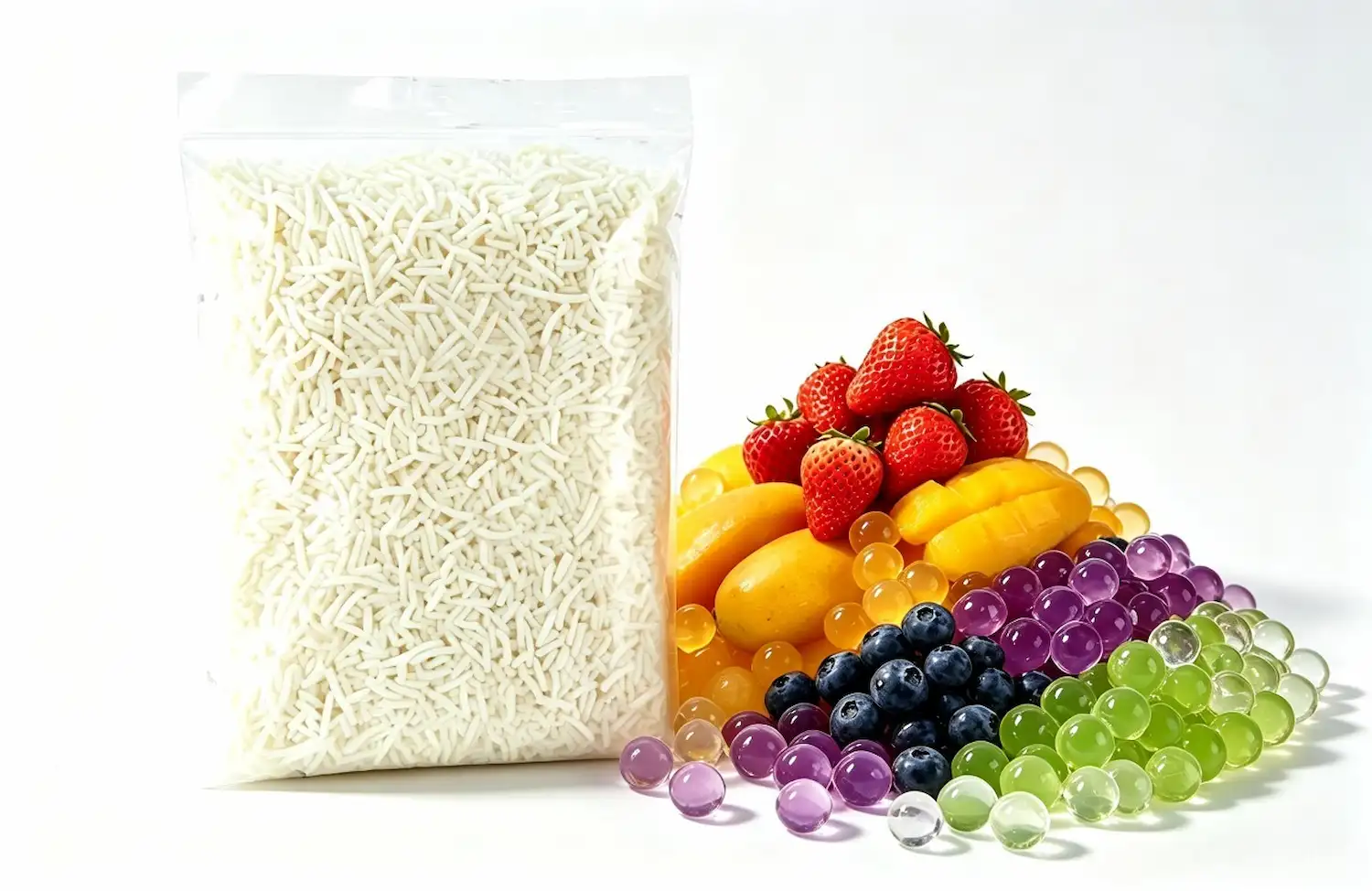

Sodium Alginate for Popping Boba: A Formulation Guide to Pairing with Calcium Lactate
WEHENGFOOD supplies bulk food-grade Sodium Alginate and calcium lactate for popping boba, dessert caviar, and molecular gastronomy applications. For product specifications, samples, pricing, or bulk orders, please contact us at nancy@wehengfood.com.
Popping boba — also called bursting pearls or bursting boba — looks like a simple bubble tea topping, but getting a batch that pops cleanly and holds its shape on the shelf depends on getting one pairing right: sodium alginate and a calcium salt. Manufacturers frequently default to whichever calcium source is cheapest or fastest-reacting, without accounting for how that choice affects taste, shelf stability, and gel texture. Understanding how sodium alginate's own structure interacts with calcium lactate — rather than treating "alginate + calcium" as a single fixed recipe — is what separates a consistent commercial-scale product from a batch that varies pearl to pearl.
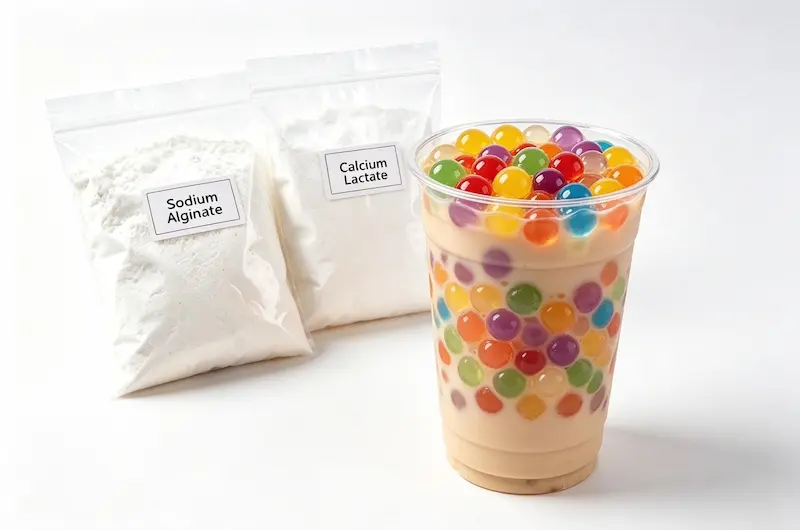
Understanding Spherification: How Sodium Alginate Gels
What Sodium Alginate Actually Is
Sodium alginate is a linear polysaccharide extracted from the cell walls of brown seaweed, built from two sugar units — β-D-mannuronic acid (M) and α-L-guluronic acid (G) — linked in blocks along the chain. It is non-toxic, biodegradable, and already widely used across food gels, controlled-release coatings, and edible films because of one defining property: it forms a gel matrix the moment it contacts calcium ions[1].
That gelling reaction is what makes popping boba possible. When a sodium alginate solution meets a calcium solution, calcium ions displace the sodium ions along the alginate chain and cross-link neighboring guluronic-acid blocks, forming a thin, flexible skin around the liquid inside — the same mechanism used in the classic "drop of alginate into a calcium bath" demonstration[3]. No heat and no setting agent beyond the calcium source is required, which is why the process is sometimes called cold gelation.
Commercial popping boba is almost always made by reverse spherification: instead of adding alginate to the juice, the calcium source is mixed directly into the flavored liquid, and that liquid is dripped into a bath of dissolved sodium alginate. The calcium in each droplet reacts with the alginate bath on contact, forming the gel membrane from the outside in. This is the preferred method for high-acid or calcium-friendly liquids, and it is the method calcium lactate is built for.
High-G Sodium Alginate
Guluronic-acid-rich chains bind calcium more readily, producing a firmer, more brittle, heat-stable gel skin — the texture profile popping boba manufacturers usually target for a clean "pop."High-M Sodium Alginate
Mannuronic-acid-rich chains bind calcium more loosely, producing a softer, more elastic gel with better freeze-thaw stability — useful for frozen dessert inclusions rather than a crisp-skinned pearl.Sodium Alginate Grades: G/M Ratio and Viscosity
Every sodium alginate on the market is the same base polymer, engineered to different combinations of two parameters: the G/M ratio (the proportion of guluronic to mannuronic acid blocks) and viscosity (governed by molecular weight and chain length). Alginates are generally described as "high-G" or "high-M" depending on which block dominates, and each behaves differently once calcium is introduced[2].
Gel strength is not simply a function of adding more calcium. A higher proportion of guluronic-acid blocks forms a stronger, more calcium-reactive network, while a higher proportion of mannuronic-acid blocks is typically chosen when the goal is added viscosity or emulsion stability rather than a firm, brittle skin[2]. Molecular weight compounds this: apparent viscosity of a sodium alginate solution drops sharply as molecular weight decreases, even at a constant G/M ratio, and alginate solutions behave as pseudoplastic (shear-thinning) liquids — meaning viscosity readings must always be interpreted alongside the shear rate and concentration used to measure them, not as a single standalone number[2].
Viscosity Grades (1% Solution, mPa·s, 20°C)
WEHENGFOOD's standard sodium alginate range spans low-viscosity, fast-dissolving grades through high-viscosity grades for a firmer pearl skin:
| Product | Viscosity (1%, mPa·S) |
|---|---|
| Sodium Alginate | 100–200 |
| Sodium Alginate | 200–400 |
| Sodium Alginate | 400–600 |
| Sodium Alginate | 600–800 |
| Sodium Alginate | 800–1000 |
Why Calcium Lactate Is the Preferred Partner for Popping Boba
Any soluble calcium salt will trigger gelation, but the choice of calcium source shapes the final pearl as much as the alginate grade does. Calcium chloride is highly soluble and dissociates quickly, which drives fast, high-ionic-strength cross-linking — useful for speed, but prone to producing an uneven or overly brittle skin if the droplet isn't dispersed evenly, and it carries a bitter, metallic, sour off-flavor that becomes noticeable at the concentrations needed for reliable gelling[5].
Calcium lactate reacts more gently and brings a comparatively neutral, discreet taste, which is why it is the calcium source most often recommended specifically for reverse spherification, where the calcium is mixed directly into the beverage or fruit liquid consumers will taste[4]. This is also the combination used in commercial popping boba formulations: sodium alginate for the outer bath and calcium lactate blended into the flavored liquid, alongside sugar and fruit juice or other flavoring, to form the finished pearl.
Formulating Popping Boba: A Working Ratio Table
Exact ratios vary by alginate viscosity grade, target pearl size, and desired firmness, but the following starting ranges reflect typical commercial and small-batch reverse-spherification formulations:
| Component | Typical Dosage | Role |
|---|---|---|
| Sodium Alginate (bath) | 0.5%–1% in water | Forms the outer gel membrane on contact with calcium |
| Calcium Lactate (mix-in) | 0.3%–1% in the flavored liquid | Provides the calcium ions that trigger gelation from inside the droplet |
| Contact / set time | A few seconds to a few minutes | Controls skin thickness before rinsing |
| Rinse | Clean water bath after setting | Removes residual alginate/calcium solution from the surface |
Two practical points matter more than the exact percentages: droplet size and dispersion must be uniform for consistent pop, and highly acidic flavored liquids can slow or weaken gel formation, which is one reason the reverse method — calcium in the liquid, alginate in the bath — is generally more forgiving than dosing acidic liquids directly with alginate[3].
Application Scenarios Beyond Bubble Tea
Popping boba is the highest-volume application, but the same sodium alginate + calcium lactate reaction supports a wider range of formats.
Bubble Tea & Beverages: Popping boba/bursting pearls as a topping, using mid-to-high viscosity, high-G-leaning sodium alginate for a clean pop and a calcium lactate mix-in for flavor-neutral gelling.
Frozen Desserts: Fruit-flavored spheres used as ice cream or frozen yogurt toppings, where a higher-M alginate's freeze-thaw stability is often preferred over maximum firmness.
Dessert Caviar & Plant-Based Roe: Small spheres used as visual garnishes or as a plant-based alternative to fish roe, typically requiring a firmer, more uniform skin.
Cocktail & Molecular Gastronomy: Spherified cocktail garnishes and savory spheres, where the alginate grade is selected to balance mouthfeel against the liquid's own acidity and alcohol content.
Making the Choice: A Decision Framework
A structured evaluation against the finished product's texture target avoids defaulting to "send me your highest-viscosity grade," which can produce an overly stiff or overly soft pearl for the intended use.
- Liquid acidity: high-acid juice or citrus base → reverse spherification with calcium lactate mixed into the liquid, rather than direct alginate dosing.
- Texture priority: crisp, clean "pop" → higher-G, higher-viscosity alginate; soft burst with freeze-thaw stability → higher-M alginate.
- Taste sensitivity: consumer-facing beverages and desserts → calcium lactate over calcium chloride, to avoid a metallic aftertaste.
- Existing product to match: if switching suppliers, request the current alginate's viscosity grade and G/M profile so the new supplier can match performance rather than guessing from a generic grade name.
| Business Priority | Recommended Direction |
|---|---|
| Bubble tea popping boba | Mid-to-high viscosity, high-G-leaning sodium alginate + calcium lactate |
| Frozen yogurt / ice cream toppings | Higher-M alginate for freeze-thaw stability |
| Dessert caviar / plant-based roe | High-G alginate for a firm, uniform skin |
| Cocktail spherification | Grade selected per liquid acidity and alcohol content, calcium lactate preferred for taste |
Supplier & Sourcing Insights for Bulk Procurement
Consistent pearl texture batch after batch depends as much on supplier reliability as on the spec sheet.
| Supplier Attribute | What to Verify | WEHENGFOOD Standard |
|---|---|---|
| Certifications | ISO9001, ISO22000, Kosher, Halal status | Full certification package available on request |
| Viscosity & Purity Verification | Batch-specific COA with viscosity and purity | COA provided with every shipment |
| Minimum Order Quantity | Flexibility for trial batches vs. full-container runs | 500KG trial orders up to 20MT/20' FCL |
| Packaging | Moisture-resistant packaging, since alginate readily absorbs water | 25kg kraft paper compound bags with PE liner |
| Technical Support | Grade recommendation for popping boba, desserts, and beverage formats | Dedicated technical support for application matching |
Conclusion
Sodium alginate's reaction with calcium is a single chemical mechanism, but the finished popping boba depends on how that mechanism is tuned — G/M ratio and viscosity on the alginate side, and the choice between calcium lactate and calcium chloride on the other. For consumer-facing beverages and desserts, calcium lactate's milder taste combined with a G/M-appropriate sodium alginate grade is what produces a pearl that pops cleanly without an off-flavor. Working with a supplier that documents viscosity and purity on every batch, and can help match an existing product's texture, is what keeps that result consistent at scale.
FAQ
Can I use calcium chloride instead of calcium lactate for popping boba?
Chemically, yes — both are soluble calcium salts that will trigger gelation with sodium alginate. In practice, calcium lactate is preferred for popping boba because its taste is milder, while calcium chloride can leave a bitter, metallic aftertaste at the concentrations needed for reliable gelling.
What sodium alginate grade is best for a firm "pop"?
A higher-G (guluronic-acid-rich), mid-to-high viscosity sodium alginate generally produces a firmer, more calcium-reactive gel skin, which is the texture most popping boba formulations target.
What information should I send a supplier to get an accurate recommendation?
Ideally a sample of your target texture, or the viscosity grade and G/M profile of your current sodium alginate. At minimum, describe the liquid's approximate pH/sugar content and whether you're using direct or reverse spherification.
Source Sodium Alginate & Calcium Lactate in Bulk
WEHENGFOOD supplies COA-verified Sodium Alginate and calcium lactate for popping boba, dessert, and beverage manufacturers, with ISO9001/ISO22000/Kosher/Halal certification and flexible order quantities from 500KG trial batches to full-container bulk supply. Our team can help match your current pearl texture or develop a custom grade for your application.
Request a Free Sample & QuoteReferences
- Bi, D., Yang, X., Yao, L., Hu, Z., Li, H., Xu, X., & Lu, J. (2022). Potential food and nutraceutical applications of alginate: A review. Marine Drugs, 20(9), 564.
- Jiao, W., Chen, W., Mei, Y., Yun, Y., Wang, B., Zhong, Q., Chen, H., & Chen, W. (2019). Effects of molecular weight and guluronic acid/mannuronic acid ratio on the rheological behavior and stabilizing property of sodium alginate. Molecules, 24(23), 4374.
- Science Buddies. Spherification and the chemistry of popping boba: reaction between sodium alginate and calcium salts. sciencebuddies.org.
- Special Ingredients. Calcium lactate for spherification and reverse spherification: taste profile versus calcium chloride. specialingredients.it.
- van Tonder, E. (2025). Calcium chloride, calcium gluconate, and calcium lactate with sodium alginate meat formulations. earthwormexpress.com.
Product Introduction
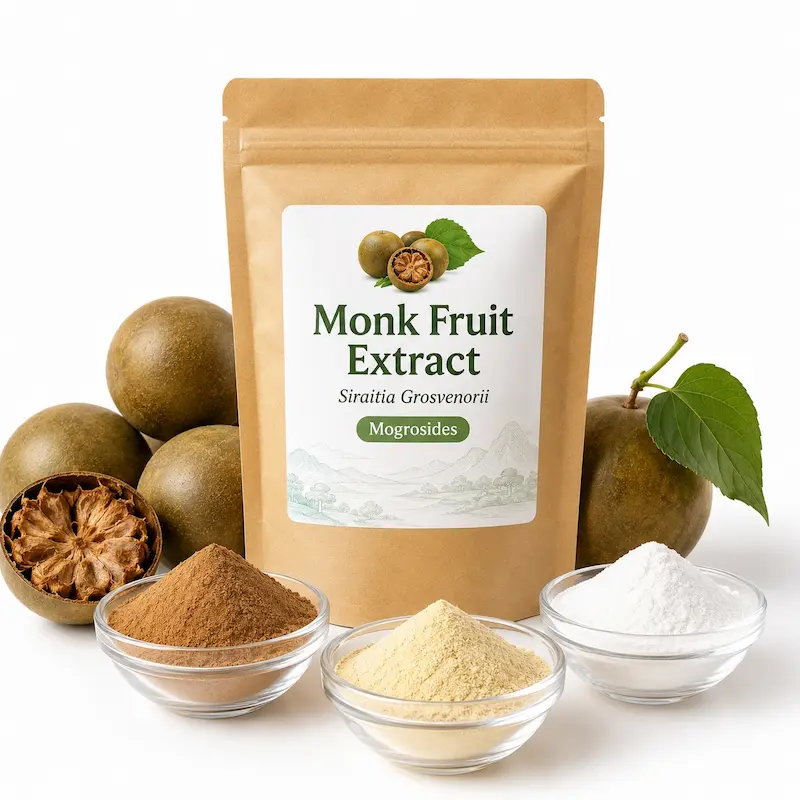
WEHENGFOOD Monk Fruit Extract offers excellent solubility and a clean, pleasant sweetness profile free from off-flavors. Depending on the concentration of mogrosides, its sweetness ranges from approximately 80 to 260 times that of sucrose, allowing for flexible application across various food products based on production requirements.
Mogrosides are 100% natural sweeteners extracted from carefully selected, fresh, ripe monk fruit. Produced using a proprietary process without added carriers, they serve primarily as sugar substitutes. Characterized by a superior taste and zero- or low-calorie content, they offer an ideal solution for food and beverage companies seeking natural sugar-reduction options. They are suitable for use in a wide range of products, including foods, beverages, dietary supplements, and flavorings.
Monk fruit extract is available in various ratios (10:1, 20:1, 30:1, 50:1) and mogroside V concentrations (10% to 65%); it is also frequently blended with sweeteners such as stevia, erythritol, and sucralose.
Monk Fruit Extract (Mogroside V) Sweetness Specification
| Product Specification | Mogroside V Content | Relative Sweetness (Compared with Sucrose) |
|---|---|---|
| Monk Fruit Extract Mogroside V 20% | 20% | 80 times sweeter |
| Monk Fruit Extract Mogroside V 25% | 25% | 100 times sweeter |
| Monk Fruit Extract Mogroside V 30% | 30% | 120 times sweeter |
| Monk Fruit Extract Mogroside V 40% | 40% | 160 times sweeter |
| Monk Fruit Extract Mogroside V 50% | 50% | 200 times sweeter |
| Monk Fruit Extract Mogroside V 55% | 55% | 220 times sweeter |
| Monk Fruit Extract Mogroside V 60% | 60% | 240 times sweeter |
| Monk Fruit Extract Mogroside V 65% | 65% | 260 times sweeter |
Certificate of Analysis
Product | Plant Part Used: fruit |
Botanical Name: | Quantity: |
ITEM | SPECIFICATION | METHOD | RESULTS |
Physical&Chemical Control | |||
Appearance | Fine powder | Organoleptic | Complies |
Color | Yellow Brown | Organoleptic | Complies |
Odor&Taste | Characteristic | Organoleptic | Complies |
Loss On Drying | ≤5.0% | Eur.Ph.6.0<2.8.17> | 3.82% |
Ash | ≤5.0% | Eur.Ph.6.0<2.4.16> | 3.99% |
Assay (Glycosides;) | 5% | UV | Complies |
Sieve Analysis | 98% pass 80 mesh | USP34<786> | Complies |
Heavy Metals | ≤10ppm | Eur.Ph.7.0<2.2.58> | Complies |
Cadmium(Cd) | ≤2ppm | Eur.Ph.7.0<2.2.58> | Complies |
Mercury(Hg) | ≤0.1ppm | Eur.Ph.7.0<2.2.58> | Complies |
Arsenic(As) | ≤2ppm | Eur.Ph.7.0<2.2.58> | Complies |
Lead(Pb) | ≤3ppm | Eur.Ph.7.0<2.2.58> | Complies |
Bulk density | 45-65g/100ml | Eur.Ph.7.0<2.9.15> | Complies |
Microbiological Control | |||
Total plate count | ≤1000 CFU/g | USP34<61> | Complies |
Yeast & mold | ≤100 CFU /g | USP34<61> | Complies |
E.coli | Negative | USP34<62> | Negative |
Salmonella | Negative | USP34<62> | Negative |
Conclusion: Conform with specification
Storage: Stored in dry and cool place, keep away from strong light and heat.
Shelf Life: Two years when stored properly
Functions and Usages
As a premium natural sugar substitute, Monk Fruit Extract is widely used in sugar reduction formulations for food, beverages, dietary supplements, and functional nutrition products.
Key Functions & Benefits
- Natural Sweetness Enhancement
Provides intense sweetness with a clean taste profile, making it an ideal alternative to traditional sugar. - Sugar Reduction Solution
Helps formulators reduce added sugar while maintaining sweetness and consumer acceptance. - Zero-Calorie Sweetener Ingredient
Suitable for low-calorie, keto-friendly, and clean-label product development. - Plant-Based & Clean Label
Derived from natural monk fruit, meeting the growing demand for plant-based sweetening solutions. - Taste Optimization
Can improve sweetness balance and reduce unwanted aftertaste when combined with other sweeteners.
Applications of Monk Fruit Extract
Monk Fruit Extract is commonly used in:
- Beverages
- Functional drinks
- Energy drinks
- Sports nutrition beverages
- Low-sugar beverages
- Food Products
- Bakery products
- Chocolate & confectionery
- Dairy products
- Ice cream
- Sauces and dressings
- Nutrition & Health Products
- Protein powders
- Meal replacement products
- Dietary supplements
- Sugar-free formulations
- Tabletop Sweeteners
- Powder sweeteners
- Sweetener blends
- Sugar replacement products
Monk Fruit Extract Sweetener Blends
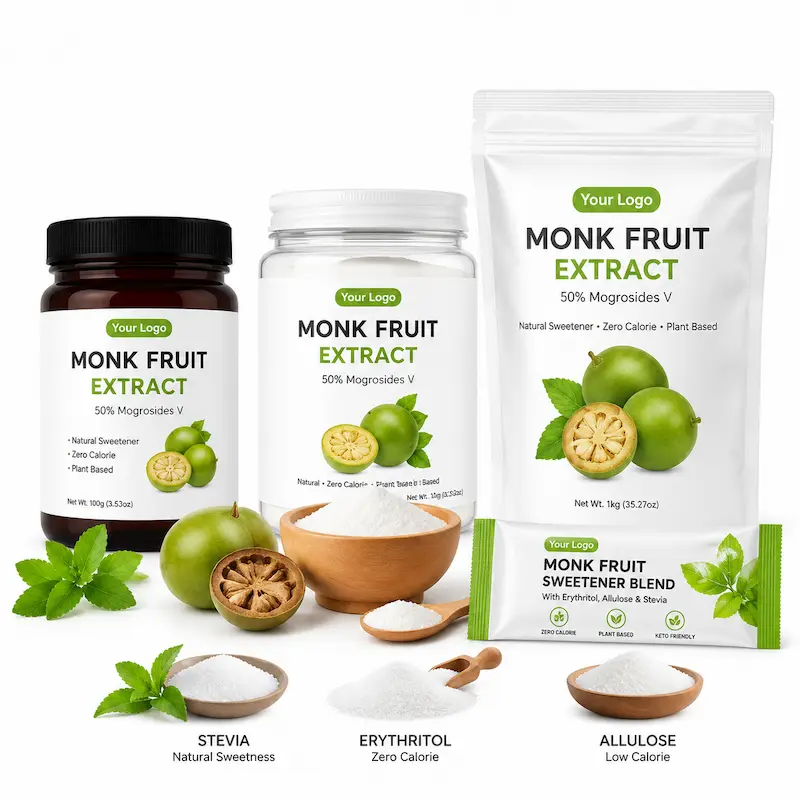
Monk Fruit Extract is often combined with other sweeteners to achieve a more balanced sweetness profile, better mouthfeel, and sugar-like functionality.
Monk Fruit + Erythritol
A popular natural sweetener combination that provides bulk, sugar-like texture, and reduced-calorie sweetness. Widely used in tabletop sweeteners, baking mixes, beverages, and keto products.
Monk Fruit + Allulose
A premium sugar replacement solution offering excellent taste, low-calorie properties, and improved texture for bakery, confectionery, and beverage applications.
Monk Fruit + Stevia
Combines two natural high-intensity sweeteners to create a balanced sweetness profile and improve flavor performance in beverages and functional foods.
Monk Fruit + Sucralose
Used in some industrial formulations to achieve high sweetness intensity, excellent stability, and cost-effective sugar reduction solutions.
Multi-Sweetener Blends
Custom blends such as:
- Monk Fruit + Erythritol + Stevia
- Monk Fruit + Allulose + Stevia
- Monk Fruit + Erythritol + Allulose + Stevia
are widely developed for sugar-free, low-calorie, keto, and clean-label products.
OEM & ODM Service
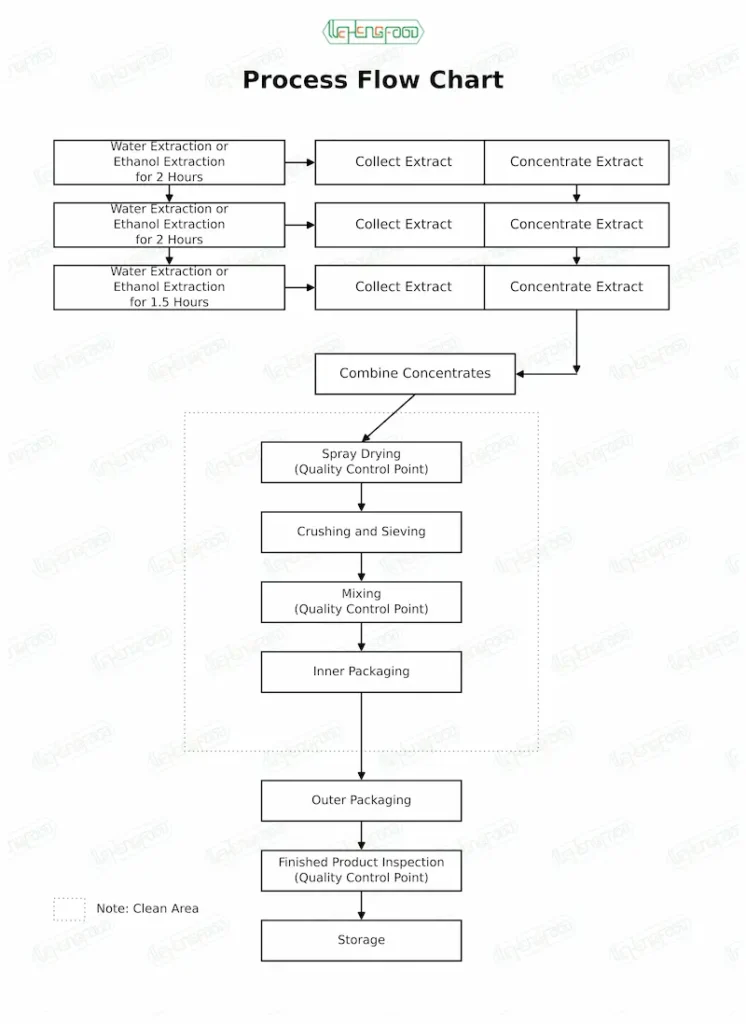
WEHENGFOOD offers a one-stop OEM & ODM service for mulberry leaf extract production, processing, and packaging customization, including tablets, powders, granules, hard capsules, soft capsules, gummies, etc., tailored to specific customer needs.
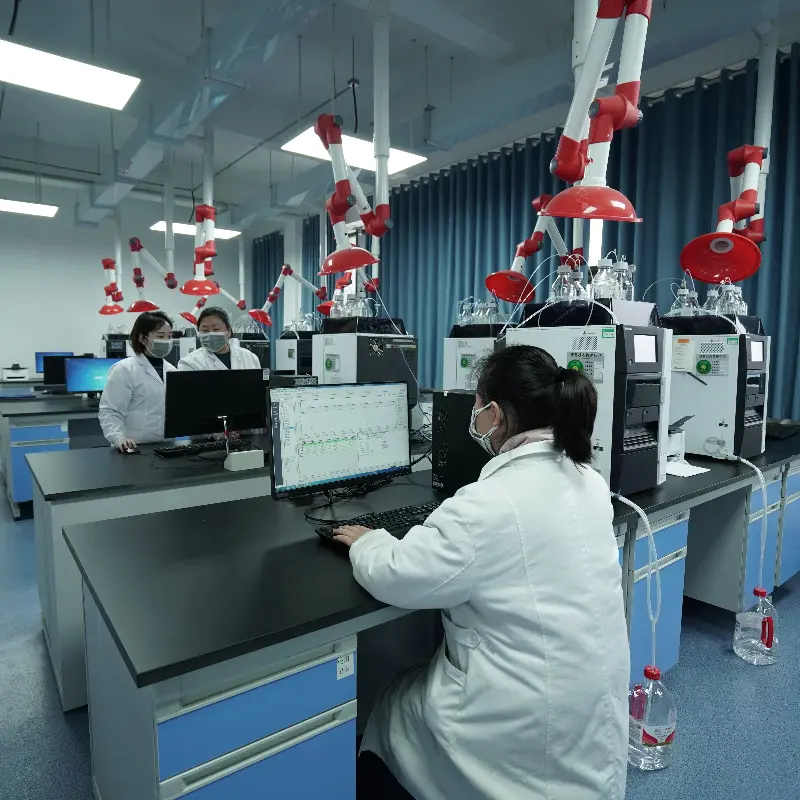
Factory
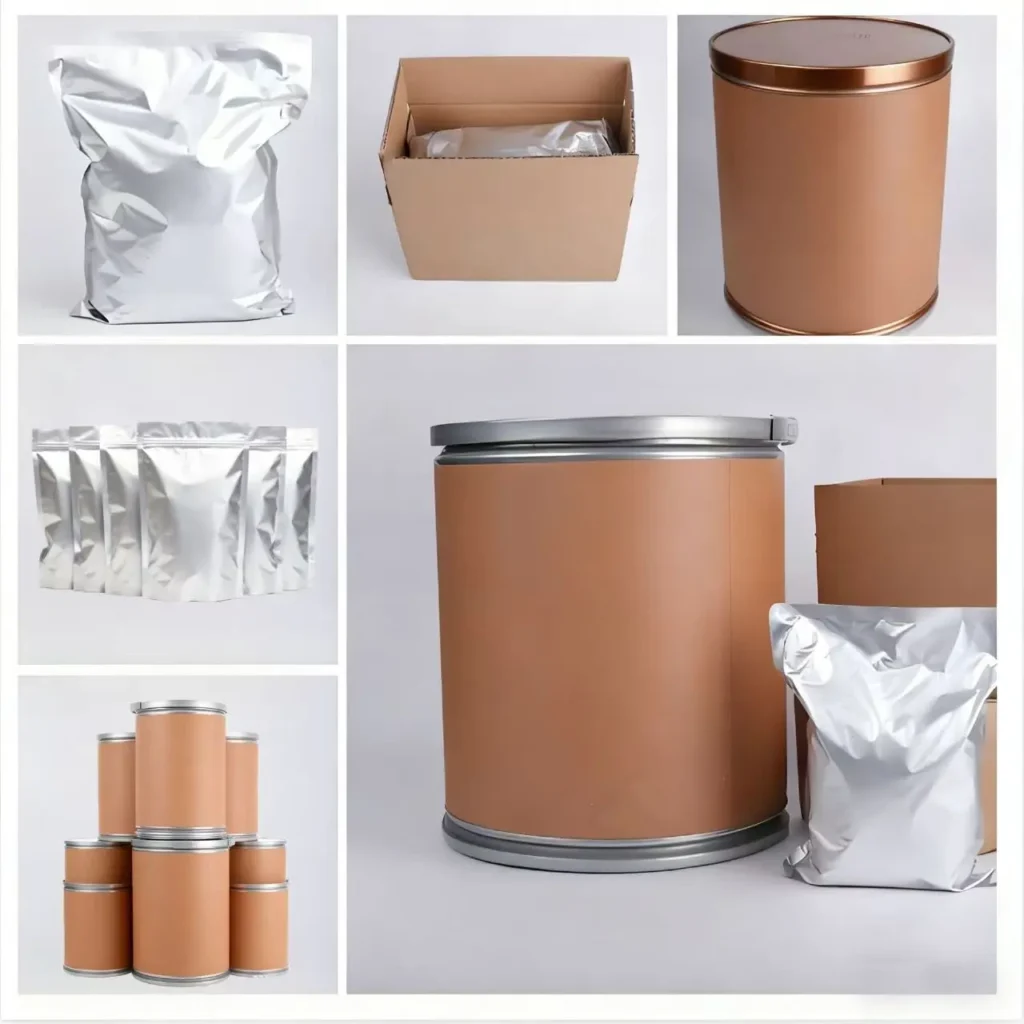
Package
Exhibitions

FAQ
Q1: What is monk fruit extract?
Monk fruit extract is a natural sweetener extracted from Siraitia grosvenorii, a fruit native to China. Its sweetness mainly comes from mogrosides, especially mogroside V.
Q2: How sweet is monk fruit extract?
Monk fruit extract can be approximately 100-300 times sweeter than sucrose depending on mogroside concentration.
Q3: What is Mogroside V?
Mogroside V is the major sweet compound in monk fruit extract and is commonly used as the quality indicator for premium monk fruit sweeteners.
Q4: What specifications of monk fruit extract can you supply?
We supply:
- Mogroside V 10%-98%
- 4:1, 10:1, 20:1, 30:1, 50:1 extracts
- Customized specifications according to customer requirements.
Q5: Is monk fruit extract suitable for beverages?
Yes. Monk fruit extract is widely used in beverages including zero sugar drinks, tea drinks, functional beverages and nutritional drinks.
Q6: Can you provide OEM ODM monk fruit products?
Yes. We provide OEM ODM services including powder, capsules, tablets, gummies, granules and customized formulas.
Q7: Is monk fruit extract natural?
Yes. Monk fruit extract is derived from the fruit of Siraitia grosvenorii and is considered a natural plant-based sweetener.