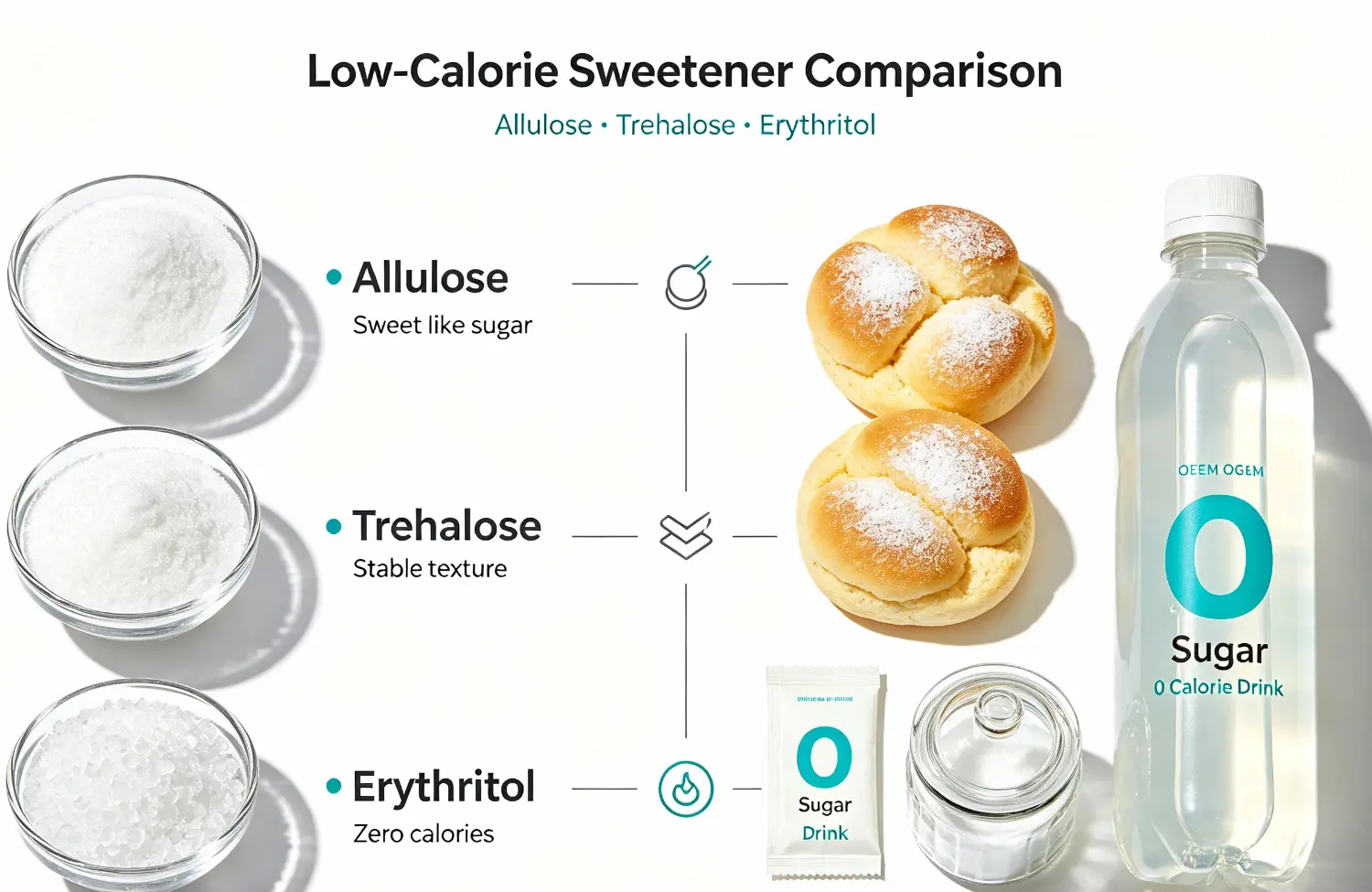

Allulose, Erythritol & Trehalose: Reading the Label Behind Three Low-Calorie Sweeteners
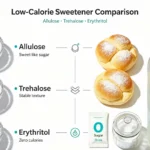
One is a rare sugar almost identical to fructose. One is a fermentation-made polyol the body barely metabolizes. One is a disaccharide that lets desert plants survive without water. Here's how they actually compare on sweetness, calories, stability and formulation fit.
Allulose is a rare monosaccharide, roughly 70% as sweet as sucrose, with an FDA-recognized calorie value low enough to be excluded from "sugar" and "added sugar" on U.S. nutrition labels — the closest sensory match to table sugar of the three.
Erythritol is a fermentation-made sugar alcohol, 60–70% as sweet as sucrose, with the lowest caloric value of any bulk sweetener (0–0.2 kcal/g) and a zero glycemic index — the standard choice where "zero sugar, zero calorie" is the label claim.
Trehalose is only 45% as sweet as sucrose and is metabolized like a conventional sugar, so it is chosen for what it does to a formulation — protecting proteins, texture and shelf life — rather than for calorie reduction.
Allulose (D-Psicose)
C₆H₁₂O₆ · MW 180.16 g/mol · CAS 551-68-8
Allulose is a C-3 epimer of fructose — structurally identical to fructose except for the orientation of one hydroxyl group. That near-identical shape is exactly why it tastes so close to real sugar, and exactly why the human body handles it so differently: allulose is absorbed in the small intestine (an estimated 66–80% of an oral dose in humans) but cannot be broken down for energy, has no measurable effect on blood glucose or insulin, and is excreted largely unchanged.
- Appearance
- White crystalline powder
- Melting point
- 96°C
- Solubility (25°C)
- 291 g / 100 g water (74% w/w)
- Solubility (50°C)
- 489 g / 100 g water (83% w/w)
- Acute toxicity
- LD50 16.3 g/kg (rat) — lowest toxicity class
- Regulatory status
- FDA GRAS since 2011
How it's made. Allulose barely exists in nature — trace amounts occur in wheat and a handful of bacteria — so commercial supply is produced enzymatically from D-fructose using D-tagatose-3-epimerase family enzymes (the "DTEase/DPEase" family) under the Izumoring rare-sugar conversion strategy. The catalytic step is a single, reversible C-3 epimerization, but the equilibrium caps out around a 28–33% fructose-to-allulose conversion ratio, and because allulose and fructose share almost identical physical and chemical properties, separating them afterward is the real bottleneck. Producers use simulated moving bed chromatography (reaching ~98.5% purity), yeast-fermentation of residual fructose, or enzymatic conversion of leftover fructose to gluconic acid for downstream removal.
Functional and physiological research associated with allulose includes suppressed fat accumulation via GLUT5/GLUT2 transporter competition, reduced post-prandial blood glucose through inhibition of intestinal α-amylase and α-glucosidase, antioxidant and anti-inflammatory activity, and neuroprotective effects tied to elevated intracellular glutathione.
Erythritol
1,2,3,4-Butanetetrol · C₄H₁₀O₄ · MW 122.12 · CAS 149-32-6
Erythritol is a four-carbon sugar alcohol with no reducing aldehyde group, which is the source of most of its distinctive behavior: it resists browning, tolerates a wide pH range, and passes through the body largely untouched. It occurs naturally in trace amounts in fruits like melon and grapes, fermented foods, and even human tissue — but at commercial scale it is the only sugar alcohol produced industrially by microbial fermentation rather than catalytic hydrogenation.
- Appearance
- White crystalline powder
- Melting point
- 118–120°C
- Boiling point
- 329–331°C
- Density
- 1.451 g/cm³
- pH stability range
- 2–12
- Solubility (25°C)
- ~36% — must be blended with other polyols to prevent crystallization out of solution
Production route: starch → liquefaction → saccharification → sterilization → fermentation → ceramic nanofiltration & ion exchange → concentration/crystallization → fluidized-bed drying.
Its solubility heat of −97.4 J/g gives erythritol a genuine cooling sensation on dissolution (roughly a 4.8°C drop when 10 g dissolves in 90 g water), a property leveraged in cooling candies and instant/cold-brew beverage powders. Hygroscopicity is the lowest of any commercial sugar alcohol — about 2% weight gain after 5 days at 20°C / 90% RH, versus ~10% for sucrose and ~17% for maltitol — making it well suited to baked goods where moisture uptake shortens shelf life.
| Metric | Erythritol | Xylitol |
|---|---|---|
| Glycemic index | 0 | 13 |
| Insulin index | 2 | 11 |
| Caloric value | 0–0.2 kcal/g | 3.5 kcal/g (1/12 higher) |
Tolerance is unusually high for a sugar alcohol — WHO toxicology data puts the maximum tolerated dose at 0.66 g/kg body weight/day for women and 0.87 g/kg/day for men, the highest of any industrially produced polyol, which is why erythritol rarely triggers the digestive discomfort associated with poorly absorbed sugar alcohols.
Trehalose
α,α-1,1-glucoside · C₁₂H₂₂O₁₁·2H₂O · CAS 6138-23-4
Trehalose is two glucose units joined at their reducing ends, which makes it a non-reducing sugar with no free carbonyl group — the structural reason it neither browns nor reacts with amino acids. In nature, it's the mechanism behind some genuinely strange survival stories: desert resurrection plants that look dead until rehydrated, wood frogs that survive partial freezing, and dried yeast that reactivates instantly in water all rely on trehalose accumulating inside cells under heat, cold, drought or osmotic stress to stabilize proteins and membranes. Nature summarized it in 2000 as a sugar for which, for many organisms, "presence or absence means life or death."
- Appearance
- White crystalline powder (dihydrate)
- Purity
- ≥98.0%
- pH (30% solution)
- 5.0–6.7
- Melting point
- 97°C (dehydrates at 130°C)
- Density
- 1.512 g/cm³
- Relative sweetness
- 45% of sucrose, clean taste, no aftertaste
Production route: starch → liquefaction → enzymatic conversion → filtration & refining → separation/purification → concentration/crystallization → drying — converting the reducing end of a starch-derived glucose chain directly into the trehalose linkage.
Its functional value shows up most clearly in what it prevents: independent tests recorded roughly a 7% starch-retrogradation rate for trehalose versus 18% for sucrose and 35% for corn syrup; a protein-denaturation rate of about 1% after freeze-thaw versus 14% for sucrose and 35% for corn syrup; and markedly slower lipid oxidation, with treated linoleic acid samples showing roughly one-third the hydroperoxide accumulation of untreated controls after two weeks. It also measurably suppresses ice-crystal growth during freezing, which is why it shows up disproportionately in frozen desserts, surimi and other freeze-thaw-sensitive products.
Across recorded end uses, Japanese and Western-style confectionery accounts for the largest single application segment (about 42%), followed by candy (17%), beverages (7%) and seafood processing (6%), with the remainder spread across noodles, rice products, meat processing, cosmetics and biologics stabilization.
Side-by-Side Comparison
A quick-reference summary for formulators comparing the three ingredients on the metrics that most often decide which one fits a given application.
| Property | Allulose | Erythritol | Trehalose |
|---|---|---|---|
| Chemical class | Rare monosaccharide (fructose epimer) | Sugar alcohol (polyol) | Non-reducing disaccharide |
| Relative sweetness (sucrose=100) | 70 | 60–70 | 45 |
| Caloric value | ~0.2 kcal/g (~10% of sucrose) | 0–0.2 kcal/g | ~4 kcal/g (fully digestible) |
| Glycemic / insulin impact | Negligible; no insulin response | GI 0; insulin index 2 | Digested to glucose — count as carbohydrate |
| Heat / Maillard behavior | Browns readily (reducing sugar) | No browning; stable to 160°C | No browning (non-reducing) |
| Production method | Enzymatic epimerization of fructose (DTEase/DPEase) | Microbial fermentation of glucose | Enzymatic conversion of starch-derived glucose |
| Signature functional trait | Antioxidant browning & flavor development | Cooling effect on dissolution; lowest hygroscopicity | Protein & cell protection under stress |
| Best-fit applications | Baked goods, beverages, browning-driven flavor | Zero-sugar drinks, sugar-free candy, tablets | Freeze-dried products, frozen foods, protein stabilization |
| Regulatory status (US) | FDA GRAS (2011); excluded from added-sugar labeling | FDA GRAS (1997); JECFA ADI "not specified" (1999) | FDA GRAS |
Which One Fits Your Formulation?
Reach for Allulose
Closest sensory match to sucrose, browns naturally in baking, and its FDA labeling exemption makes it attractive for "reduced sugar" and "no added sugar" claims without sacrificing taste.
Reach for Erythritol
The lowest calorie count of the three, a clean and predictable sweetness, and stability across pH and temperature make it the default bulk sweetener behind most "0 sugar / 0 calorie" beverage and snack lines — typically blended with a high-intensity sweetener to round out the top-note.
Reach for Trehalose
Chosen less for sweetness than for what it protects — dosed at 0.5–3% it slows starch retrogradation, protein denaturation and moisture loss in frozen foods, baked goods and rice products, and stabilizes proteins, enzymes and probiotics through drying and freezing.
Blend two or three
Many commercial formulations combine allulose or erythritol for sweetness with trehalose for texture and stability, then round out the sweetness curve with stevia or monk fruit — a system approach rather than a single-ingredient swap.
Regulatory & Safety Snapshot
Allulose
- FDA GRAS since 2011
- Excluded from "total sugars" and "added sugars" on U.S. Nutrition Facts labels
- LD50 (rat) 16.3 g/kg — lowest toxicity category
Erythritol
- WHO/FAO JECFA approved 1999 — no ADI required
- FDA GRAS since 1997
- Listed in China GB 2760-2011 for use per GMP
Trehalose
- FDA GRAS notified ingredient
- Widely approved across major food regulatory frameworks
- Long history of use in pharma/biologics stabilization
Regulatory status varies by market and intended use — always confirm current requirements with your regulatory team for the specific jurisdiction and application.
Frequently Asked Questions
Are allulose, erythritol and trehalose the same thing?
No. Allulose is a rare monosaccharide (an epimer of fructose), erythritol is a four-carbon sugar alcohol, and trehalose is a non-reducing disaccharide of two glucose units. They come from three different chemical families and are not interchangeable on a 1:1 basis.
Which of the three has the fewest calories?
Erythritol is lowest at 0–0.2 kcal/g, since roughly 80% is absorbed unchanged and excreted without being metabolized. Allulose is close behind at around 0.2 kcal/g. Trehalose, being fully digestible, sits near conventional sugar at about 4 kcal/g and is used for its functional rather than caloric benefits.
Are these sweeteners suitable for diabetic-friendly products?
Allulose and erythritol both carry a glycemic index near zero and don't meaningfully move blood glucose or insulin. Trehalose is metabolized to glucose, so it should be counted as a carbohydrate even though its sweetness and absorption profile differ from sucrose.
Can they be combined in one formulation?
Yes — many products blend two or three of these, plus a high-intensity sweetener like stevia or monk fruit, to balance sweetness, mouthfeel, browning behavior and cost.
Which one performs best in high-heat applications like baking?
Erythritol and trehalose are heat- and acid-stable and resist the Maillard reaction, so they stay pale even above 150°C. Allulose does the opposite: it browns readily, which is unwanted in white icing but valuable for golden crust and roasted flavor in baked goods.
Sourcing allulose, erythritol or trehalose?
WEHENGFOOD supplies food-grade allulose, erythritol, trehalose and related functional carbohydrates for beverage, bakery, confectionery and nutraceutical manufacturers worldwide. Send us your target sweetness profile, application and volume, and we'll come back with specs and pricing.