
Transglutaminase for Turkish Kebab: Doner Binding, Dosage & Process Guide
WEHENGFOOD supplies food-grade Transglutaminase (TG Enzyme) for kebab, gyros, sausage, surimi and dairy manufacturers. For product specifications, samples, pricing, or bulk orders, please contact us at nancy@wehengfood.com.
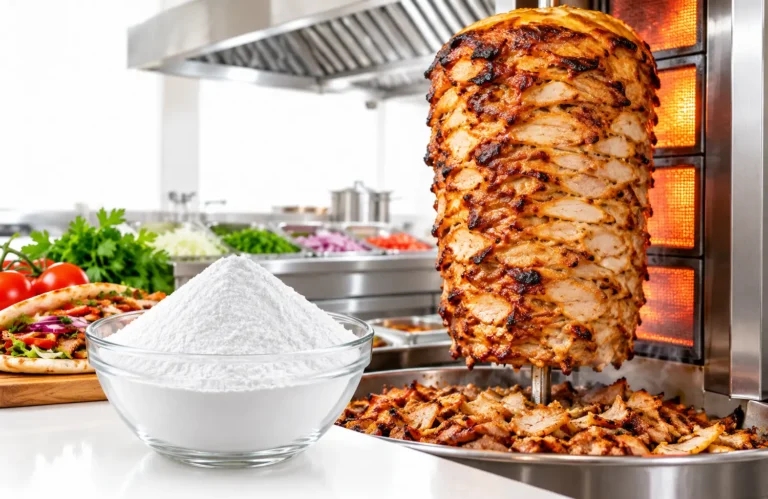
A good doner or gyros cone has to do several things at once: hold together on a vertical spit, slice cleanly into thin shavings, stay juicy under a hot grill, and survive freezing and transport. Traditional recipes rely on layered whole-muscle meat, phosphates and heavy mincing to get there. As producers push for higher minced-meat content, lower cost and phosphate-free labels, the binding problem gets harder. Transglutaminase (TG enzyme) solves it at the protein level, by forming covalent links between the meat proteins themselves, which is why it has become a standard tool for kebab and gyros producers.
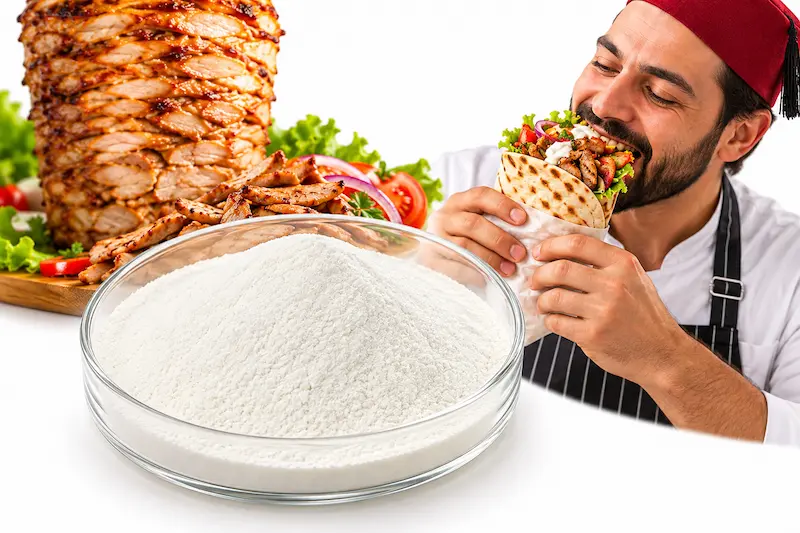
What Is Transglutaminase (TG Enzyme)?
A Natural Protein Cross-Linker
Transglutaminase (EC 2.3.2.13, TG) is an enzyme found widely in nature, in animals, plants and microbes. The commercial food-grade version is microbial TG, obtained by fermentation of Streptomyces mobaraensis, first isolated as a TG source by Ando and co-workers[2]. Older commercial TG was extracted from guinea-pig liver, and animal TG depends on calcium to work. The microbial enzyme does not need calcium, which makes it far easier to use in a meat plant[1][5].
In practical terms, microbial TG is a fermentation-derived, non-animal enzyme, which matters for halal and kosher kebab production, although certification must still be confirmed with the supplier. Regulatory history is long: the manufacturer timeline records US FDA approval in 1999, China in 2001 and the EU in 2009[5].
How TG Binds Kebab Meat
TG catalyses an acyl-transfer reaction between the amino acids glutamine and lysine in proteins. The result is an ε-(γ-glutamyl)lysine isopeptide bond, with ammonia released, which links protein chains inside and between molecules[3]. Myosin and actin, the main muscle proteins in kebab meat, are good substrates[5]. Whey, soy, wheat and casein proteins are also good substrates, which is why TG works across so many products.
What it forms
Covalent cross-links that are heat-stable and resistant to physical stress, so the bonded meat stays together on the spit, during slicing and on the grill.What stays in the product
The enzyme is a protein used at low levels. It is not part of the cross-link and has no function in the finished product; cooking inactivates it[5].Benefits in Kebab & Gyros
Manufacturer application data for kebabs and gyros lists the following gains[5]:
- Better slice cohesion and cut appearance: slices hold together with no holes when frying.
- Better texture and juiciness: improved bite and moisture retention.
- Good water and fat binding: less drip and purge, and pieces of fat stay in the matrix.
- Higher minced-meat content: cones with more minced meat keep their shape.
- Raw-material savings: trim and meat sections can be incorporated, which also lowers raw-material use and associated CO2.
- Ideal for phosphate-free products: natural binding without a negative aftertaste and without E-numbers.
- Standardisation: more consistent cones when raw-material quality fluctuates.
Enzyme Properties to Design Around
| Property | Typical Behaviour (Microbial TG) |
|---|---|
| pH range | Active at pH 4–9; optimum pH 5–8 (best around 6–7) |
| Temperature | Optimum about 50°C; at pH 7.0 over 10 min, no loss at 40°C and about 74% activity kept at 50°C |
| Cold activity | Still active below 10°C and near freezing, which allows a cold reaction on perishable meat |
| Inactivation | About 70°C within minutes; 70°C for 15 min or 80°C for 1 min is quoted for full inactivation |
| Inhibitors | Heavy-metal ions (e.g. Fe³⁺, Cu²⁺, Hg⁺) and oxidising agents |
| Storage | Below 10°C, dry, dark, sealed; once opened, reseal and freeze (about 1 month) |
Property values come from the manufacturer's technical presentation[5]; activity varies by strain and product grade.
Dosage & Process Guide
Dosage depends on the enzyme activity of the product and on whether it is a pure enzyme or a compound binder. The manufacturer publishes the following ranges for meat, which are useful as trial starting points[5]:
| Meat Type | Reported Addition | Where Added |
|---|---|---|
| Beef | 0.2–1.0% | At chopping or second chopping |
| Pork | 0.1–3.0% | At chopping or after ingredients |
| Chicken | 0.2–4.0% | At chopping or after ingredients |
| Ham / grilled sausage | 0.3–0.6% | Before chopping |
| Meatballs | 0.1–1% | At chopping |
A typical kebab or gyros line runs like this:
| Step | What Happens |
|---|---|
| 1. Raw material prep | Chilled meat, trim and fat are sized; a chilled temperature protects hygiene during the cold reaction. |
| 2. Mixing / tumbling | Salt, spices and TG are added with the meat, so the enzyme reaches all protein surfaces evenly. |
| 3. Forming | Meat is stacked or pressed into cones, layers or blocks on the skewer. |
| 4. Cold reaction | Perishable meat is held at 1–10°C for roughly 2–12 hours or more, so cross-links build before cooking[5]. |
| 5. Freezing / cooking | Cones are frozen, or roasted; temperatures above about 70–80°C inactivate the enzyme and fix the texture. |
TG vs Other Binding Options for Kebab Meat
| Option | How It Binds | Trade-offs |
|---|---|---|
| Transglutaminase | Covalent protein cross-links | Needs reaction time and temperature control; low dose; processing aid |
| Sodium alginate + calcium | Cold-setting hydrocolloid gel bridging meat pieces | Needs a calcium source; gel-based binding, listed as an additive |
| Phosphates | Raise water-holding and extract myosin | Target of clean-label reduction; no true protein bonding |
| Starch / fibre / soy | Water binding and filler | Adds bulk and can change flavour or texture |
TG and sodium alginate can also be tested together: alginate gives quick cold-set surface adhesion while TG builds permanent protein bonds through the reaction period.
Other Meat & Food Applications
Poultry doner & shawarma: chicken cones benefit from improved hardness, water retention and reformed trim[5].
Meatballs & köfte, sausages and hams: higher gel strength, elasticity and yield, often with less phosphate[5].
Surimi & fish products: better gel strength, bite and elasticity.
Dairy, bakery and vegan proteins: yogurt and cheese texture, dough handling, and binding of plant-based kebab and sausage substitutes[4].
Supplier & Sourcing Insights for Bulk Procurement
| Supplier Attribute | What to Verify |
|---|---|
| Enzyme activity (U/g) | Batch COA stating activity, so dosage is comparable batch-to-batch |
| Halal / kosher & non-GMO documents | Current certificates and documentation for your target market |
| Format | Pure enzyme or compound binder, matched to your meat type and process |
| Packaging & storage | Sealed, moisture-resistant packs with clear cold-storage guidance |
| Technical support | Help with trial dosage, reaction time and phosphate-reduction work |
Note for exporters: in the EU, products that could look like a whole cut but are formed from pieces may need a "formed from pieces of meat" statement[6]. Check labelling rules for each destination.
Conclusion
Transglutaminase gives kebab and gyros producers a way to bind meat with the meat's own proteins, improving slice cohesion, juiciness and water and fat binding while supporting phosphate-free labels and higher minced-meat content. Success depends on process discipline: pH, cold reaction time, activity-based dosage and a proper heat step. Choose a supplier that documents activity and certification for every batch, and validate your dosage on your own line.
FAQ
Is transglutaminase safe to use in doner kebab?
TG is a protein-based food enzyme approved for food use in major markets. It is used at low levels and is inactivated by cooking, after which it is simply protein. Always confirm local regulations and labelling for your target market.
Can transglutaminase replace phosphates in kebab meat?
Manufacturers describe TG as well suited to phosphate-free kebab because cross-linking improves water and fat binding. Results depend on meat quality, salt level and process, so run line trials before switching.
What temperature does TG enzyme work at in kebab production?
Its optimum is about 50°C, but for perishable meat the reaction is normally run cold (1–10°C) for 2–12 hours or more. The enzyme is inactivated at about 70°C within minutes.
Is microbial transglutaminase halal and kosher?
Microbial TG comes from fermentation of Streptomyces mobaraensis rather than animal tissue. Halal or kosher status still depends on the supplier's certification, so request certificates for each batch.
Source Transglutaminase in Bulk
WEHENGFOOD supplies Transglutaminase (TG Enzyme) for kebab, gyros, sausage and surimi producers, with batch documentation and technical support for dosage trials. We can also supply Sodium Alginate for combined binding systems.
Request a Free Sample & QuoteReferences
- Kieliszek, M., & Misiewicz, A. (2014). Microbial transglutaminase and its application in the food industry. A review. Folia Microbiologica, 59, 241–250.
- Ando, H., et al. (1989). Purification and characteristics of a novel transglutaminase derived from microorganisms. Agricultural and Biological Chemistry, 53(10), 2613–2617.
- Motoki, M., & Seguro, K. (1998). Transglutaminase and its use for food processing. Trends in Food Science & Technology, 9(5), 204–210.
- Kuraishi, C., Yamazaki, K., & Susa, Y. (2001). Transglutaminase: its utilization in the food industry. Food Reviews International, 17(2), 221–246.
- Yota Bio-Engineering Co., Ltd. (2020). Transglutaminase (TG) and its applications; and manufacturer transglutaminase application sheet (meat, dairy, bakery, vegan).
- Regulation (EU) No 1169/2011 on the provision of food information to consumers, Annex VI (formed meat labelling).