
How to Choose CMC: A Buyer's Guide to Viscosity, Degree of Substitution & Purity
WEHENGFOOD supplies bulk Sodium Carboxymethyl Cellulose (CMC) across food, toothpaste, oilfield, battery, textile, and ceramic grades. For product specifications, samples, pricing, or bulk orders, please contact us at nancy@wehengfood.com.
Strictly speaking, CMC is a single chemical substance — sodium carboxymethyl cellulose. But it is produced in thousands of different grades, and buyers frequently default to comparing suppliers on viscosity number alone. That's an incomplete comparison: viscosity, degree of substitution (D.S.), and purity interact, and the same viscosity number can behave completely differently in a beverage, a drilling fluid, or a battery slurry depending on the other two parameters. Understanding how these three specs relate — and what information to request from a supplier — helps procurement and R&D teams avoid a costly reformulation after the first shipment arrives.
Understanding CMC: What Determines Performance
What CMC Actually Is
CMC (Sodium Carboxymethyl Cellulose) is a water-soluble cellulose ether made by reacting natural cellulose fiber with sodium hydroxide and chloroacetic acid, replacing hydrogen atoms on the cellulose backbone's hydroxyl groups with carboxymethyl groups (–CH₂COOH). The molecule was first synthesized in 1918 and has since become one of the most widely produced cellulose derivatives, used as a thickener, stabilizer, emulsifier, and binder across food, pharmaceutical, and industrial fields[1].
Every "type" or "model" of CMC on the market is the same base polymer engineered to different specifications of three core indicators: degree of substitution, viscosity, and purity. Because these three parameters combine in near-unlimited ratios, no catalogue can list every possible grade — a full breakdown would run into the thousands of SKUs.
Low D.S. / Low Viscosity CMC
D.S. approx. 0.4–0.7 · dissolves more slowly, lower transparency · better tolerance in some high-salinity/divalent-ion environments · typically used in oilfield drilling fluids and lower-cost industrial applications.High D.S. / High Viscosity CMC
D.S. approx. 0.8–1.2 · faster dissolving, higher transparency and clarity · stronger thickening at low use levels · typically used in food, toothpaste, and battery-binder applications requiring clean, clear performance.Why These Parameters Interact
Degree of substitution (D.S.) refers to the average number of carboxymethyl groups attached per glucose unit on the cellulose chain, and it directly governs solubility: below roughly D.S. 0.4, CMC does not reliably dissolve in water, and above that threshold, water solubility and transparency improve as D.S. rises[2]. But D.S. does not behave the same way in every environment. A solubility study synthesizing CMC across a D.S. range of 0.48 to 1.86 found that in the presence of divalent cations such as calcium and strontium, phase separation became more likely as D.S. increased, while common monovalent salts caused no precipitation regardless of D.S.[3] This is why oilfield-grade CMC and food-grade CMC are formulated to very different D.S. targets even when their viscosity numbers look similar on paper.
Viscosity depends jointly on D.S. and the polymer's chain length (degree of polymerization) — not on D.S. alone — which is why two CMC samples with identical D.S. can still show very different viscosity, and why viscosity must always be read alongside D.S. rather than as a standalone spec[2].
Comparing CMC Grades by Function
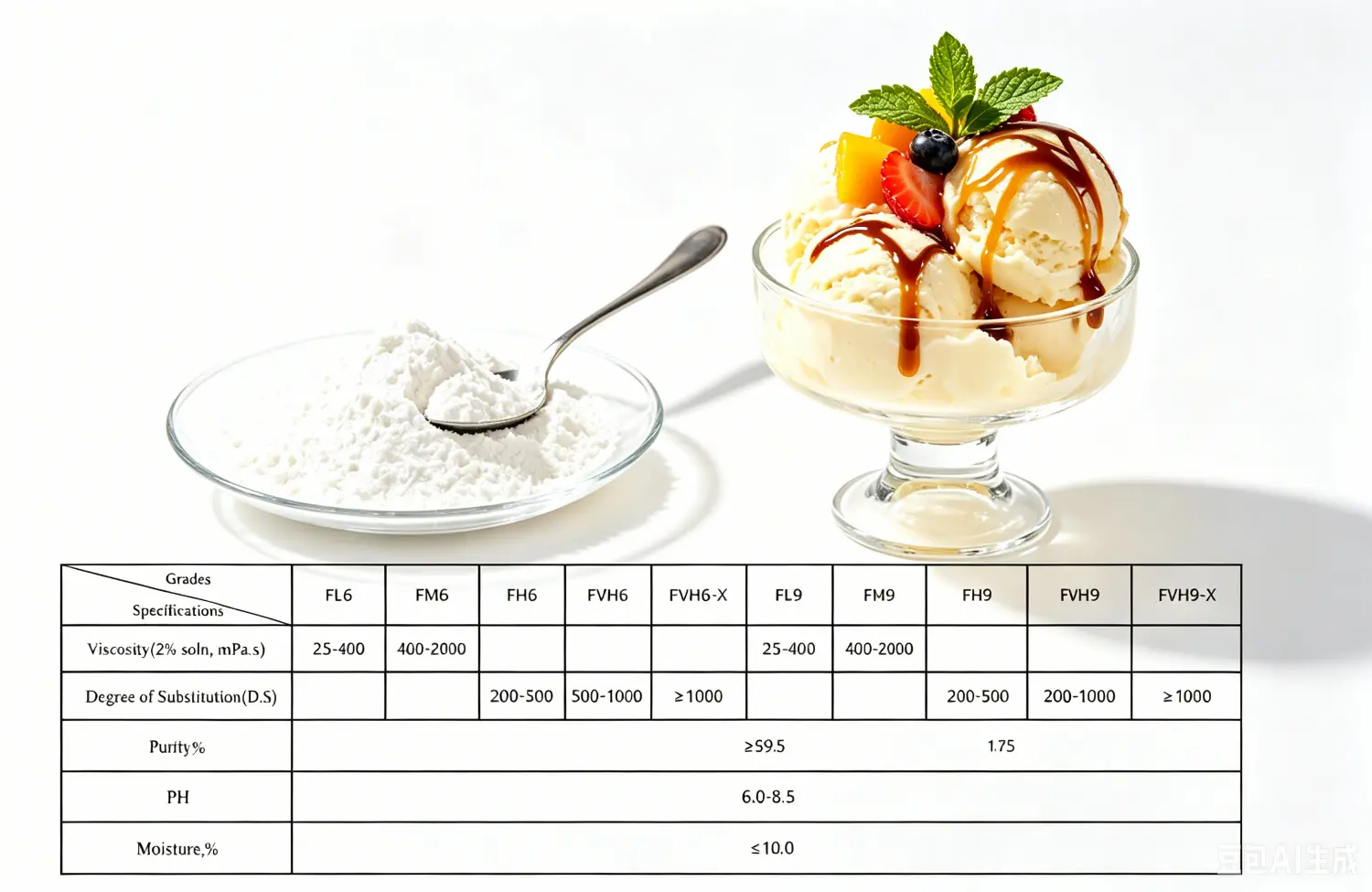
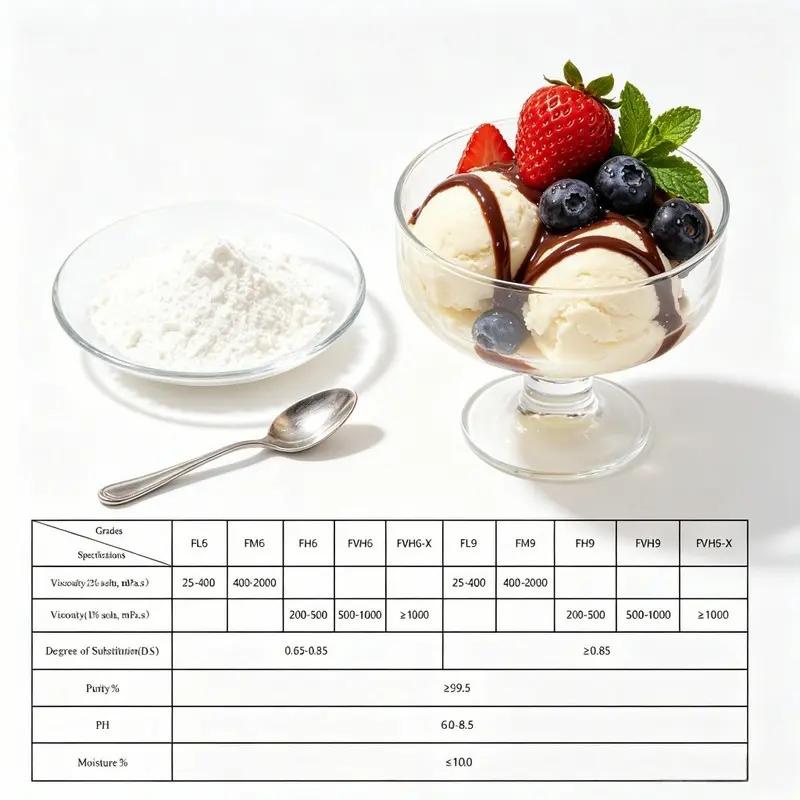
Viscosity Grades (1% Solution, mPa·s, 25°C)
WEHENGFOOD's standard viscosity range spans from low-viscosity, fast-dissolving grades to ultra-high viscosity grades for maximum thickening power:
| Product | Viscosity (1%, mPa·S) |
|---|---|
| Sodium Carboxymethyl Cellulose | 1000–2000 |
| Sodium Carboxymethyl Cellulose | 2000–3000 |
| Sodium Carboxymethyl Cellulose | 3000–4000 |
| Sodium Carboxymethyl Cellulose | 4000–5000 |
| Sodium Carboxymethyl Cellulose | 5000–6000 |
| Sodium Carboxymethyl Cellulose | 6000–7000 |
| Sodium Carboxymethyl Cellulose | 7000–8000 |
Why "Higher Viscosity" Isn't Always "Better"
Buyers often assume a higher-viscosity, higher-D.S. grade is automatically the premium option. Battery binder research shows this isn't universal: a study testing CMC binders with different D.S. values in lithium battery electrodes found that lower-D.S. CMC produced better electrochemical performance and cycling stability than higher-D.S. variants when substituted for PVDF, delivering an initial specific capacity of 214 mAh·g⁻¹ with improved charge/discharge stability[4]. The correct D.S./viscosity combination is application-specific, not a universal quality ranking.
Application Scenarios in B2B Procurement
Choosing the right grade — or requesting a custom specification — should follow the application's real performance requirement, not just a target viscosity.
Food & Beverage: CMC is used at 0.1–0.5% for thickening, water retention, and freeze-thaw stability in juices, instant noodles, baked goods, and ice cream. A functional-properties study testing CMC as a thickener in tomato ketchup found it produced measurably higher viscosity and better sensory scores than a no-gum control, supporting its role as a texture-modifying food additive[5].
Toothpaste: Thickening, suspending, and dispersing agent that gives toothpaste good compatibility, gloss, and shape retention while resisting dehydration in storage.
Oilfield / Drilling Fluids: Reduces fluid loss and stabilizes mud viscosity; D.S. and purity must be matched to the salinity of the drilling environment rather than maximized.
Battery Binders: Improves electrode slurry coating uniformity and cycling stability; D.S. selection can favor lower values depending on the electrode chemistry, contrary to the "higher is premium" assumption.
Textile Printing & Ceramics: Acts as a thickener and dye-carrier paste (textile) or a plasticizer and bonding agent (ceramics), with low gel content required for fine-pattern printing and crack-free clay bodies.
Making the Choice: A Decision Framework
A structured evaluation against your product's real requirements avoids defaulting to "just send me your highest viscosity grade," which can lead to reformulation later.
- Application environment: high-salinity/divalent-ion system → lower D.S. grade; clean aqueous system requiring clarity → higher D.S. grade.
- Performance priority: maximum thickening at low dose → high-viscosity grade; fast dissolution and processing speed → low-to-mid viscosity grade.
- Regulatory context: food/pharma applications require food-grade purity and documentation (COA, allergen statement); industrial applications prioritize cost-per-kg and consistency.
- Existing product to match: if you're switching suppliers, request your current product's COA/TDS so the new supplier can match viscosity test method, D.S., and purity rather than guessing from a generic grade name.
| Business Priority | Recommended CMC Direction |
|---|---|
| Beverage / instant noodle thickening | Mid-viscosity food grade (FH/FM series) |
| Ice cream / dairy stabilization | Higher-viscosity food grade with strong freeze-thaw stability |
| Toothpaste base | TH-series, high transparency, low free-fiber content |
| Oilfield drilling mud | PAC-LV / PAC-HV, D.S. matched to mud salinity |
| Battery electrode binder | BH-series, D.S. selected per electrode chemistry, not maximized |
Supplier & Sourcing Insights for Bulk Procurement
Spec-sheet performance is only half the sourcing decision — supplier reliability determines whether that performance shows up consistently, batch after batch.
| Supplier Attribute | What to Verify | WEHENGFOOD Standard |
|---|---|---|
| Certifications | ISO9001, ISO22000, Kosher, Halal status | Full certification package available on request |
| Purity & D.S. Verification | Batch-specific COA with viscosity, D.S., purity | COA provided with every shipment |
| Minimum Order Quantity | Flexibility for trial batches vs. full-container runs | 500KG trial orders up to 20MT/20' FCL |
| Packaging | Moisture-resistant packaging, since CMC readily absorbs water | 25kg kraft paper compound bags with PE liner |
| Technical Support | Grade recommendation and custom D.S./viscosity development | Dedicated technical support for application matching |
Conclusion
CMC is chemically a single substance, but its real-world performance is defined by the interaction of degree of substitution, viscosity, and purity — not any one number in isolation. A grade that performs well in a food beverage may be the wrong choice for an oilfield drilling fluid or a battery electrode, even at a matching viscosity figure. Working with a supplier that can provide full COA documentation, explain the D.S./viscosity relationship for your specific application, and support custom grade development will determine how reliably that choice performs at scale.
FAQ
What is the difference between CMC grades?
CMC grades differ by three interacting parameters — degree of substitution, viscosity, and purity — rather than by a single "type" number. The right combination depends on the application, not a universal quality ranking.
Is higher viscosity CMC always the better choice?
No. Higher viscosity and higher degree of substitution can actually reduce performance in some applications, such as certain battery binder systems, where lower-D.S. CMC has shown better electrochemical stability.
What information should I send a supplier to get an accurate CMC quote?
Ideally your current product's COA/TDS. Without one, share the viscosity test conditions (concentration, method, viscometer details) and degree of substitution, or at minimum your intended application.
Source Verified CMC in Bulk
WEHENGFOOD supplies COA-verified Sodium Carboxymethyl Cellulose across food, toothpaste, oilfield, battery, and textile grades, with ISO9001/ISO22000/Kosher/Halal certification and flexible order quantities from 500KG trial batches to full-container bulk supply. Our team can help match your current specification or develop a custom D.S./viscosity grade for your application.
Request a Free Sample & QuoteReferences
- Rahman, M.S., Hasan, M.S., Nitai, A.S., Nam, S., Karmakar, A.K., Ahsan, M.S., Shiddiky, M.J.A., & Ahmed, M.B. (2021). Recent developments of carboxymethyl cellulose. Polymers, 13(8), 1345.
- Markovic, Z., Markovic, S., & Zlatanovic, S. (2007). Gas chromatographic determination of the degree of substitution of CMC. Acta Agriculturae Serbica, 12(24), 59–68.
- Huang, L., Ma, Z., Li, Z., & Huang, Y. (1991). Effect of degree of substitution on the salt tolerance of carboxymethyl cellulose. Acta Petrolei Sinica, 12(4), 111–119.
- Hao, H., & Shao, Z. (2012). The electrochemical performance of carboxymethyl cellulose with different DS as a binding material in lithium batteries. Advanced Materials Research, 499, 114–119.
- Mesbahi, G., Niakoosari, M., Savadkoohi, S., & Farahnaky, A. (2010). A comparative study on the functional properties of carboxymethyl cellulose produced from sugar-beet pulp and other thickeners in tomato ketchup. Journal of Food Science and Technology (Iran), 7(26), 62–73.