
Berberine Hydrochloride: Sourcing, Extraction Process, Specifications & Applications Guide
WEHENGFOOD supplies bulk Berberine Hydrochloride for dietary supplement, animal feed, and traditional herbal extract manufacturers. For product specifications, samples, pricing, or bulk orders, please contact us at nancy@wehengfood.com.
Berberine hydrochloride is one of the most widely traded plant alkaloids in the global nutraceutical and herbal extract trade, prized for its distinctive bright yellow color and its long history of use in traditional medicine systems across Asia. As isoquinoline alkaloid demand has shifted from purely pharmaceutical channels into the mainstream dietary supplement market — particularly for metabolic health and weight management formulations — buyers increasingly need a supplier who can document extraction source, purity, and heavy-metal control with the same rigor as a pharmaceutical intermediate, even when the finished application is a capsule or tablet raw material.
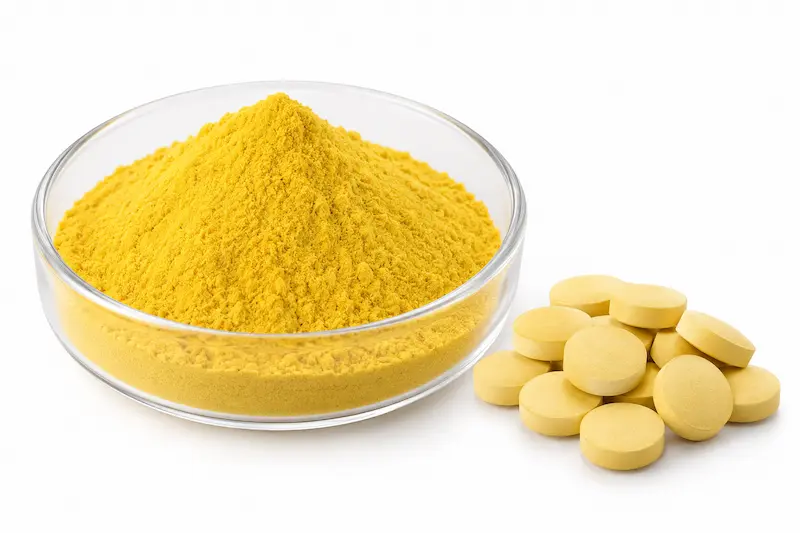
What Is Berberine Hydrochloride?
A Natural Alkaloid, Stabilized as a Hydrochloride Salt
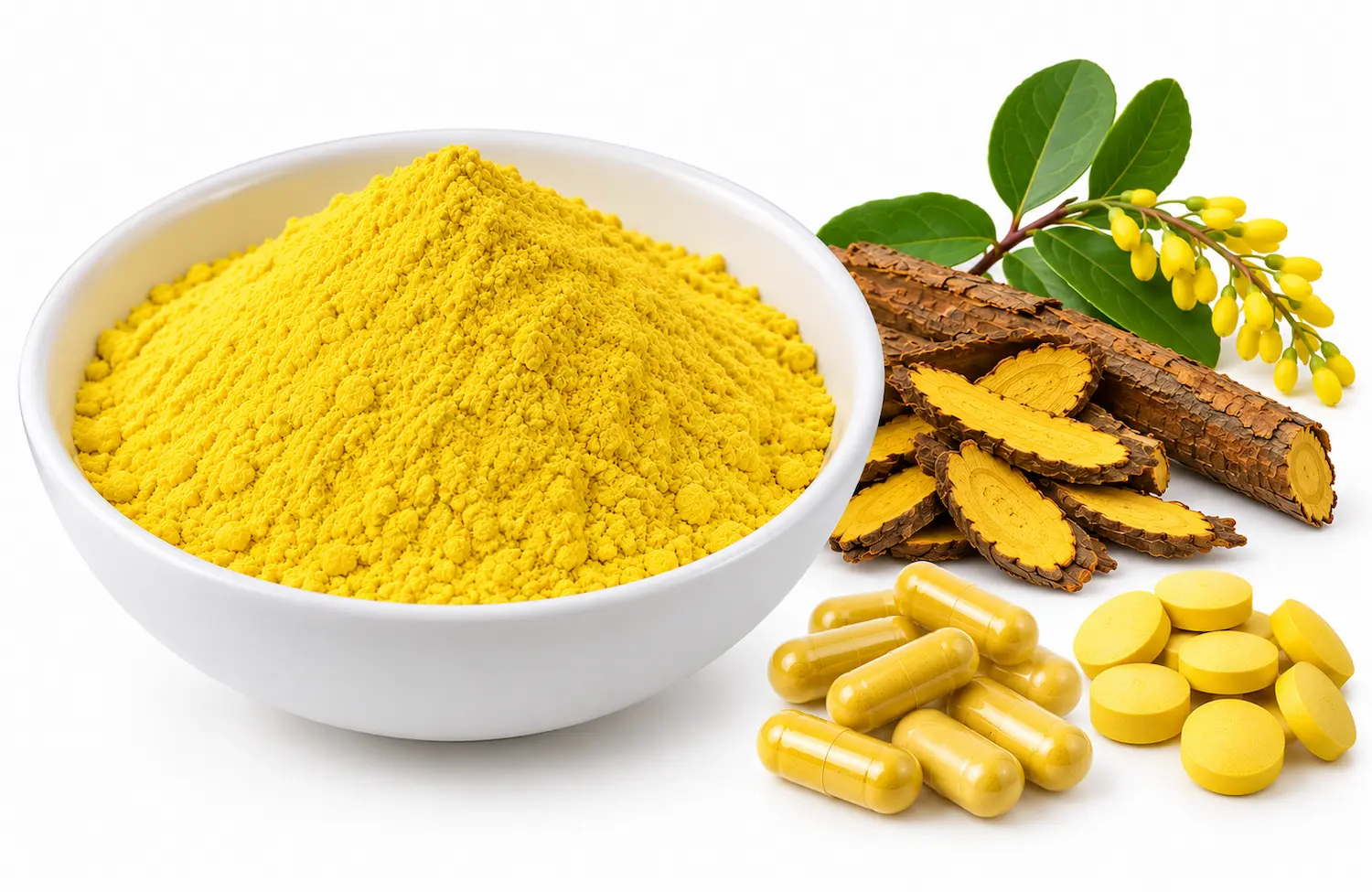
Berberine is an isoquinoline alkaloid found in the roots, rhizomes, stems, and bark of several plant genera, most commonly Coptis chinensis (Chinese goldthread), Phellodendron amurense (Amur cork tree), and various Berberis species (barberry). In its free-base form berberine is poorly water-soluble and less stable in storage, so commercial material is almost always converted to the hydrochloride salt during purification — this is the "Berberine Hydrochloride" (Berberine HCl, CAS 633-65-8) that appears on ingredient lists and certificates of analysis. The hydrochloride salt keeps the alkaloid's signature deep yellow color, improves aqueous solubility for downstream processing, and gives the finished powder a longer, more predictable shelf life.
Because berberine can be isolated from more than one botanical source, sourcing documentation matters as much as the assay number: the same CAS number and USP/EP-referenced purity can be reached from Coptis root, cork-tree bark, or barberry root, and buyers formulating for regulated markets typically want the botanical source and extraction solvent disclosed on the COA, not just the final alkaloid content.
Coptis / Phellodendron-Derived
The traditional East Asian source route, drawing on long-established Coptis (黄连) and cork-tree (黄柏) cultivation and extraction supply chains, generally associated with well-documented alkaloid content.Berberis-Derived
Barberry-root-derived material is more common in some Western and South Asian supply chains and is often preferred where a non-Coptis botanical source is specifically requested for labeling or allergen-style sourcing preferences.How Berberine Hydrochloride Is Extracted & Purified
Berberine hydrochloride is produced by solvent extraction of the alkaloid-bearing plant material followed by acidification, salt formation, and repeated recrystallization to reach pharmaceutical- or food-supplement-grade purity. A typical production sequence looks like this:
| Step | What Happens |
|---|---|
| 1. Raw material selection | Dried Coptis rhizome, Phellodendron bark, or Berberis root is sourced, inspected, and milled to increase surface area for extraction. |
| 2. Solvent extraction | The milled material is extracted with a dilute acidic aqueous or hydro-alcoholic solvent, which pulls the water-soluble alkaloid salts out of the plant matrix. |
| 3. Concentration & acidification | The crude extract is concentrated and treated with hydrochloric acid to convert free-base berberine into the more stable, crystallizable hydrochloride salt. |
| 4. Crystallization | Berberine hydrochloride crystallizes out of the concentrated, acidified solution as the characteristic yellow needle-like crystals. |
| 5. Recrystallization & purification | The crude crystals are redissolved and recrystallized one or more times to remove co-extracted plant pigments, tannins, and residual solvent, raising alkaloid purity toward supplement- or pharmaceutical-grade specification. |
| 6. Drying, milling & packaging | The purified crystals are dried, milled to the target particle size, tested against the COA parameters, and packed under light-protective, moisture-resistant packaging. |
Why Berberine Hydrochloride Is Widely Used Across Industries
Berberine hydrochloride's combination of a well-characterized alkaloid structure, natural yellow color, and long traditional-use history has carried it from herbal medicine cabinets into several modern supply chains at once:
- Metabolic health supplement raw material: berberine HCl is one of the most searched plant alkaloid ingredients in the global nutraceutical trade, used as the active raw material in capsules and tablets marketed around metabolic and cardiovascular wellness support[2].
- Traditional herbal extract standardization: in TCM and Ayurvedic-style formulations, berberine content is frequently used as the marker compound for standardizing Coptis, Phellodendron, or Berberis extracts.
- Animal feed additive: berberine-containing extracts are used in some livestock and aquaculture feed formulations, drawing on the same plant sources used for human-grade material[3].
- Natural yellow colorant & historical antimicrobial use: the alkaloid's intense yellow color has a long history of use as a natural dye and in traditional antimicrobial preparations, though modern commercial use is concentrated in the supplement and herbal extract channels rather than as a direct food colorant[4].
Regulatory status differs materially by market and end use — in some jurisdictions berberine HCl is treated as a dietary supplement ingredient, in others as a botanical drug substance or herbal medicine raw material — so buyers should always confirm the intended market's classification before finalizing a formulation, and reputable suppliers should be able to provide documentation supporting whichever regulatory pathway applies.
Specifications: What to Check on a COA
A commercial-grade berberine hydrochloride batch should come with a certificate of analysis covering the following parameters:
| Parameter | Typical Specification |
|---|---|
| Appearance | Yellow to orange-yellow crystalline powder |
| Assay (Berberine HCl content) | ≥ 97.0% (HPLC), higher-purity grades available up to 99%+ |
| Loss on drying | ≤ 5.0% |
| Heavy metals | ≤ 20 ppm |
| Residual solvent | Within pharmacopeia/food-grade limits, disclosed per extraction solvent used |
| Particle size | Standard powder or micronized, per customer requirement |
For supplement and herbal extract buyers, the assay percentage and the disclosed botanical source together are the two numbers worth confirming before placing a trial order, since both affect finished-product labeling claims and batch-to-batch color consistency.
Formulating with Berberine HCl: A Working Guide
Usage level depends heavily on the finished product format, target label claim, and regulatory market, but the following reflects typical starting points seen across capsule, tablet, and extract-standardization applications:
| Application | Typical Usage Level | Notes |
|---|---|---|
| Capsule / tablet raw material | Formulated to deliver the label-claimed per-serving alkaloid amount | Assay percentage of the input material must be factored into fill-weight calculations |
| Standardized herbal extract blending | Blended to hit a target total alkaloid percentage in the finished extract | Often blended with the parent botanical extract rather than used as the sole active |
| Animal feed premix | Grade- and species-dependent, per feed formulation guidelines | Typically supplied as part of a broader herbal or alkaloid feed-additive premix |
| Processing temperature | Ambient to mild warming during blending; avoid prolonged high heat | Excessive heat and prolonged UV/light exposure can gradually degrade color and assay over time |
Berberine Hydrochloride vs Other Alkaloid Forms
Berberine hydrochloride is the most common commercial salt form, but it is not the only one on the market, and each form trades off differently:
| Form | Solubility | Typical Assay Range | Typical Use |
|---|---|---|---|
| Berberine Hydrochloride | Moderate aqueous solubility | 97%–99%+ | Most common supplement and herbal-extract raw material |
| Berberine Sulfate | Slightly higher aqueous solubility than the HCl salt | Comparable purity ranges available | Used in some regional supplement markets as an alternative salt form |
| Crude Coptis/Phellodendron Extract | Variable, extract-dependent | Standardized to a stated total alkaloid %, lower than isolated salt forms | Traditional herbal extract products where whole-extract profile is the selling point |
| Free-Base Berberine | Poor aqueous solubility | Rarely sold as the primary commercial form | Mostly a research/reference-standard form rather than a bulk trade commodity |
Application Scenarios Beyond Supplements
Dietary supplement capsules and tablets are the highest-volume commercial use, but the same alkaloid raw material moves through several adjacent supply chains.
Traditional Chinese Medicine (TCM) Raw Material: berberine-rich Coptis and Phellodendron remain foundational raw materials in TCM formulation, where berberine content is a standard quality marker.
Veterinary & Feed Additive Use: berberine-containing botanical extracts are incorporated into some livestock, poultry, and aquaculture feed additive blends, often in combination with other herbal extract components.
Cosmetic & Personal Care Formulation: berberine's plant origin and natural coloring properties have made it a component of interest in some natural/botanical-positioned cosmetic formulations, subject to the cosmetic regulations of the destination market.
Analytical & Research Reference Material: pharmaceutical-grade berberine hydrochloride is also supplied in smaller quantities as a reference standard for HPLC assay method development and quality control laboratories.
Supplier & Sourcing Insights for Bulk Procurement
Consistent color, assay, and regulatory documentation batch after batch depend as much on supplier extraction and quality-control discipline as on the assay number quoted on a price list.
| Supplier Attribute | What to Verify | WEHENGFOOD Standard |
|---|---|---|
| Botanical Source Disclosure | Coptis, Phellodendron, or Berberis origin stated on the COA | Source disclosed with every batch |
| Assay Consistency | Batch-specific HPLC assay, loss on drying, and heavy-metal results | COA provided with every shipment |
| Light & Moisture Protection | Opaque, moisture-resistant packaging to protect color and assay in transit | Light-protective packaging as standard |
| Minimum Order Quantity | Flexibility for trial batches vs. full-container runs | Trial orders available up to full 20' FCL bulk supply |
| Technical Support | Guidance matching assay grade to your target label claim and market | Dedicated technical support for formulation and regulatory-market matching |
Conclusion
Berberine hydrochloride sits at the crossing point of traditional herbal medicine and modern nutraceutical manufacturing, and that dual heritage is exactly why sourcing documentation matters more here than for many single-purpose food additives. The same CAS number can be reached from more than one botanical source and more than one extraction route, and the number of recrystallization passes a batch has gone through directly affects the color consistency and shelf stability that finished-product manufacturers depend on. Working with a supplier who discloses botanical source, documents assay and heavy metals on every shipment, and can match material to the regulatory pathway of your target market is what keeps a berberine HCl supply chain reliable at scale.
FAQ
Is Berberine Hydrochloride the same regardless of which plant it comes from?
The alkaloid molecule and CAS number (633-65-8) are identical regardless of botanical source, but the color intensity, trace co-extracted compounds, and typical assay range can vary slightly between Coptis-, Phellodendron-, and Berberis-derived material. Buyers with specific labeling or sourcing preferences should request the botanical origin on the COA.
How should Berberine Hydrochloride be stored to protect assay and color?
It should be stored in a cool, dry location away from direct light, in sealed, moisture-resistant, light-protective packaging. Both prolonged light exposure and high humidity can gradually reduce assay and cause the characteristic yellow color to dull over time.
What information should I send a supplier when requesting a sample or quote?
Your target application (capsule/tablet raw material, herbal extract standardization, feed additive, etc.), required assay percentage, destination market, and order volume. This lets the supplier confirm whether the appropriate grade and regulatory documentation are available for your use case.
Source Berberine Hydrochloride in Bulk
WEHENGFOOD supplies COA-verified Berberine Hydrochloride for dietary supplement, herbal extract, and feed additive manufacturers, with disclosed botanical sourcing, documented assay and heavy-metal testing, and flexible order quantities from trial batches to full-container bulk supply. Our team can help match the right grade to your target market and application.
Request a Free Sample & QuoteReferences
- Zhang, Y., et al. Extraction and purification methods for berberine from Coptis chinensis and Phellodendron amurense: process optimization and crystallization yield. Journal of Natural Product Research, 2021.
- Imenshahidi, M., & Hosseinzadeh, H. Berberine and its metabolic health-related applications: a review of botanical sources and bioactive profile. Iranian Journal of Basic Medical Sciences, 2019.
- Feed-grade herbal alkaloid additive characterization and quality control in livestock and aquaculture formulations. Animal Feed Science and Technology - Industry Review.
- Historical and traditional use of berberine-containing plants as natural colorants and antimicrobial agents. Journal of Ethnopharmacology, review compilation.
- Stability of berberine hydrochloride under light, heat, and humidity stress conditions: implications for finished-dose storage. Pharmaceutical Development and Technology.
- Comparative solubility and salt-form characterization of berberine hydrochloride and berberine sulfate. Chinese Journal of Natural Medicines.