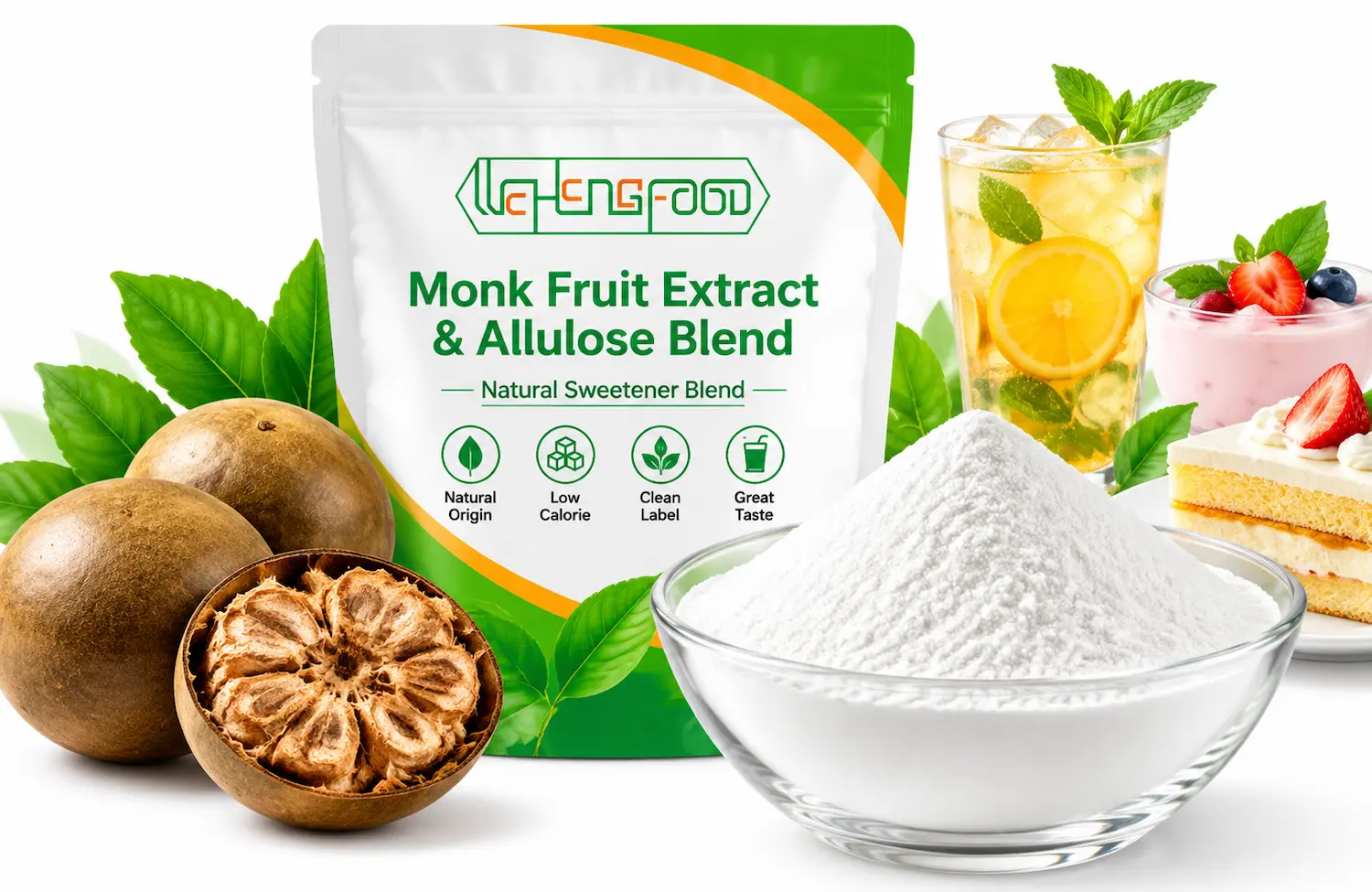

Monk Fruit Extract + D-Allulose Blend: The Complete Formulator's Guide to Clean-Label Sugar Reduction
WEHENGFOOD supplies bulk food-grade Monk Fruit Extract and D-Allulose for sugar-reduction and zero-calorie sweetener formulation. For product specifications, samples, pricing, or bulk orders, please contact us at nancy@wehengfood.com.
Formulators who try to remove sugar with just one substitute usually run into the same wall. High-intensity sweeteners like monk fruit extract deliver sweetness at a fraction of the usage level of sugar, but pushed high enough to replace all of sugar's sweetness they can bring a lingering, licorice-like aftertaste — and they add none of sugar's bulk, body, or browning. Bulk sweeteners like D-Allulose taste and behave far more like sugar, but on their own they are only about 70% as sweet, so hitting a full sugar-equivalent sweetness means using close to a one-to-one replacement, which raises cost and can affect texture at high inclusion. Blending the two together is how commercial "sugar-free" and "reduced-sugar" products solve both problems at once: monk fruit extract supplies the missing sweetness intensity, while D-Allulose supplies the bulk, mouthfeel, and clean finish that monk fruit alone cannot.
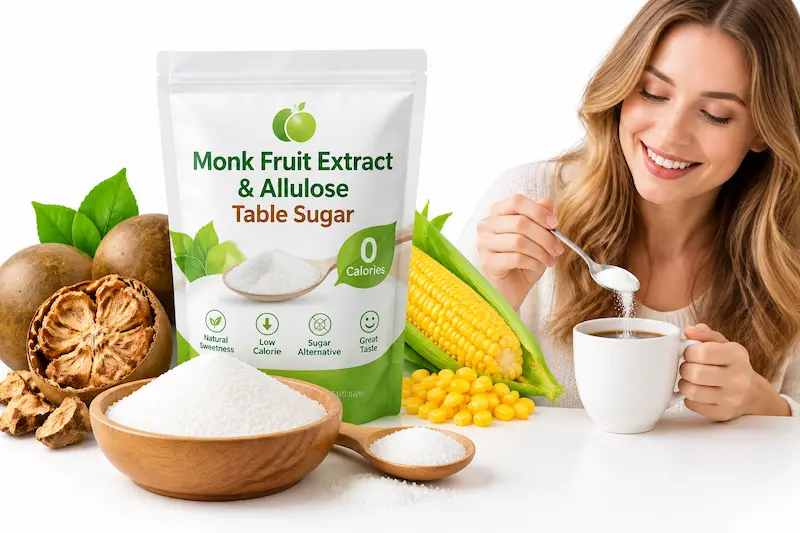
What Is a Monk Fruit Extract + Allulose Blend?
Two Sweeteners, One Job
Monk fruit extract (Luo Han Guo extract) is a natural high-intensity sweetener obtained by aqueous extraction from the fruit of Siraitia grosvenorii. Its sweetness comes almost entirely from a family of cucurbitane-type triterpene glycosides called mogrosides, of which Mogroside V is the dominant and most valued compound — commercial grades are standardized to a specific Mogroside V content (commonly 25%, 40%, or 50%) because sweetness intensity and cost scale directly with it.
D-Allulose (also called D-psicose) is a rare sugar that is structurally almost identical to fructose but is metabolized very differently by the body, so it contributes negligible calories despite tasting, dissolving, and browning much like real sugar. Because it is a genuine carbohydrate rather than a high-intensity sweetener, it behaves like sugar in a formulation — it can be measured by weight or volume, it contributes to a solution's freezing-point depression and Maillard browning, and it provides real bulk and mouthfeel[1].
Monk Fruit Extract — High-Intensity
150–300x the sweetness of sucrose depending on Mogroside V grade. Zero calories, zero glycemic impact, but no bulk and a detectable aftertaste when used as the sole sweetness source at high replacement levels.D-Allulose — Bulk, Sugar-Like
About 70% as sweet as sucrose, near-zero calories, low glycemic impact. Provides real bulk, browning, and freezing-point depression that mimic sugar's function in a recipe[1].Why Blend Them? Solving Each Sweetener's Weakness Alone
Used by itself, each ingredient asks a formulator to accept a trade-off. Blending lets each ingredient cover for what the other lacks:
- Monk fruit extract alone: at the dosage needed to match full sugar sweetness, its aftertaste becomes more noticeable, and it contributes no bulk — a finished product still needs a separate bulking agent.
- D-Allulose alone: matching 100% of sucrose's sweetness requires close to a 1:1 replacement by weight, which is costly at scale and can shift moisture and texture more than a formulator wants in some recipes.
- The blend: a small fraction of monk fruit extract lifts the blend's sweetness back up to a sugar-equivalent level at a much lower total allulose dose, while the allulose supplies the bulk and mouthfeel monk fruit cannot — and at the blend's typical ratios, the monk fruit fraction is diluted below the concentration where its aftertaste is perceptible on its own[2].
Sensory & Functional Synergy
Beyond simply covering each other's weak points, the two ingredients interact in ways that improve the finished product's sensory profile and function:
- Sweetness curve: sucrose delivers a fast, clean sweetness onset and decay; D-allulose's time-intensity curve is close to sucrose's, and blending in monk fruit extract for the top-line sweetness keeps the overall onset and finish closer to sugar than a high-intensity sweetener used alone.
- Aftertaste masking: the mild cooling and rounding effect of D-allulose's sugar-like body helps soften the tail-end aftertaste that monk fruit extract can otherwise leave behind.
- Bulk and texture: in tabletop sugar, baked goods, and confectionery, D-allulose supplies the volume and crystalline structure that monk fruit extract's minute usage level cannot.
- Browning & Maillard reaction: as a genuine reducing sugar, D-allulose browns in baking much like sucrose does, which monk fruit extract cannot replicate on its own[1].
- Freezing-point depression: in frozen desserts, D-allulose's colligative behavior helps control ice crystal formation and scoopability in a way high-intensity sweeteners cannot.
Typical Blend Ratios & Mogroside V Grades
There is no single universal ratio — it depends on the Mogroside V content of the monk fruit extract used and the target sweetness equivalence to sugar — but the following starting points are common in the industry:
| Monk Fruit Extract Grade | Typical Blend Ratio (Monk Fruit : Allulose) | Approx. Sweetness vs. Equal Weight of Sugar |
|---|---|---|
| Mogroside V 25% | 1 : 15 – 1 : 25 | ~1:1 sugar-equivalent |
| Mogroside V 40% | 1 : 25 – 1 : 40 | ~1:1 sugar-equivalent |
| Mogroside V 50% | 1 : 35 – 1 : 55 | ~1:1 sugar-equivalent |
Higher-potency Mogroside V grades let a formulator use less total monk fruit extract to hit the same sweetness lift, which is useful when minimizing any risk of aftertaste at scale, but they also cost more per kilogram — the right grade is usually a balance between finished cost and target flavor cleanliness.
Specifications: What to Check on a COA
Since a blend combines two distinct raw materials, request certificates of analysis for each ingredient individually before they are combined:
| Parameter | Monk Fruit Extract | D-Allulose |
|---|---|---|
| Assay / Purity | Mogroside V ≥ 25% / 40% / 50% (HPLC) | ≥ 98% (dry basis, HPLC) |
| Appearance | Off-white to light yellow fine powder | White crystalline powder or granules |
| Moisture | ≤ 6% | ≤ 0.5% |
| Loss on drying | ≤ 6% | ≤ 0.5% |
| Heavy metals / Pesticide residue | Within food-grade limits, COA per batch | Within food-grade limits, COA per batch |
| Non-GMO / Allergen status | Non-GMO, allergen-free | Non-GMO, allergen-free (typically corn-derived) |
Dosage Guide by Application
Exact ratios should always be trialed in the target matrix, but the following ranges reflect common starting points for a monk fruit extract + D-allulose sugar-reduction system:
| Application | Typical Total Replacement Level | Formulation Notes |
|---|---|---|
| Beverages (juice drinks, RTD tea/coffee) | Allulose 2–6% w/v + Monk fruit extract 0.01–0.03% | Monk fruit lifts sweetness without adding the viscosity a full sugar load would |
| Baked goods | Allulose replacing 30–70% of sugar + Monk fruit extract to restore sweetness | Allulose contributes browning and moisture retention; watch bake time as allulose browns faster than sucrose |
| Dairy & yogurt | Allulose 3–8% + Monk fruit extract 0.005–0.02% | Allulose supports body and mouthfeel lost when sugar is removed |
| Tabletop sugar / sachets | Allulose as primary bulk carrier + Monk fruit extract 0.5–3% of blend weight | Blend is granulated to a sugar-like crystal size for a familiar pour and spoon-for-spoon use |
| Sauces & condiments | Allulose replacing 50–100% of sugar + Monk fruit extract to taste | Allulose's browning helps preserve glaze and caramelization character |
Monk Fruit + Allulose Blend vs Other Sugar-Reduction Systems
Compared against other common approaches to cutting sugar, the monk fruit + allulose blend occupies a "closest to sugar" position on taste and function:
| System | Aftertaste | Bulk / Mouthfeel | Browning | Digestive Tolerance at High Dose |
|---|---|---|---|---|
| Monk Fruit + Allulose Blend | Minimal at typical ratios | Sugar-like (from allulose) | Yes (from allulose) | Generally well tolerated within recommended intake |
| Monk Fruit Extract Alone | Noticeable at high replacement | None | No | Well tolerated (used at very low dose) |
| D-Allulose Alone | Clean, sugar-like | Sugar-like | Yes | Possible GI effects at very high single doses |
| Stevia + Erythritol Blend | Licorice/bitter note common | Erythritol crystallizes, cooling effect | No | Erythritol can cause GI discomfort in sensitive individuals |
| Sugar Alcohols Alone (e.g. Erythritol/Maltitol) | Cooling effect (erythritol) or sweet-lag (maltitol) | Sugar-like | Limited | Higher risk of GI discomfort at bulk-replacement levels |
Regulatory & Labeling Considerations
Both ingredients are broadly recognized as safe sweeteners in major food markets, but labeling conventions differ by region and should always be confirmed against the destination market's current regulations before finalizing packaging:
- Monk fruit extract is generally labeled as "Monk Fruit Extract" or "Luo Han Guo Extract," sometimes with the Mogroside V percentage declared.
- D-Allulose is typically declared as "Allulose" or "D-Allulose" on the ingredient list; in some markets it may be excluded from "Total Sugars" and "Added Sugars" declarations, which is one reason it is popular in reduced-sugar reformulation — confirm current rules for your specific target market.
- Claims such as "sugar-free," "no added sugar," or "keto-friendly" carry different thresholds by jurisdiction and should be verified against local food-labeling regulations before use.
Supplier & Sourcing Insights for Bulk Procurement
Because the blend combines two separately sourced ingredients, batch-to-batch consistency depends on both suppliers documenting the same specifications every time:
| Supplier Attribute | What to Verify | WEHENGFOOD Standard |
|---|---|---|
| Mogroside V Consistency | Batch-specific HPLC assay for monk fruit extract | COA provided with every shipment |
| Allulose Purity | Batch-specific HPLC assay, low residual sugars | ≥98% purity, COA per batch |
| Particle Size Matching | Compatible granulation for tabletop or dry-mix blends | Custom mesh sizing available on request |
| Minimum Order Quantity | Flexibility for trial batches vs. full-container runs | Trial orders available up to full 20' FCL bulk supply |
| Technical Support | Ratio recommendation matched to your specific application | Dedicated technical support for formulation matching |
Conclusion
Monk fruit extract and D-allulose solve opposite halves of the same sugar-reduction problem: one delivers concentrated sweetness with none of sugar's bulk, the other delivers sugar-like bulk, browning, and mouthfeel at a sweetness level below sucrose. Blended together at the right ratio for the Mogroside V grade in use, they let a formulator hit full sugar-equivalent sweetness with minimal aftertaste and a texture much closer to real sugar than either ingredient can achieve alone. As with any sugar-reduction system, the right ratio is matrix-specific, which is why working with a supplier that can provide consistent COAs for both ingredients and help match your target sweetness and texture is what keeps a reformulated product tasting right batch after batch.
FAQ
Can this blend fully replace sugar 1:1 by volume in a recipe?
Not by simple substitution — D-allulose alone is about 70% as sweet as sugar, so the monk fruit extract fraction is what brings the total blend back up to sugar-equivalent sweetness. Most commercial blends are pre-formulated so they can be swapped in close to a 1:1 volume basis, but a custom ratio should be trialed in your specific recipe.
Does the blend behave like sugar in baking?
Largely yes — D-allulose is a genuine reducing sugar, so it browns and caramelizes similarly to sucrose, and it contributes moisture retention. Because it browns somewhat faster than sucrose, bake times or temperatures sometimes need slight adjustment.
Is there any aftertaste at typical blend ratios?
At the ratios used in most commercial formulations, the monk fruit extract fraction is diluted well below the concentration where its aftertaste becomes noticeable on its own, and D-allulose's sugar-like body helps round out the finish further.
Are monk fruit extract and D-allulose considered natural ingredients?
Monk fruit extract is a plant-derived extract from the Siraitia grosvenorii fruit. D-allulose occurs naturally in small amounts in certain fruits and is commercially produced via enzymatic conversion, which is generally regarded as a natural production process, though labeling conventions vary by market.
What information should I send a supplier to get a formulation recommendation?
The application (beverage, baked good, dairy, tabletop sugar, etc.), your target total sugar reduction percentage, and if possible a sample of the current sugar-sweetened product so the sweetness and texture can be matched.
Source Monk Fruit Extract & D-Allulose in Bulk
WEHENGFOOD supplies COA-verified Monk Fruit Extract and D-Allulose for sugar-reduction and clean-label sweetener formulation, with consistent Mogroside V and allulose purity, and flexible order quantities from trial batches to full-container bulk supply. Our team can help match your target sweetness profile or develop a custom blend ratio for your application.
Request a Free Sample & QuoteReferences
- Hossain, A., et al. Rare sugar D-allulose: properties, functionality, and applications in reduced-sugar food formulation. Food Science & Nutrition Reviews, 2022.
- Pawar, R. S., et al. Extraction and characterization of mogrosides from Siraitia grosvenorii (monk fruit) and their role as high-intensity natural sweeteners. Journal of Agricultural and Food Chemistry, 2013.
- Chen, W. J., et al. Sensory and physicochemical evaluation of blended natural sweetener systems for sugar reduction in beverages. Food Hydrocolloids / ScienceDirect, 2020.
- Zhou, Y., et al. Allulose as a functional sugar substitute: metabolic fate, sweetness properties, and applications in food processing. Trends in Food Science & Technology, 2021.
- Sardesai, V. M., & Waldshan, T. Comparative review of high-intensity and bulk sweetener combinations for sugar-reduced product development. International Journal of Food Science, 2019.