
Monk Fruit + Erythritol + Stevia Blended Sweetener: Ratios, Function & Formulation Guide
WEHENGFOOD supplies bulk food-grade Organic Monk Fruit Extract, Erythritol, and Organic Stevia Leaf Extract for sugar-free beverage, baking, and functional food manufacturers. For product specifications, samples, pricing, or bulk orders, please contact us at nancy@wehengfood.com.
No single natural sweetener replaces sugar cleanly on its own. Monk fruit extract carries an intense, fast-onset sweetness but a noticeable lingering aftertaste at high potency; stevia leaf extract is even sweeter but leans toward a bitter, licorice-like finish as concentration rises; erythritol tastes clean and sugar-like but is only about 60–70% as sweet as sucrose and contributes almost no bulk on its own at the low doses needed to reach full sweetness. Blending the three together is the standard way the sweetener industry solves this: erythritol supplies the bulk and mouthfeel of sugar, while monk fruit and stevia layer on the missing sweetness — and, critically, mask each other's off-notes far better than either does alone. This is why a Monk Fruit + Erythritol + Stevia blend has become one of the most widely used "clean-label," zero-calorie sugar replacers in sugar-free beverages, baked goods, tabletop sweeteners, and confectionery.
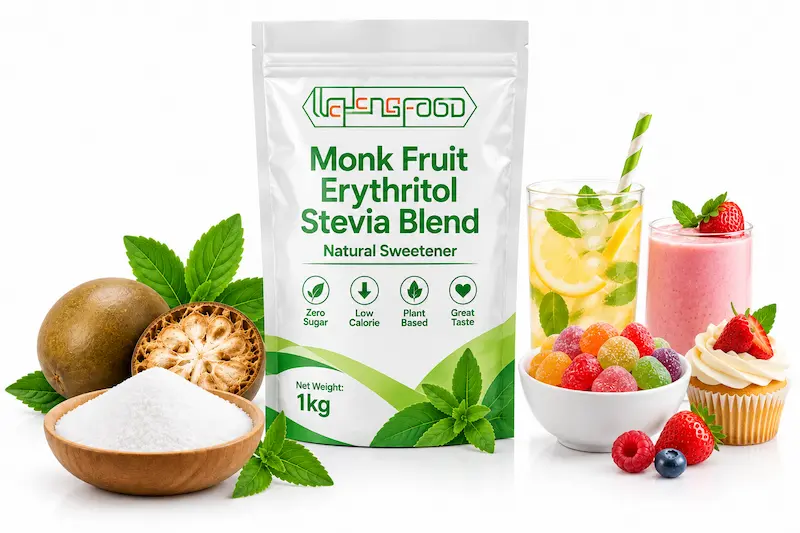
What Is a Monk Fruit + Erythritol + Stevia Blend?
Three Natural Sweeteners, One Sugar-Replacement System
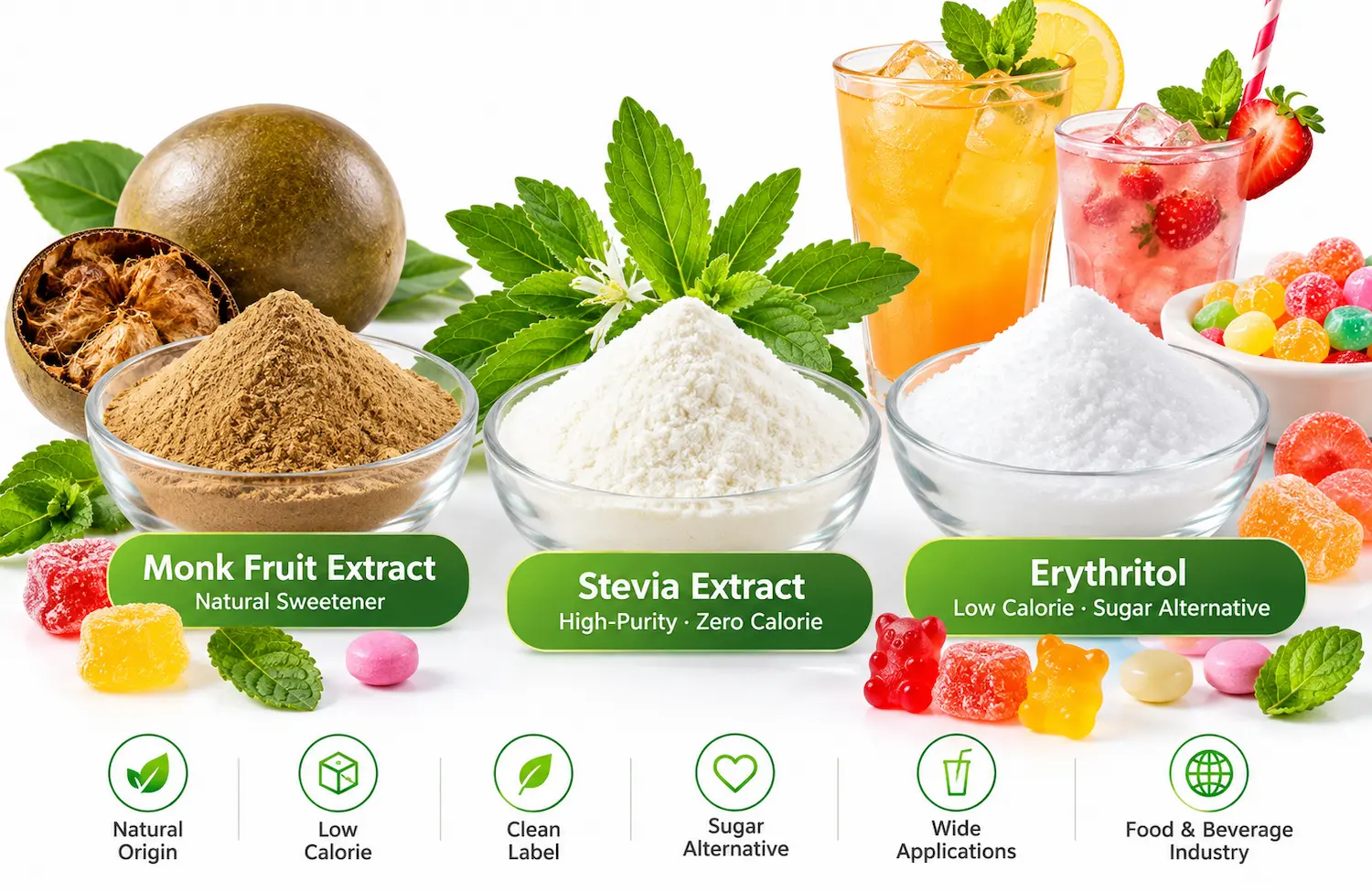
A Monk Fruit + Erythritol + Stevia blend combines three plant- and fermentation-derived ingredients, each contributing a different function:
- Erythritol — a four-carbon sugar alcohol produced by microbial fermentation of natural sugar sources. It is non-caloric, does not raise blood sugar, and is non-cariogenic, and it provides the bulk, crystalline structure, and cooling mouthfeel that closely mimics table sugar[1].
- Monk Fruit Extract — a high-intensity natural sweetener extracted from Siraitia grosvenorii fruit, standardized to its mogroside content (commonly Mogroside V). It delivers sweetness many times that of sucrose at very low use levels[2].
- Stevia Leaf Extract — a high-intensity natural sweetener derived from the leaves of Stevia rebaudiana, standardized to its steviol glycoside content (Reb A, Reb M, stevioside, etc.). Like monk fruit, it is many times sweeter than sucrose per gram[3].
None of the three is used alone at full replacement level in most commercial formulations. Instead, erythritol is used as the primary bulking agent (often 90–98% of the blend by weight), with a small, carefully tuned fraction of monk fruit extract and/or stevia leaf extract added to bring total sweetness up to a 1:1 sugar equivalence.
Erythritol's Role
Provides bulk, texture, and a clean cooling sweetness with essentially no calories and no impact on blood glucose — but alone it only reaches 60–70% of sucrose's sweetness, so it under-delivers on sweetness at a 1:1 swap.Monk Fruit & Stevia's Role
Both are intensely sweet at very low inclusion (often under 1% of the blend), closing the sweetness gap left by erythritol — while their combined presence also tends to soften each other's individual off-notes better than either used alone[4].Why Blend Three Sweeteners Instead of Using One?
Each sweetener has a taste profile that becomes a liability when pushed to full-replacement levels on its own:
- Monk fruit alone: clean at low levels, but its aftertaste becomes more noticeable as concentration rises to replace all of sugar's sweetness.
- Stevia alone: similarly clean at low doses, but known for a bitter, licorice-like lingering note once steviol glycoside concentration climbs, particularly with lower-purity extracts[3].
- Erythritol alone: tastes the most sugar-like of the three, but cannot reach full sweetness equivalence without adding so much bulk that formulations become impractical, and very high doses can affect digestive tolerance in sensitive individuals.
Blending sidesteps all three limitations at once. Because monk fruit and stevia are used at a fraction of a percent of the formulation, their individual off-notes stay below the perception threshold, while erythritol's bulk and clean taste dominate the sensory profile. The result is a blend that tastes closer to sucrose than any of the three components would alone — a strategy widely used across the sugar-reduction industry precisely because monk fruit, stevia, and erythritol complement each other's weaknesses[4][5].
Typical Blending Ratios & Sweetness Equivalence
Exact ratios vary by mogroside/steviol glycoside purity and the target sweetness intensity, but the following reflects common commercial starting points for a 1:1 sugar-equivalent tabletop or formulation blend:
| Component | Typical Share of Blend | Function |
|---|---|---|
| Erythritol | 92%–98% | Bulk, texture, cooling mouthfeel, carrier for the high-intensity sweeteners |
| Monk Fruit Extract (Mogroside V standardized) | 0.3%–2% | Adds high-intensity sweetness; contributes a fruit-forward top note |
| Stevia Leaf Extract (Reb A/Reb M standardized) | 0.3%–2% | Adds high-intensity sweetness; extends and rounds out the sweetness curve |
Specifications: What to Check on a COA
Each component of the blend should come with its own certificate of analysis. Typical parameters to verify:
| Component | Key Parameter | Typical Specification |
|---|---|---|
| Erythritol | Purity / Assay | ≥ 99.5% |
| Erythritol | Particle size / Moisture | Grade-dependent; moisture ≤ 0.2% |
| Monk Fruit Extract | Mogroside V content | Commonly 25%–60%, per requirement |
| Stevia Leaf Extract | Total steviol glycosides / Reb A or Reb M content | Commonly 90%–98% total glycosides |
Mogroside V and steviol glycoside content are the practical proxies for both sweetness intensity and taste quality — higher-purity extracts of both generally carry a cleaner taste with less aftertaste, and should be matched batch-to-batch when replicating an existing formulation.
Formulating with the Blend: A Working Dosage Table
Exact dosage depends on the application and desired sweetness intensity, but the following ranges reflect typical starting points for a Monk Fruit + Erythritol + Stevia blend used as a 1:1 sugar replacer:
| Application | Typical Usage Level | Notes |
|---|---|---|
| Beverages | 4%–8% of formulation | Dissolves readily; monitor for slight cooling effect at higher erythritol loads |
| Baked goods | 1:1 sugar replacement by weight | Erythritol contributes less browning than sucrose; adjust Maillard-reaction ingredients if needed |
| Tabletop sweetener | 1:1 to 2:1 volume-for-volume vs. sugar | Bulk density of erythritol differs slightly from sucrose; calibrate packaging fill by weight |
| Confectionery / chocolate | Full or partial sugar replacement | Erythritol's negative heat of solution gives a cooling note; useful in mints, less so in warm-eaten items |
Blended Sweetener vs Single-Source Sweeteners
Each sweetening approach trades off differently against a Monk Fruit + Erythritol + Stevia blend:
| Sweetener Approach | Sweetness Match to Sugar | Aftertaste | Bulk / Texture |
|---|---|---|---|
| Monk Fruit + Erythritol + Stevia Blend | Close 1:1 match achievable | Minimal, well-masked | Sugar-like, from erythritol |
| Monk Fruit Extract alone | Requires very high dilution to reach 1:1 | Noticeable at high dose | None — needs a bulking agent |
| Stevia Leaf Extract alone | Requires very high dilution to reach 1:1 | Bitter/licorice note at high dose | None — needs a bulking agent |
| Erythritol alone | Only 60–70% as sweet as sugar | Clean, but under-sweet | Sugar-like |
Application Scenarios
The blend's sugar-like bulk combined with natural high-intensity sweetness makes it broadly applicable across functional food and beverage categories.
Sugar-Free & Reduced-Sugar Beverages: carbonated drinks, juices, and ready-to-drink teas use the blend to hit full sweetness without the caloric or glycemic load of sucrose.
Baking & Confectionery: cookies, cakes, and candy formulated for sugar-controlled or diabetic-friendly product lines rely on the blend's 1:1 measuring convenience.
Tabletop Sweeteners: retail sugar-replacement packets and jars commonly use exactly this three-ingredient system to deliver a clean, sugar-like sweetening experience for home use.
Nutritional & Functional Foods: protein bars, meal-replacement powders, and health beverages use the blend to reduce added sugar declarations while keeping the product palatable.
Supplier & Sourcing Insights for Bulk Procurement
Consistent sweetness and taste from batch to batch depends on tightly controlled sourcing of all three components.
| Supplier Attribute | What to Verify | WEHENGFOOD Standard |
|---|---|---|
| Mogroside/Glycoside Consistency | Batch-specific COA for each raw material | COA provided with every shipment |
| Non-GMO / Organic Sourcing | Traceable origin for monk fruit and stevia leaf | IP non-GMO supply chain and organic-certified options available |
| Certifications | Food safety and religious/dietary certifications relevant to your market | ISO9001, ISO22000, BRC, KOSHER, HALAL, SMETA |
| Minimum Order Quantity | Flexibility for trial batches vs. full-container runs | Trial orders available up to full bulk container supply |
| Technical Support | Ratio recommendation matched to your existing sweetness target | Dedicated technical support for formulation matching |
Conclusion
A Monk Fruit + Erythritol + Stevia blend works because it lets each ingredient do what it does best: erythritol supplies bulk, texture, and a clean sugar-like base; monk fruit and stevia supply the missing high-intensity sweetness at doses low enough that their individual aftertastes stay below the taste threshold. The result is a natural, zero-calorie sugar replacer that comes closer to a true 1:1 sugar swap — in both sweetness and mouthfeel — than any single ingredient can achieve alone. Sourcing each component from a supplier that documents mogroside and steviol glycoside content on every shipment, and can help tune the ratio to your target taste profile, is what keeps that sweetness consistent at scale.
FAQ
What ratio of monk fruit to stevia works best in a blend?
There is no single universal ratio — it depends on the purity of each extract and the target taste profile. Many commercial blends use roughly equal small fractions of monk fruit and stevia extract alongside the bulk of erythritol, since combining the two tends to round out the sweetness curve better than using either alone.
Does the blend behave like sugar in baking?
It measures 1:1 by weight in most formulations and provides similar bulk, but erythritol contributes less to browning (Maillard reaction) than sucrose, so recipes relying heavily on caramelization or crust color may need adjustment.
What information should I send a supplier to match my current sweetness profile?
Ideally your target sweetness equivalence versus sucrose, your current blend ratio if you have one, or a sample of the finished product. At minimum, describe the application (beverage, baked good, tabletop) and any aftertaste concerns you're trying to solve.
Source Monk Fruit, Erythritol & Stevia Blend Components in Bulk
WEHENGFOOD supplies COA-verified Organic Monk Fruit Extract, Erythritol, and Organic Stevia Leaf Extract for sugar-free beverage, baking, and functional food manufacturers, with consistent mogroside and steviol glycoside content, controlled moisture, and flexible order quantities from trial batches to full-container bulk supply. Our team can help tune your blend ratio to match your target sweetness and taste profile.
Request a Free Sample & QuoteReferences
- Regnat, K., et al. Erythritol as a sweetener — wherefrom and whereto? Applied Microbiology and Biotechnology, 2018.
- Pawar, R. S., et al. Sweeteners from plants — with emphasis on Stevia rebaudiana (Bertoni) and Siraitia grosvenorii (Swingle). Analytical and Bioanalytical Chemistry, 2013.
- Samuel, P., et al. Stevia leaf to Stevia sweetener: exploring its science, benefits, and future potential. Journal of Nutrition, 2018.
- Prakash, I., et al. Development of rebiana, a natural, non-caloric sweetener. Food and Chemical Toxicology, 2008.
- Carakostas, M. C., et al. Overview: the history, technical function, and safety of rebaudioside A, a naturally occurring steviol glycoside. Food and Chemical Toxicology, 2008.