
Squalene vs Squalane: A Formulator's Guide to Structure, Efficacy & Sourcing
WEHENGFOOD is a bulk manufacturer, supplier, and exporter of sugarcane-fermented Squalene and Squalane for skincare, haircare, and full-oil cosmetic formulations. For product specifications, samples, pricing, or bulk orders, please contact us at nancy@wehengfood.com.
Squalene and squalane are frequently used as if they were interchangeable, but they are chemically distinct ingredients with different performance profiles. Squalene is the unsaturated compound naturally present in human sebum, prized for its high bioactivity and rapid skin compatibility; squalane is its hydrogenated, fully saturated counterpart, valued instead for near-total oxidative stability and a lighter, long-shelf-life texture. Choosing the wrong one — or assuming one can simply substitute for the other at the same dosage — is one of the more common formulation missteps in oil-based skincare and haircare development.
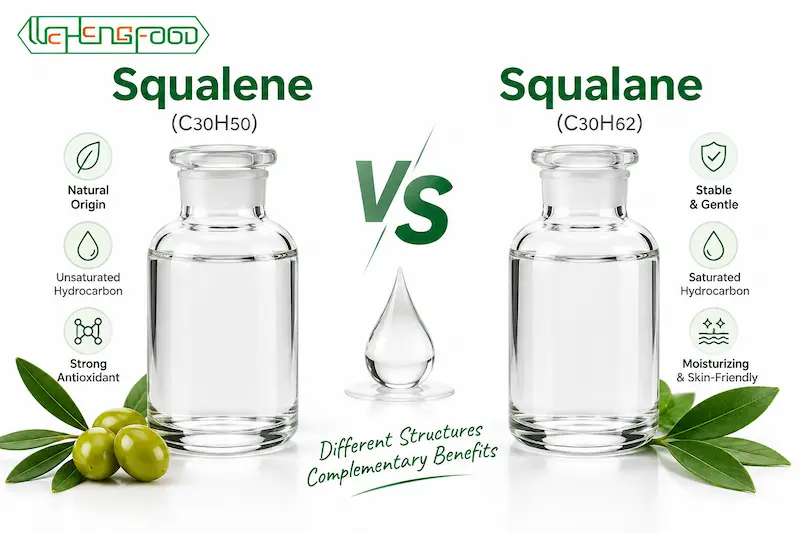
Squalene vs Squalane: What's the Difference
What Squalene Actually Is
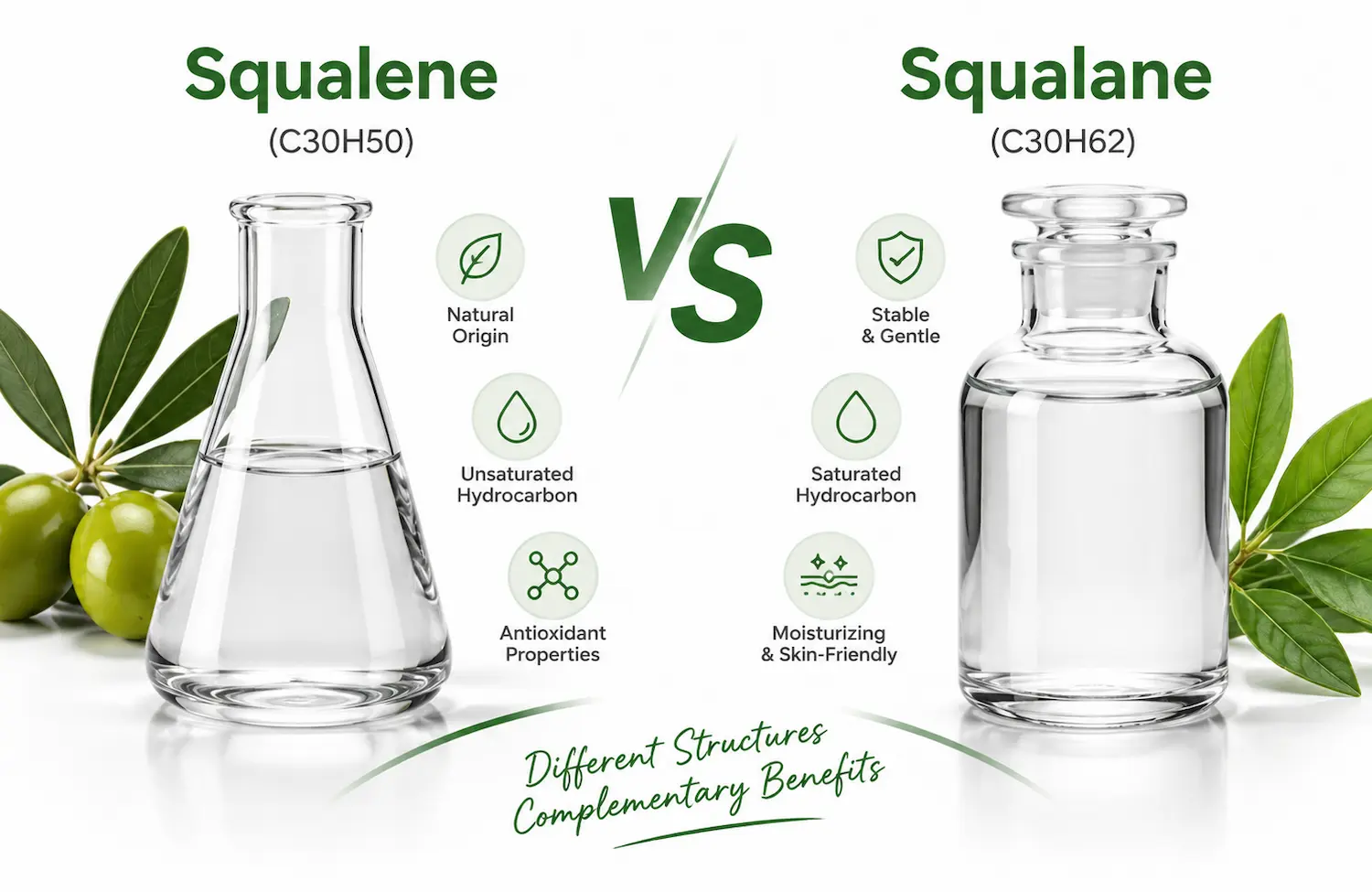
Squalene (CAS 111-02-4) is a triterpene hydrocarbon that occurs naturally throughout human tissue, with its highest concentration found in skin, where it makes up a meaningful share of sebum lipids[1]. Structurally, it is an unsaturated hydrocarbon containing six carbon-carbon double bonds. Those double bonds are the source of squalene's high biological reactivity — they let it scavenge free radicals effectively — but they also make the molecule chemically unstable and prone to oxidation once exposed to air, heat, or light. The body's own squalene output is highest at birth and declines steadily after the mid-twenties, which is one reason topical squalene is positioned as replenishing a resource skin naturally loses over time[2].
What Squalane Actually Is
Squalane (CAS 111-01-3) is produced by hydrogenating squalene — adding hydrogen across each double bond until the molecule becomes fully saturated. The resulting hydrocarbon is one of the closest lipid matches to human sebum in terms of spreadability and polarity, but because its double bonds are gone, it is essentially odorless, colorless, and highly resistant to oxidation. Squalene and squalane are not the same substance: the hydrogenation step that stabilizes squalane also strips out part of the biological activity that makes squalene distinctive, since several of squalene's antioxidant and repair-signaling functions depend specifically on those double bonds.
Squalene (Unsaturated)
Six reactive double bonds along the carbon chain. High bioactivity and strong antioxidant/repair performance, but sensitive to heat, light, and oxygen — a heavier, more occlusive skin feel suited to intensive, short-duration use.Squalane (Saturated)
No double bonds — hydrogen fills every position. Slightly reduced bioactivity relative to squalene, but near-indefinite oxidative stability, colorless and odorless, and a light, fast-absorbing skin feel suited to daily, long-term use.Side-by-Side Specification Comparison
Beyond the structural difference, the two ingredients diverge on nearly every practical formulation criterion:
| Attribute | Squalene | Squalane |
|---|---|---|
| CAS No. | 111-02-4 | 111-01-3 |
| Molecular Formula | C₃₀H₅₀ | C₃₀H₆₂ |
| Structure | Unsaturated (6 double bonds) | Fully saturated hydrocarbon |
| Bioactivity | High — strong antioxidant & repair signaling | Moderate — retains part of squalene's benefits |
| Oxidative Stability | Lower — requires antioxidant co-formulation | Very high — resists rancidity long-term |
| Skin Feel | Richer, more occlusive | Light, silky, fast-absorbing |
| Best-Fit Use Case | Short-term intensive repair | Daily long-term moisturizing |
Clinical Efficacy Data
Squalene: A Six-Dimension Efficacy Profile
Panel testing on WEHENGFOOD-grade squalene has demonstrated measurable improvement across firming, anti-wrinkle, moisturizing, antioxidant, spot-lightening, and wrinkle-reduction endpoints. In one wrinkle-reduction panel, a 0.1% squalene treatment reduced the wrinkle-area-to-region-of-interest ratio from a baseline near the control group down to roughly half after four weeks of use. In a separate hydration panel at 2% concentration, moisture improvement at the cheek reached close to 30% by week four, tracking slightly ahead of the eye-area result over the same period. A pigmentation panel showed the pigmented-area ratio falling from roughly 14.5% to around 6.4% after four weeks. Squalene's anti-inflammatory activity is understood to work in part by reducing phosphorylated NF-κB (P65) signaling, which lowers downstream release of pro-inflammatory cytokines such as TNF-α and IL-6[3].
Squalane: Moisture Retention & Barrier Support
Squalane's defining functional claim is moisture retention rather than active repair. In a zebrafish-embryo water-loss model at 5% concentration, squalane suppressed tail-area shrinkage by approximately 99%, compared with roughly 30% for a glycerin positive control — indicating a substantially stronger moisture-barrier effect under that test condition. Squalane is also positioned as microbiome-friendly, supporting a stable and diverse skin microbial environment, and is commonly recommended for sensitive, thin, redness-prone, dry, and acne-compromised skin types where lighter, non-reactive lipids are preferred.
Sourcing: From Sharks to Sugarcane
Both ingredients can be produced from several raw material sources, and sourcing has shifted substantially over the past two decades. Shark liver oil was historically the dominant commercial source of squalene, but shark populations in several regions have declined sharply, prompting CITES restrictions on multiple shark species and an EU import/use restriction on shark liver oil. Plant-derived squalene, typically from olive oil deodorizer distillate, avoids the animal-welfare and heavy-metal-accumulation concerns associated with shark-liver sourcing, but natural squalene content in plant oils is low — often under 2% in olive oil and under 1% in sugarcane or rice bran — and the chemical similarity between squalene and co-occurring plant sterols, tocopherols, and waxes makes high-purity separation difficult and costly.
| Attribute | Shark Liver Source | Plant (Olive) Source | Sugarcane Fermentation |
|---|---|---|---|
| Raw Material Use | ~3 sharks per kg product | ~250 kg olive oil per kg product | ~6 kg sugarcane per kg product |
| Purity | ≥98% | ≤85% | ≥98% |
| Endotoxin/Pyrogen Risk | High | Low | None |
| Color/Odor | Pale yellow, fishy odor, darkens over time | Yellow, impurities, darkens over time | Colorless, virtually odorless, color-stable |
| Supply Reliability | Low — regulatory & ecological constraints | High but volume-limited | High — year-round fermentation |
WEHENGFOOD supplies squalene and squalane produced through sugarcane fermentation and biosynthesis rather than shark-liver extraction, positioning our range with the industry's broader shift toward a 100% plant/microbial carbon source. As a manufacturer, supplier, and exporter of fermentation-derived squalene and squalane, WEHENGFOOD's process avoids the supply volatility of seasonal plant extraction and the ecological and regulatory exposure of animal-derived material, while supporting heat stability up to short exposures at 100°C and consistent batch-to-batch purity.
Product Specifications
| Item | Squalene | Squalane |
|---|---|---|
| INCI Name | Squalene | Squalane |
| CAS No. | 111-02-4 | 111-01-3 |
| Molecular Formula | C₃₀H₅₀ | C₃₀H₆₂ |
| Appearance | Colorless, transparent liquid | Colorless, clear liquid |
| Purity | ≥98% | ≥97% |
| Packaging | 1kg / 10kg | 20kg/drum |
| Recommended Usage | 0.1%–10.0% | Up to 96.8% (carrier-grade) |
WEHENGFOOD also supplies a water-soluble squalane variant (1kg/bottle, 25kg/drum) that dilutes into a stable microemulsion at ratios from 1:1 up to 1:200, recommended at 0.1%–8.0% usage, for formulators who need squalane's stability in water-based systems such as toners, laundry care, or silicone-free hair conditioners without a separate emulsification step.
Application Scenarios & Dosage
Squalene performs best where intensive, short-duration repair is the goal:
- Repair serums & ampoules: 2%–10%, for post-procedure and intensive anti-aging use.
- Creams & lotions: 1%–3%, for daily barrier support in dry or sensitive-skin lines.
- Sunscreen / after-sun: around 2%, to help counter UV-driven oxidative stress.
- Toners & masks: 0.1%–3%, for lightweight hydration or intensive sheet-mask formats.
- Lip care: 2%–5%, for crack prevention and plumping.
Squalane is the more common choice for full-oil, daily-use, and rinse-off formats:
- Facial oils & "all-oil" skincare: as a primary carrier lipid, valued for its light, non-greasy finish in the broader "oil-nourished skin" cosmetic trend.
- Hand & body care: soothing, fast-absorbing moisturization for frequently-washed hands.
- Haircare: deep-penetration conditioning oils and silicone-free conditioner formulations, where it improves slip and shine without buildup.
- Cleansers & washes: as an emollient that supports barrier comfort without disrupting microbiome balance.
Making the Choice: A Decision Framework
- Formulation shelf life: long shelf-life, mass-market products → squalane; short-shelf, antioxidant-protected premium serums → squalene is workable.
- Efficacy claim: active anti-aging/repair claims → squalene; moisture/barrier-comfort claims → squalane.
- Skin sensitivity target: reactive, thin, or acne-prone skin → squalane's lighter, more neutral profile is generally better tolerated.
- Format: water-based systems (toners, laundry, water-based conditioners) → water-soluble squalane; oil-phase serums and full-oil products → standard oil-soluble squalene or squalane.
| Business Priority | Recommended Direction |
|---|---|
| Premium repair serum / ampoule | Squalene, 2%–10%, with antioxidant co-formulation |
| Daily face cream / body lotion | Squalane, 1%–5% |
| Silicone-free hair conditioner | Water-soluble squalane, 0.1%–8.0% |
| Full-oil / "skin-food" cosmetic line | Squalane as base oil, squalene as active boost |
Supplier & Sourcing Insights for Bulk Procurement
Consistent lipid quality batch after batch depends on supplier process control as much as on the spec sheet.
| Supplier Attribute | What to Verify | WEHENGFOOD Standard |
|---|---|---|
| Certifications | ISO9001, ISO22000, Kosher, Halal, GRAS status | Full certification package available on request |
| Purity & Stability Verification | Batch-specific COA with purity and oxidation data | COA provided with every shipment |
| Minimum Order Quantity | Flexibility for trial batches vs. full-container runs | Trial quantities up to full 20' FCL bulk supply |
| Packaging | Light- and oxygen-protective packaging for squalene | Sealed drums with nitrogen-flush option on request |
| Technical Support | Guidance on dosage and co-formulation by product format | Dedicated technical support for formulation matching |
Conclusion
Squalene and squalane share a carbon backbone but not a performance profile: squalene's double bonds deliver high bioactivity at the cost of stability, while squalane's saturation trades some of that activity for near-indefinite shelf stability and a lighter skin feel. Neither is a universal substitute for the other — matching the ingredient to the format's shelf-life requirement and the claim a brand wants to make is what determines the right choice. Sourcing matters just as much as the molecule: sugarcane-fermentation production avoids the supply and ecological constraints of shark-liver extraction and the purity ceiling of plant extraction, which is why it has become the reference source for both ingredients in modern formulation.
FAQ
Is squalane just a cheaper version of squalene?
No — they are different molecules with different jobs. Squalane is squalene's hydrogenated, saturated form, made specifically for stability rather than as a lower-cost substitute. Pricing and performance should be evaluated separately for each intended use case, not treated as interchangeable.
Can squalene and squalane be used together in one formula?
Yes, and it is a common approach: squalane as the stable base carrier oil, with squalene added at a lower percentage for its added bioactivity, protected by an antioxidant system to offset squalene's oxidation sensitivity.
Why does squalene need antioxidant co-formulation but squalane doesn't?
Squalene's six double bonds react readily with oxygen, so without an antioxidant (such as tocopherol) the ingredient can oxidize over the product's shelf life. Squalane has no double bonds to oxidize, which is why it remains stable without added protection.
Is fermentation-derived squalene/squalane as effective as shark-derived squalene?
Purity specifications are comparable or higher, since fermentation avoids the co-extracted impurities found in animal or plant-derived material. The molecule itself is chemically identical regardless of source; what differs is purity, consistency, and the absence of heavy-metal or endotoxin risk.
What is water-soluble squalane used for?
It is squalane formulated to disperse into a stable microemulsion in water, which lets formulators add squalane's moisturizing benefit to water-based products — toners, water-based conditioners, laundry care — without building a separate oil-phase emulsification system.
What information should I send a supplier to get an accurate recommendation?
Describe your target format (leave-on vs. rinse-off), expected shelf life, and whether the claim is active repair or daily moisturizing. That's usually enough to recommend squalene, squalane, or a blend, plus the right concentration range.
Source Squalene & Squalane in Bulk
WEHENGFOOD is a manufacturer, supplier, and exporter of sugarcane-fermentation Squalene and Squalane, including a water-soluble squalane grade, with ISO9001/ISO22000/Kosher/Halal certification and flexible order quantities from trial batches to full-container bulk supply. Our team can help match your target formulation format and shelf-life requirement.
Request a Free Sample & QuoteReferences
- Huang, Z.-R., Lin, Y.-K., & Fang, J.-Y. (2009). Biological and pharmacological activities of squalene and related compounds: potential uses in cosmetic dermatology. Molecules, 14(1), 540–554.
- Purkiewicz, A., Czaplicki, S., & Pietrzak-Fiećko, R. (2022). The occurrence of squalene in human milk and infant formula. International Journal of Environmental Research and Public Health, 19(19), 12928.
- Interdependence of anti-inflammatory and antioxidant properties of squalene: implication for cardiovascular health. (2021). Life, 11(2), 103.