
Oxidized Starch for Papermaking: Mechanism, Production Process & Surface Sizing Guide
WEHENGFOOD supplies bulk industrial-grade Oxidized Starch (E1404) for paper mills using it as a surface sizing agent, coating adhesive, and spray/wet-end additive. For product specifications, samples, pricing, or bulk orders, please contact us at nancy@wehengfood.com.
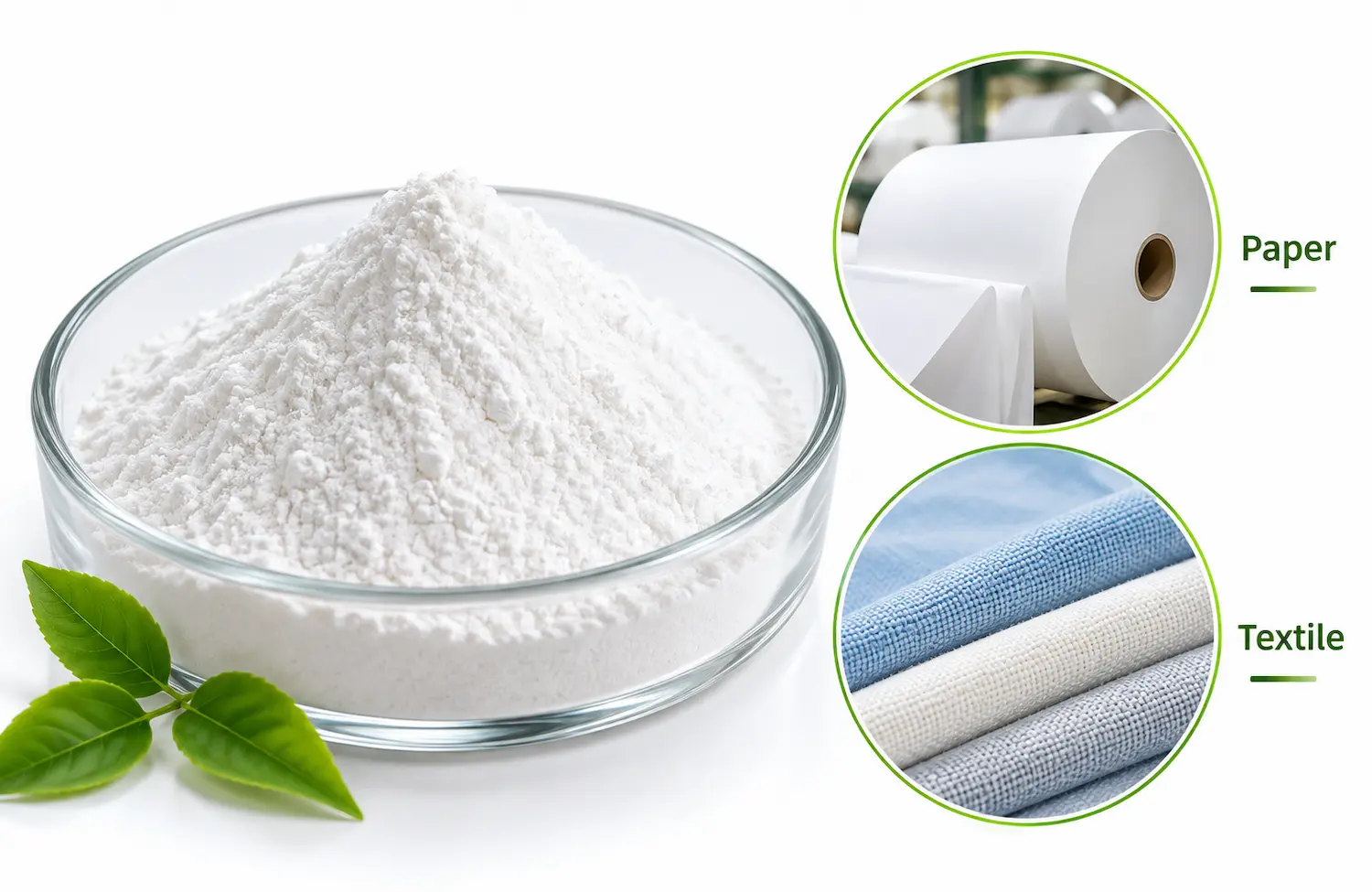
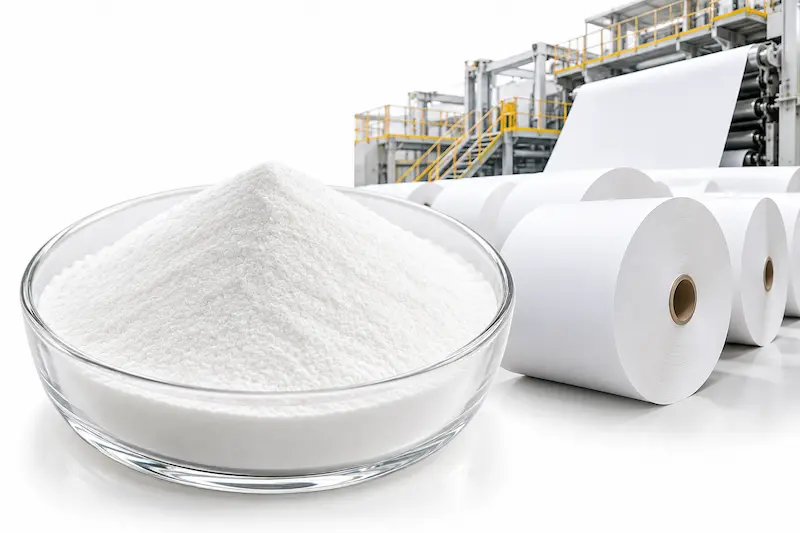
Papermakers need a starch that does something native starch simply cannot: cook down into a thin, easy-to-pump paste at high solids, then dry into a clear, tough, non-brittle film on the paper surface. Native starch resists this — its hot paste stays thick and hard to handle at the concentrations a size press or coater needs, and once dried it tends to retrograde into a stiff, opaque film that cracks rather than flexes. Oxidized starch solves this by controlled chain scission: sodium hypochlorite (or, in some plants, hydrogen peroxide) breaks down the starch molecule and introduces carboxyl and carbonyl groups along the chain, which is why it remains the most widely used modified starch for surface sizing, coating, and paper-product adhesives across the industry.
What Is Oxidized Starch?
From Native Starch to a Low-Viscosity, Anionic Film Former
Oxidized starch (INS/E1404) is produced by treating a native starch slurry — typically corn — with a controlled dose of an oxidizing agent under alkaline conditions. Industrially, sodium hypochlorite is by far the most common oxidant because it is inexpensive, effective, and easy to dose at scale; hydrogen peroxide is used in some plants as an alternative. The oxidant penetrates the granule's amorphous regions and cleaves glycosidic bonds, shortening the starch chains, while simultaneously converting some of the hydroxyl groups on the glucose units into carbonyl and carboxyl groups. The result is a starch that is at once smaller in molecular weight, whiter, and mildly anionic — properties that happen to be exactly what a paper size press or coater needs.
Because the granule structure is broken down through the whole particle rather than resolved into an ungelatinized powder, oxidized starch cooks to a noticeably clearer, lower-viscosity paste than native starch at the same concentration, and that paste stays fluid and stable on cooling instead of setting into a stiff gel. That combination — low, stable viscosity plus a strong, continuous dried film — is what has kept oxidized starch the default choice for paper surface treatment for decades.
Lower-Oxidation Grades
Fewer carboxyl/carbonyl groups introduced, so viscosity stays comparatively higher and film strength is maximized — favored where adhesion and initial tack matter more than flow.Higher-Oxidation Grades
More extensive chain scission gives a thinner, more fluid paste at the same solids, ideal for high-speed size presses and spray applications where pumpability is the priority.The Hypochlorite Oxidation Mechanism
In the sodium hypochlorite route, the starch slurry is first made alkaline. Under these conditions, the hydroxyl groups on the anhydroglucose units are converted into negatively charged alkoxide sites, which then react with the hypochlorite ion to form carbonyl and carboxyl groups while the ring structure at the C2–C3 secondary alcohol positions opens. As the alkaline pH rises, both the starch alkoxide and the hypochlorite ion carry negative charge, and the resulting electrostatic repulsion between the two ions actually slows the reaction — which is why pH control throughout the dosing window is one of the most closely watched process variables, alongside agitation speed, dosing rate, and reaction temperature.
How Oxidized Starch Is Manufactured
A typical sodium hypochlorite oxidation run follows a tightly sequenced process, with pH and temperature held inside a narrow band throughout:
| Step | What Happens |
|---|---|
| 1. Slurry preparation & instrument check | Native starch is slurried in water; the pH probe is confirmed to be inserted and calibrated, and all line valves are checked before any reagent is charged. |
| 2. Alkali pre-adjustment | Dilute alkali (roughly 1.4–1.8% concentration) is added over 20–30 minutes to bring the slurry to pH 8.5–8.6 before oxidant addition begins. |
| 3. Hypochlorite dosing | Sodium hypochlorite is metered in at a controlled rate — while pH stays below 10.0 — with dilute alkali added back in to hold pH between 8.8 and 9.5, and slurry temperature maintained around 40–45°C. Dosage is calculated from the starch dry-basis weight and the available chlorine content of the hypochlorite. |
| 4. Reaction & in-process viscosity control | The reaction is tracked against an in-process viscosity target; once the target is reached, reaction is stopped by adding a small dose of sodium thiosulfate to quench residual oxidant. |
| 5. Neutralization | Dilute hydrochloric acid brings the slurry down to a food/industrial-safe finishing pH of roughly 4.5–5.0. |
| 6. Washing, dewatering & drying | The neutralized starch is washed to remove residual salts and hydrolysis by-products, dewatered, and dried to a controlled moisture level before packaging. |
Key Properties That Matter for Paper Mills
The same oxidation chemistry that shortens the starch chain also delivers a cluster of properties that line up almost perfectly with what a size press, coater, or spray bar needs:
- Whiter, brighter starch: hypochlorite's bleaching action dissolves and washes out residual protein and pigment, so oxidized starch runs noticeably whiter than native starch — and whiter still as the degree of oxidation increases.
- Lower gelatinization temperature and hot paste viscosity: the paste cooks out thinner and at a lower temperature than native starch, with markedly improved thermal stability once cooked.
- Weak retrogradation, stable cold viscosity: the carboxyl groups keep the cooled paste fluid and clear instead of setting into a gel, so viscosity stays predictable through a shift or a size-press run.
- Excellent, high-clarity film formation: dried films are tough, continuous, and highly transparent rather than brittle and opaque, which is exactly the surface finish a printing or writing grade paper needs.
- Strong adhesion at low cost: despite the lower viscosity, bonding strength and initial tack remain high — a large part of why oxidized starch continues to out-compete pricier synthetic binders on cost per tonne of paper produced.
Specifications: What to Check on a COA
An industrial oxidized starch batch intended for papermaking should come with a certificate of analysis covering the following parameters:
| Parameter | Typical Specification |
|---|---|
| Whiteness | ≥ 90 |
| Fineness | ≥ 98% |
| Moisture | ≤ 14% |
| Spot count | ≤ 2.0 |
| pH | 5.5–7.5 (adjustable per customer requirement) |
| Ash | ≤ 2.0% |
| Carboxyl content | ≥ 0.3% |
| Viscosity grade | Low, medium, or high, set to the customer's process — from light oxidation up through high, coating-grade viscosity |
Carboxyl content and viscosity grade are the two numbers worth requesting and matching batch-to-batch: carboxyl content is the practical proxy for how far the oxidation has progressed, and viscosity grade determines whether a batch is suited to spray application, surface sizing, or heavier coating work.
How Oxidized Starch Is Used in Papermaking
Modified starch is used at nearly every stage of the papermaking process, and paper mills generally sort their starch use into four categories:
| Use Category | Typical Starch Type | Role |
|---|---|---|
| Wet-end (internal) addition | Cationic or native starch, sometimes aldehyde-modified oxidized starch | Improves fiber and filler retention, sheet formation, and wet strength |
| Spray starch | Oxidized or native starch | Applied between plies to strengthen interlayer bonding in multi-ply board |
| Surface sizing starch | Oxidized or weakly cationic starch | Applied at the size press to build surface strength, holdout, and printability |
| Coating starch | Oxidized starch (often with synthetic co-binders) | Binder in pigmented coatings for carbonless paper, tube paper, and other coated grades |
Within that framework, oxidized starch is the anionic workhorse — alongside phosphate starch, it's one of the two most common anionic starches on the paper machine, and it earns its place across three specific jobs:
Surface sizing: Oxidized starch's low gelatinization temperature, low viscosity, and strong adhesion make it an ideal surface sizing agent for printing and writing grades, improving the printing and writing surface of the finished sheet.
Coating adhesive: The same clarity and film strength let oxidized starch stand in for more expensive synthetic resins or casein as a coating binder, meaningfully lowering the production cost of coated paper without giving up finish quality.
Wet-end & binder use: Aldehyde-modified oxidized starch added at the wet end improves sheet wet strength, and oxidized starch used as a general adhesive brings high bond strength, strong initial tack, good flowability, and low, non-corrosive consumption — useful for paper-product bonding such as cartons and paper tubes.
Oxidized Starch vs Other Papermaking Starches
Oxidation is one of several ways to modify starch for the paper machine, and each route is suited to a different stage of the process:
| Starch Type | Charge | Effect on Viscosity | Typical Papermaking Use |
|---|---|---|---|
| Oxidized starch | Anionic (mild) | Sharply reduced, stable on cooling | Surface sizing, coating adhesive, spray starch |
| Cationic starch | Cationic | Increases with degree of substitution | Wet-end addition — fiber/filler retention, sheet strength |
| Acid-treated (thin-boiling) starch | Neutral | Sharply reduced, sets into a firmer gel | Surface sizing, corrugating adhesive |
| Phosphate (esterified) starch | Anionic | Reduced gelatinization temperature; good clarity and flow | Surface sizing, some coating use |
| Native starch | Neutral | High, unstable on cooling | Limited direct use — usually converted before use on the paper machine |
Economic & Quality Benefits for Paper Mills
Beyond the chemistry, mills adopt oxidized and other modified starches because the returns show up directly on the paper machine and the balance sheet:
- Physical strength & furnish cost: raises paper strength properties and grade quality, allowing a lower wood pulp ratio in the furnish.
- Retention & process efficiency: improves retention of fines and fillers, lifting ash content, brightness, and opacity while cutting energy use, wet-end breaks, and effluent load.
- Sizing economy: improves sizing performance and reduces sizing-agent consumption, particularly valuable as a companion additive in neutral papermaking.
- Printability: reduces web breaks, linting, dusting, and blanket piling during printing, and increases ink absorption for sharper, more vivid print.
- Cost substitution: replaces costlier synthetic resin or casein binders in surface sizing and coating, lowering the cost of coated paper production.
- Paper-product adhesion: serves as a strong, low-cost, low-pollution adhesive for converted paper products such as cartons and paper tubes.
Supplier & Sourcing Insights for Bulk Procurement
Consistent sizing and coating performance batch after batch depends as much on supplier process control as on the spec sheet.
| Supplier Attribute | What to Verify | WEHENGFOOD Standard |
|---|---|---|
| Carboxyl & Viscosity Consistency | Batch-specific COA with carboxyl content, viscosity grade, and whiteness | COA provided with every shipment |
| Whiteness Stability | Consistent brightness across seasons and storage conditions | Process controls to hold whiteness stable in warm-weather production |
| Moisture Control | Dry, well-sealed packaging to prevent caking in transit and storage | Moisture held at or below 14%, moisture-resistant packaging |
| Minimum Order Quantity | Flexibility for trial batches vs. full-container runs | Trial orders available up to full 20' FCL bulk supply |
| Technical Support | Grade recommendation matched to your size press, coater, or spray application | Dedicated technical support for grade and viscosity matching |
Conclusion
Oxidized starch solves the same underlying problem for paper mills that it solves for food and textile processors: it lets a controlled, cost-effective oxidation step convert an unruly, high-viscosity native starch into a paste that flows and pumps easily, then dries into a clear, strong, flexible film. The carboxyl and carbonyl groups introduced during hypochlorite (or peroxide) oxidation are what drive nearly every downstream benefit — whiteness, low stable viscosity, weak retrogradation, and film clarity — which is why carboxyl content and viscosity grade, not just the product name, are what determine whether a batch performs on your size press or coater. Working with a supplier that documents both on every shipment, and can help match an existing sizing or coating formulation, is what keeps paper quality consistent at scale.
FAQ
What's the difference between oxidized starch and cationic starch for papermaking?
Oxidized starch is mildly anionic and used mainly for surface sizing, coating, and spray applications, where its low, stable viscosity and strong film formation matter most. Cationic starch is used at the wet end, where its positive charge lets it bind strongly to negatively charged fiber and filler, improving retention and sheet strength. Many mills use both, at different points in the process.
Why does oxidized starch sometimes turn yellow during drying or storage?
Oxidized starch is more heat-sensitive than native starch, and yellowing during drying or long-term storage is linked to aldehyde-group content increasing over time, particularly at high drying temperatures or elevated humidity. Requesting a batch with a fresher production date and following recommended storage conditions minimizes this.
What information should I send a supplier to match my current sizing or coating formulation?
Ideally your target viscosity grade (low/medium/high) and carboxyl content range, or a sample of your current starch. At minimum, describe whether the starch is going to a size press, a spray bar, or a pigmented coating line, along with your typical solids and application temperature.
Source Oxidized Starch in Bulk
WEHENGFOOD supplies COA-verified Oxidized Starch for paper mills and converters, with consistent whiteness, carboxyl content, and viscosity grading, and flexible order quantities from trial batches to full-container bulk supply. Our team can help match your current surface sizing or coating formulation, or develop a custom viscosity grade for your application.
Request a Free Sample & QuoteReferences
- Kuakpetoon, D. & Wang, Y.-J. Characterization of different starches oxidized by hypochlorite. Starch – Stärke, 53(5).
- Wurzburg, O.B. (Ed.). Modified Starches: Properties and Uses. CRC Press.
- TAPPI Press. Starch and starch derivatives in surface sizing and coating for paper and paperboard. TAPPI technical resources.
- Wang, Y.-J. & Wang, L. Physicochemical properties of common and waxy corn starches oxidized by different levels of sodium hypochlorite. Carbohydrate Polymers.
- Roquette Innovation Hub. Anionic and oxidized starches for paper surface treatment and coating applications. roquette.com.
- China Paper Industry Technical Association. Application practices of modified starch in papermaking: internal addition, spray, surface sizing, and coating. Industry technical proceedings.