
CSL vs SSL: Key Differences Between Calcium and Sodium Stearoyl Lactylate
WEHENGFOOD supplies bulk food-grade Calcium Stearoyl Lactylate (CSL) and Sodium Stearoyl Lactylate (SSL) for bakery, noodle, frozen dough, and dairy-alternative manufacturers. For product specifications, samples, pricing, or bulk orders, please contact us at nancy@wehengfood.com.
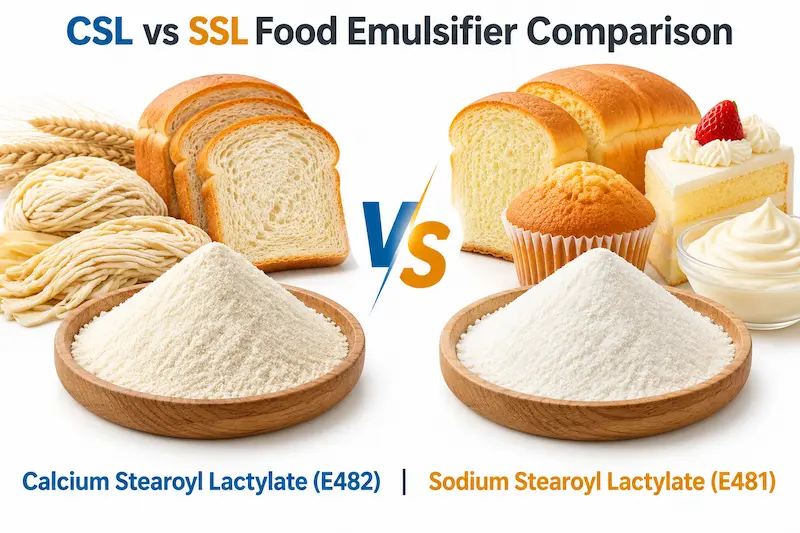
Open a bakery ingredient list and you will often find one of two similar-looking names: calcium stearoyl lactylate or sodium stearoyl lactylate. Both are anionic emulsifiers made from stearic acid and lactic acid, both look like creamy-white powders with a mild caramel note, and both are used to strengthen dough, soften crumb, and slow staling. So why do formulators keep both on the shelf? Because the metal ion attached to the molecule — calcium in one, sodium in the other — changes the HLB value, the acid tolerance, the strength of the gluten effect, and the sodium load of the finished product. This guide compares the two side by side so you can pick the right one for your formula.
What Are CSL and SSL?
Two Salts of the Same Emulsifier Family
Calcium stearoyl lactylate (CSL, INS/E482) and sodium stearoyl lactylate (SSL, INS/E481) are the calcium and sodium salts of stearoyl lactylic acid. In both molecules a stearic acid (C17H35CO–) tail is joined through an ester bond to a short lactic acid chain, and the acidic end is neutralized with either Ca or Na. That fatty tail is what interacts with starch and lipids, while the ionic head interacts with water and gluten proteins.
Both products appear as white to creamy-white powder (SSL may also be supplied as granules). They disperse well in hot water, dissolve in ethanol and hot fats, and have a pleasant caramel-like aroma. Both are classified as anionic emulsifiers[1].
CSL — Calcium Salt
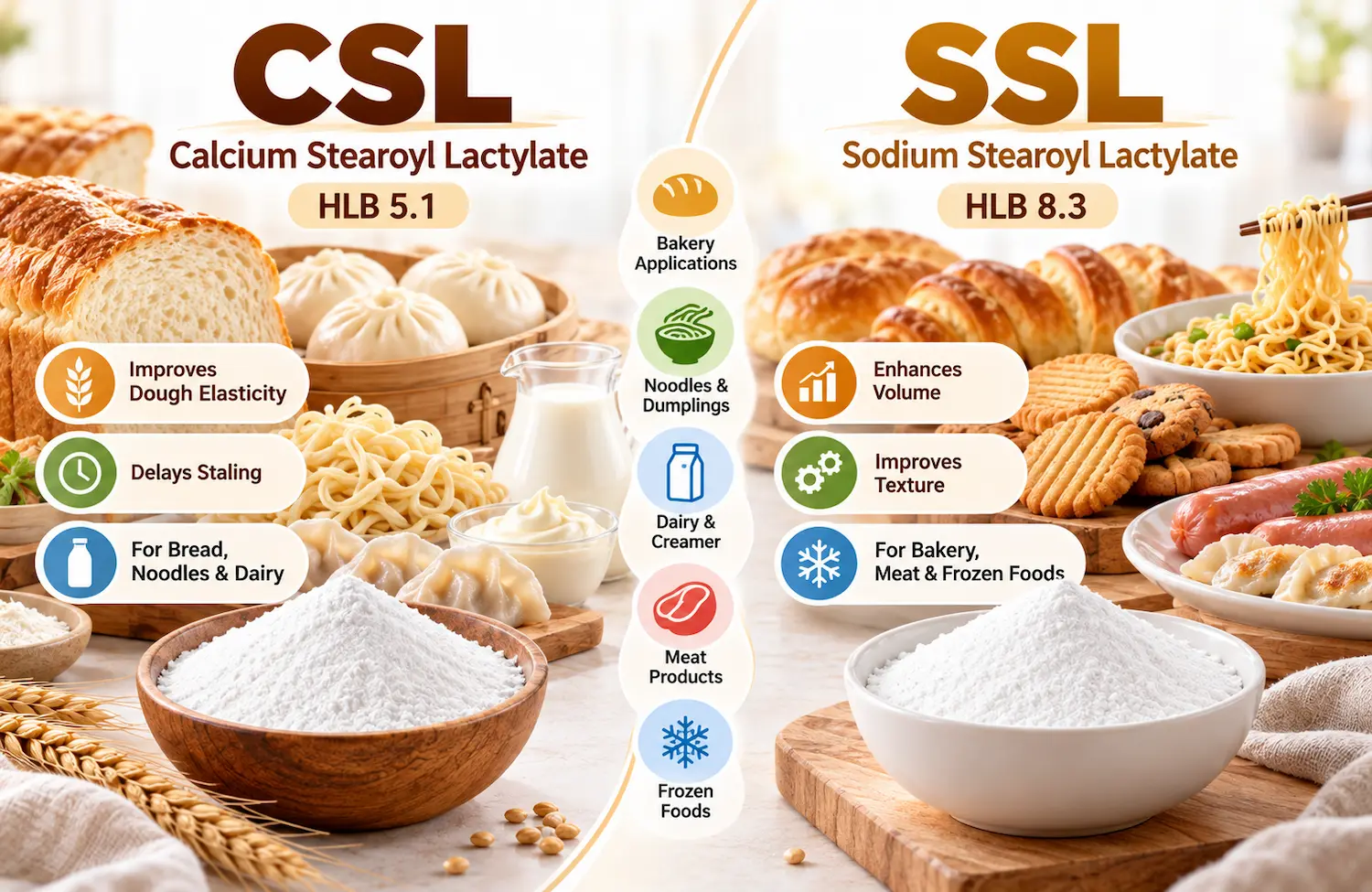
Two stearoyl lactylate chains bound to one Ca2+ ion. Lower HLB of about 5.1, so it leans fat-loving (lipophilic) and is prized for strong gluten reinforcement.SSL — Sodium Salt
One stearoyl lactylate chain with a Na+ counter-ion. Higher HLB of about 8–9 (often quoted as 8.3), so it is more balanced and works in both dough and oil-in-water systems.CSL vs SSL: Key Differences at a Glance
The table below summarizes the practical differences most often raised by bakery and noodle technologists:
| Characteristic | Calcium Stearoyl Lactylate (CSL) | Sodium Stearoyl Lactylate (SSL) |
|---|---|---|
| Ion type | Calcium ion (Ca²⁺) | Sodium ion (Na⁺) |
| HLB value | About 5.1 | About 8–9 (typically 8.3) |
| Dough strengthening | Stronger — well suited to high-gluten or whole-wheat dough | Moderate — a general-purpose option |
| pH adaptability | More acid-tolerant — suited to acidic foods such as yogurt-based products | More stable in neutral to slightly alkaline systems |
| Health positioning | Suits low-sodium foods, e.g. reduced-salt bread | Contains sodium — use with care where sodium intake must be controlled |
| Appearance | Creamy-white powder | Creamy-white powder or granules |
Properties & Appearance
Both emulsifiers are easy to handle as dry powders, but their behavior in the mixing bowl differs slightly:
| Property | CSL | SSL |
|---|---|---|
| Form & color | Creamy-white powder | White to creamy-white powder or granules |
| Solubility | Disperses well in hot water; soluble in ethanol and hot fats | Disperses well in hot water; soluble in ethanol and hot fats |
| Odor | Mild, pleasant caramel note | Mild, pleasant caramel note |
| Emulsifier type | Anionic | Anionic |
| HLB | 5.1 | 8–9 (8.3 in many spec sheets) |
Note that SSL HLB values vary slightly between suppliers and specification sheets — you will see anything from 8 to 9 quoted — because the exact figure depends on the lactylate chain length and neutralization level of the batch.
What They Do in Bread, Noodles & Frozen Foods
Because they share the stearoyl lactylate backbone, CSL and SSL deliver a very similar list of benefits. Where they differ is the magnitude of the gluten effect and the food systems they suit best.
- Stronger, more elastic dough: improves dough elasticity, toughness, and gas retention, which increases loaf and steamed-bun volume and improves crumb structure.
- Anti-staling: interacts with linear starch (amylose) to delay retrogradation and slow down hardening of bread and buns.
- Better biscuit and cracker release: makes biscuit dough easier to demold, with a neat appearance, clear layers, and a crisp bite.
- Noodle quality: gives noodles, instant noodles, and dry noodles a smoother surface, lower breakage, better boil and soak tolerance, and a chewier texture.
- Frozen food quality: improves structure in quick-frozen foods such as dumplings, reducing surface cracking and filling leakage.
- Dairy-alternative emulsification: SSL, with its higher HLB, emulsifies fat well in non-dairy creamers and helps form a stable oil-in-water system.
Both ingredients are also listed for use in milk products, non-dairy creamer, artificial and fresh cream, meat products, and the emulsification of animal and vegetable oils[1]. In spicy snack applications, CSL is noted for giving a springy, tender chew and helping extend freshness.
Usage Method & Recommended Dosage
The application method is the same for both emulsifiers, and good dispersion matters more than which salt you use:
| Method | How to Apply | Best For |
|---|---|---|
| 1. Dry blend | Mix the emulsifier directly and evenly into the flour. | Simple, fast production lines |
| 2. Paste pre-dispersion | Add the emulsifier to about 6 times its weight of warm water at around 60°C to form a paste, then add to the flour in proportion. This usually gives a better effect. | Maximum dough-strengthening performance |
| 3. Heat emulsification | For creamers and similar systems, heat the emulsifier together with the phase to be emulsified until uniform, then continue processing. | Non-dairy creamer, fat emulsions |
How to Choose Between CSL and SSL
| If Your Formula Is... | Consider | Why |
|---|---|---|
| High-gluten or whole-wheat dough | CSL | Stronger gluten reinforcement for volume and structure |
| Acidic food (e.g. yogurt-type products) | CSL | Better tolerance of lower pH |
| Low-sodium or reduced-salt bread | CSL | Adds calcium rather than sodium |
| General-purpose bread, buns, noodles | SSL | Moderate, versatile effect at a familiar dosage |
| Neutral to slightly alkaline system | SSL | More stable at neutral to weakly alkaline pH |
| Non-dairy creamer or oil-in-water emulsion | SSL | Higher HLB forms oil-in-water emulsions more readily |
In practice, many bakers run a small bench trial with both salts — and sometimes a blend — at the same dosage, then compare loaf volume, crumb softness after 48–72 hours, and label impact. Differences are often easier to see in the finished product than on paper.
Application Scenarios
Bread & Steamed Buns: increase volume, improve crumb structure, and keep the product softer for longer. Use CSL for strong flour or reduced-sodium bread, and SSL for everyday formulas.
Noodles, Instant Noodles & Dumpling Wrappers: a smoother surface, reduced breakage, and better cooking tolerance for a firmer, chewier bite.
Biscuits & Crackers: easier demolding, a neat shape, distinct layers, and a crisp texture.
Frozen Dough & Quick-Frozen Foods: better structure and fewer cracks in dumplings and filled products, which reduces leakage of the filling.
Non-Dairy Creamer, Cream & Meat Products: SSL in particular helps emulsify fat into water to form a stable oil-in-water system.
Supplier & Sourcing Insights for Bulk Procurement
Emulsifier performance is sensitive to batch consistency, so supplier documentation matters as much as price.
| Supplier Attribute | What to Verify | WEHENGFOOD Standard |
|---|---|---|
| Specification & COA | Batch-specific COA with acid value, ester value, and calcium or sodium content | COA provided with every shipment |
| Regulatory Fit | Grade and labeling suitable for your target market (E481/E482, local standards) | Documentation support on request |
| Packaging | Moisture-resistant packaging to prevent caking in storage | Sealed, moisture-resistant packing |
| Minimum Order Quantity | Flexibility for trial batches vs. full-container runs | Trial orders available up to full-container bulk supply |
| Technical Support | Help selecting CSL, SSL, or a blend for your flour and process | Dedicated technical support for formulation matching |
Conclusion
CSL and SSL belong to the same emulsifier family and overlap heavily in function, but they are not interchangeable in every formula. CSL, with its lower HLB and calcium ion, is the stronger dough strengthener and the natural fit for acidic or low-sodium products. SSL, with its higher HLB and sodium ion, is the versatile all-rounder that also excels in oil-in-water systems such as creamers. Matching the salt to your dough strength, pH, and label goals — and confirming the permitted dosage in your market — is the simplest way to get consistent volume, softness, and shelf life.
FAQ
What is the main difference between CSL and SSL?
CSL is the calcium salt (HLB about 5.1) and SSL is the sodium salt (HLB about 8–9). CSL is generally chosen for stronger dough strengthening, acidic foods, and low-sodium products, while SSL is a versatile, general-purpose choice that also suits oil-in-water systems such as non-dairy creamers.
Can CSL and SSL be used together?
Yes. Both are anionic emulsifiers with similar dough-conditioning functions, so bakers often blend them or combine them with other emulsifiers. Run a bench trial to fine-tune the ratio for your flour and process.
What is the recommended dosage of CSL or SSL?
A typical supplier recommendation is 0.2%–1.0% of flour weight, referencing GB 2760-2014 in China. Always confirm the permitted level and food categories in your own market.
Which one is better for low-sodium bread?
CSL, because it contributes calcium instead of sodium, which helps when you are trying to keep the total sodium in the formula down.
Source CSL and SSL in Bulk
WEHENGFOOD supplies COA-verified Calcium Stearoyl Lactylate (CSL) and Sodium Stearoyl Lactylate (SSL) for bakery, noodle, frozen food, and creamer manufacturers, with consistent quality, moisture-resistant packaging, and flexible order quantities from trial batches to full-container bulk supply. Our team can help you choose the right emulsifier for your formula.
Request a Free Sample & QuoteReferences
- WEHENGFOOD technical data sheets for calcium stearoyl lactylate (CSL) and sodium stearoyl lactylate (SSL): properties, applications, usage methods, and recommended dosage.
- GB 2760-2014, National Food Safety Standard for Uses of Food Additives (China).
- JECFA specifications for calcium stearoyl-2-lactylate (INS 482) and sodium stearoyl lactylate (INS 481), FAO/WHO.
- U.S. FDA, 21 CFR 172.844 (calcium stearoyl-2-lactylate) and 21 CFR 172.846 (sodium stearoyl lactylate).
- Regulation (EC) No 1333/2008 on food additives (E481, E482), European Union.