
Understanding HLB Value in Food Emulsifiers: A Complete Buyer's Guide
WEHENGFOOD supplies a full range of food-grade emulsifiers — including DATEM and Distilled Monoglycerides (DMG) — across the full HLB spectrum. For product specifications, samples, pricing, or bulk orders, please contact us at nancy@wehengfood.com.
If you have ever compared two food emulsifier data sheets and wondered why one is labeled "HLB 3–4" while another says "HLB 8–9," you have already run into one of the most useful — and most misunderstood — numbers in emulsifier selection. HLB, short for Hydrophilic-Lipophilic Balance, is a simple index that tells a formulator how an emulsifier will behave in a real food system: whether it prefers water, prefers oil, and which type of emulsion it is naturally suited to stabilize. Getting the HLB range right before you even run a trial batch can save weeks of reformulation time, which is exactly why we put together this practical guide for ingredient buyers and R&D teams.
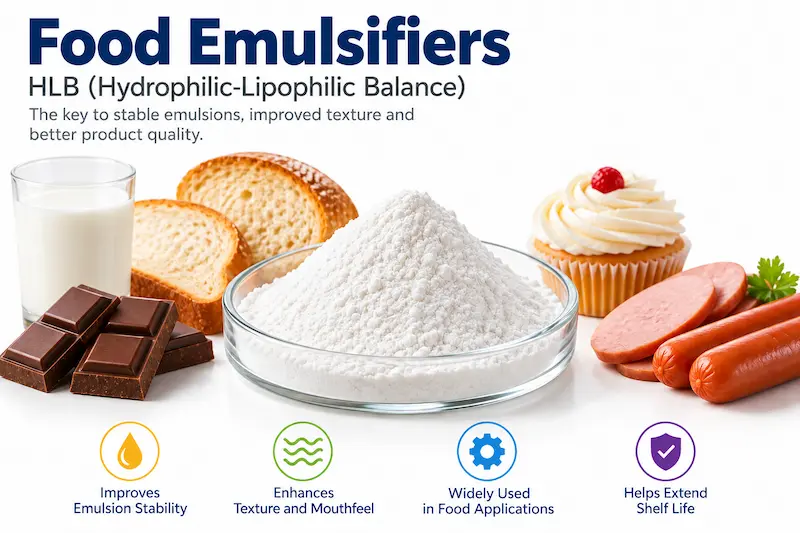
What Is HLB Value, and Why Does It Matter?
Hydrophilic Head, Lipophilic Tail
A food emulsifier is a food additive that significantly lowers the interfacial tension between oil and water, allowing two normally immiscible phases to form a stable emulsion. Structurally, every emulsifier molecule carries two very different parts: a hydrophilic head (a water-loving group, typically -OH) that dissolves or is wetted by water, and a lipophilic tail — usually a long hydrocarbon chain — that mixes readily with fats and oils. Put simply, an emulsifier is an organic compound whose molecule sits comfortably at the boundary between oil and water, pulling both phases together into a stable mixture instead of letting them separate.
An emulsifier's ability to emulsify is directly tied to the relative strength of these two parts — in other words, to how many hydrophilic groups versus lipophilic groups its molecule carries. HLB value is simply the number that quantifies that balance.
Hydrophilic Group
Water-loving portion of the molecule (e.g. -OH), which is soluble in or readily wetted by water.Lipophilic Group
A long hydrocarbon fatty-acid chain that is miscible with oils and fats.The HLB Scale: 0 to 20 Explained
By convention, an emulsifier that is 100% lipophilic (oil-loving) is assigned an HLB value of 0, while one that is 100% hydrophilic (water-loving) is assigned a value of 20. Everything in between is divided into twenty equal parts on this 0–20 scale to describe the relative strength of an emulsifier's hydrophilic and lipophilic character, and to indicate what kind of application it is best suited for.
This single number explains why the emulsion type formed in a food system is not just a formulation choice but a physical outcome of chemistry. An emulsion is a multi-phase system in which one liquid is dispersed as droplets throughout another, immiscible liquid. If oil droplets are dispersed within a continuous water phase, the system is called an oil-in-water (O/W) emulsion — milk and soy milk are everyday examples. If water droplets are dispersed within a continuous oil phase instead, the system is a water-in-oil (W/O) emulsion — margarine is the classic case. Which type forms is largely governed by the HLB value of the emulsifier used: higher-HLB emulsifiers favor O/W systems, while lower-HLB emulsifiers favor W/O systems.
HLB Value Ranges and Their Typical Applications
Food formulators generally use the following HLB ranges as a starting reference point when screening emulsifiers for a new application:
| HLB Value | Typical Application |
|---|---|
| 1 – 3 | Defoaming agent |
| 3 – 6 | W/O (water-in-oil) emulsifier |
| 6 – 17 | O/W (oil-in-water) emulsifier |
| 13 – 15 | Detergent / cleaning agent |
| 15 and above | Solubilizer |
Of course, because real food systems are chemically complex, HLB value alone cannot decide everything — but knowing an emulsifier's HLB range gives you a reliable starting point for its likely field of use, before you even look at dosage, temperature, or which other ingredients it needs to be compatible with.
Matching HLB Value to Real Emulsifiers
To make this more concrete, here is how HLB value plays out with two emulsifiers we supply regularly:
Lower HLB, W/O Territory: Distilled Monoglycerides (DMG)
Our Distilled Monoglycerides (DMG) carry an HLB value in the roughly 3.8–5.3 range, placing them solidly in W/O emulsifier territory. This is exactly why DMG performs so well in margarine, shortening, and powdered fats, where it needs to control and stabilize fat crystallization, prevent oil separation, and complex with starch to slow staling in bread and cake. In ice cream, the same lipophilic character helps prevent the formation of large ice crystals and keeps the texture fine and smooth.
Higher HLB, Bridging Into O/W: DATEM
By contrast, Diacetyl Tartaric Acid Esters of Mono and Diglycerides (DATEM) sit at a noticeably higher HLB value, generally cited in the 6–9 range depending on the grade. That hydrophilic shift is what allows DATEM to strengthen gluten networks and dough gas-holding capacity in bread and steamed bread, smooth out fresh cream, and stabilize butter and concentrated butter against oil separation — functions that need an emulsifier comfortable working from the water side of the interface, not just the oil side.
Beyond Emulsification: Other HLB-Driven Roles
Emulsification is the headline function, but the hydrophilic-lipophilic character behind HLB also drives several secondary roles that matter in real production:
- Starch and protein interaction: forming complexes with starch to delay retrogradation, keeping flour products soft and fresh longer, and strengthening the protein network in dough for better volume and crumb structure.
- Viscosity control: acting as a release agent for biscuits or reducing the viscosity of chocolate mass for easier processing.
- Wetting and dispersion: improving the dispersibility, suspension, and instant-solubility of milk powder, malted drinks, and powdered beverages.
- Crystallization control: refining cocoa butter crystals in chocolate, slowing ice crystal growth in ice cream, and preventing unwanted fat crystallization in margarine — typically the job of a lower-HLB emulsifier.
- Solubilization: emulsifiers with HLB above 15 can act as solubilizers for oil-soluble colors and flavors, and are also used as demulsifiers.
Because different emulsifiers — or even the same emulsifier under different processing conditions — can perform quite differently, and because blends of two or more emulsifiers are extremely common in commercial formulations, the practical approach is always to select and, where useful, combine food emulsifiers based on the specific food category, processing conditions, and method, using HLB value as your compass rather than your final answer.
A Sourcing Checklist for HLB Selection
When you are evaluating suppliers or comparing technical data sheets, HLB value is one of the fastest ways to sanity-check whether a proposed emulsifier is even in the right family for your application.
| Step | What to Check |
|---|---|
| 1. Confirm emulsion type | Decide whether your target system is O/W or W/O, and choose an HLB range accordingly. |
| 2. Check ionic type | Anionic (e.g. SSL, CSL) vs. non-ionic (e.g. DATEM, DMG) emulsifiers can differ in compatibility with other ingredients even at similar HLB. |
| 3. Confirm dosage range | Request the supplier's recommended dosage, usually referenced against a national food additive standard such as GB 2760. |
| 4. Request a COA | Acid value, saponification value, and HLB should be documented on every batch, not just the technical data sheet. |
| 5. Run a small trial | HLB gets you to the right neighborhood, but final performance still needs to be validated in your own formulation. |
Conclusion
HLB value is the fastest way to translate an emulsifier's chemistry into a practical prediction of how it will behave in your product — whether it will favor an O/W or W/O emulsion, and roughly where it fits among defoamers, emulsifiers, detergents, and solubilizers on the 0–20 scale. It is not the whole story: food systems are complex enough that final selection still comes down to trial batches, dosage, and compatibility with your other ingredients. But starting from the right HLB range — as with DMG on the lipophilic end and DATEM further toward the hydrophilic side — is what keeps formulation work efficient instead of a long process of trial and error.
FAQ
What does a higher HLB value mean in practice?
A higher HLB value means the emulsifier is more hydrophilic (water-loving). Emulsifiers above roughly HLB 6 are generally suited to oil-in-water (O/W) emulsions, and those above HLB 15 can act as solubilizers for oil-soluble flavors, colors, or vitamins.
Can two emulsifiers with different HLB values be blended?
Yes — blending a higher-HLB and a lower-HLB emulsifier is a common way to fine-tune an intermediate HLB value and achieve a specific emulsion stability or texture that a single emulsifier can't deliver on its own.
Does HLB value alone guarantee an emulsifier will work in my formulation?
No. HLB is a strong starting filter, but final performance also depends on dosage, processing temperature, the ionic type of the emulsifier, and compatibility with other ingredients in the system. A small-batch trial is always recommended before scaling up.
Source Food Emulsifiers Across the HLB Spectrum
WEHENGFOOD supplies a full range of food emulsifiers — including DATEM, Distilled Monoglycerides (DMG), SSL, CSL, GMS, PGE, and PGPR — with technical data sheets and application support for bakery, dairy, confectionery, and meat products. Our team can help match the right HLB range to your formulation.
Request a Free Sample & QuoteReferences
- Griffin, W.C. (1949). Classification of Surface-Active Agents by "HLB". Journal of the Society of Cosmetic Chemists, 1, 311–326.
- Griffin, W.C. (1954). Calculation of HLB Values of Non-Ionic Surfactants. Journal of the Society of Cosmetic Chemists, 5, 249–256.
- McClements, D.J. Food Emulsions: Principles, Practices, and Techniques. CRC Press.
- National Health Commission of the People's Republic of China. GB 2760, National Food Safety Standard for the Use of Food Additives.
- FAO/WHO Joint Expert Committee on Food Additives (JECFA). Compendium of Food Additive Specifications.