
Hydroxypropyl Distarch Phosphate: What's the Difference Between Hot-Swelling and Cold-Swelling Grades?
WEHENGFOOD supplies bulk food-grade Hydroxypropyl Distarch Phosphate for sauces, dairy, and convenience-food manufacturers. For product specifications, samples, pricing, or bulk orders, please contact us at nancy@wehengfood.com.
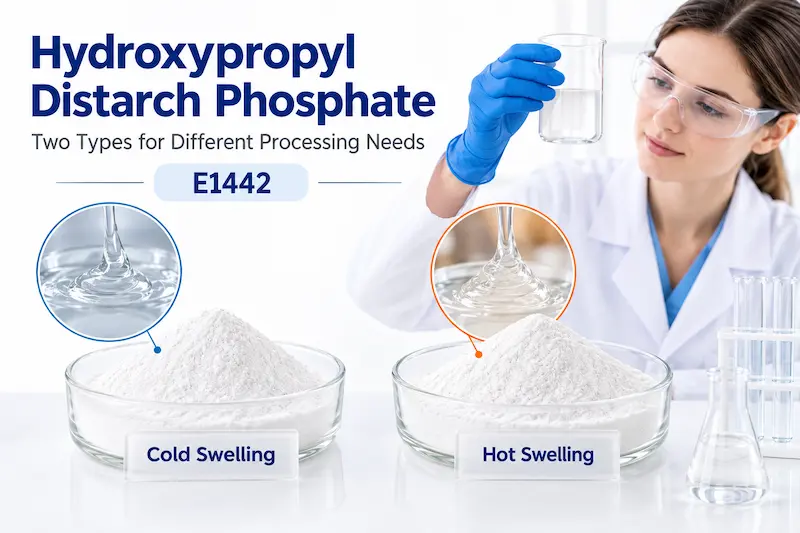
Hydroxypropyl distarch phosphate (E1442) shows up on ingredient lists across sauces, dairy, soups, and frozen foods for one reason: it thickens reliably even under heat, acid, and repeated freeze-thaw cycles that would break down native starch. But not every batch of E1442 behaves the same way in the mixing tank. Depending on how it was finished at the factory, the same chemistry can either require cooking to thicken — the standard, "hot-swelling" form — or thicken straight into cold or room-temperature liquid, the pre-gelatinized "cold-swelling" form. Choosing the wrong one for your process is one of the most common reasons a formulator gets an unexpected viscosity result on the plant floor.
What Is Hydroxypropyl Distarch Phosphate?
A Dual-Modified, Cross-Linked and Etherified Starch
Hydroxypropyl distarch phosphate is produced by modifying native starch — commonly corn, tapioca, or waxy maize — in two steps at once: cross-linking with a phosphorylating agent (sodium trimetaphosphate or phosphorus oxychloride) to bridge starch chains together, and etherification with propylene oxide to attach hydroxypropyl side groups[1][2]. The cross-linking reinforces the granule against heat, acid, and mechanical shear during processing, while the hydroxypropyl groups lower the gelatinization temperature and keep the finished paste clear, soft, and resistant to retrogradation (re-thickening or weeping on standing).
In its unmodified physical form, E1442 is a white to off-white powder with a mild starch odor. It is insoluble in fats and ethanol, and — critically for how it performs in a formulation — its behavior in water depends entirely on whether the granule has been pre-cooked at the factory or left in its native, ungelatinized state[3][4].
Cross-Linking (Phosphate Bridge)
Links neighboring starch chains together, giving the granule mechanical strength against acid, heat, and shear — the reason E1442 survives retort cooking and high-shear mixing where native starch would break down.Hydroxypropylation (Ether Group)
Attaches bulky hydroxypropyl groups that push chains apart, lowering the cooking temperature needed and improving clarity, softness, and freeze-thaw stability of the finished paste.Hot-Swelling vs Cold-Swelling: The Core Difference
The cross-linking and hydroxypropylation chemistry is identical between the two forms. What differs is a separate, physical finishing step: whether the modified starch is dried in its native granular state or is further gelatinized and dried (pre-gelatinized) before it leaves the factory.
| Hot-Swelling (Standard) E1442 | Cold-Swelling (Pre-Gelatinized) E1442 | |
|---|---|---|
| Physical form | Intact, ungelatinized granule — fine white powder | Pre-cooked and re-dried — often flakes or a coarser, amorphous powder[5] |
| How it thickens | Must be heated to its gelatinization point (commonly in a 60–95°C range depending on grade) to swell and build viscosity | Disperses and swells directly in cold or room-temperature water without any cooking step |
| Typical process fit | Any product that is already cooked, retorted, or heat-processed as part of the recipe | No-cook, cold-mix, or heat-sensitive formulations |
| Viscosity development | Builds during cooking and continues to set as the product cools | Builds almost immediately on mixing/hydration |
| Common use case | Sauces, gravies, soups, retorted and canned goods, cooked dairy | Instant desserts, cold-prepared dressings and dips, cold-process mayonnaise, powdered mixes reconstituted with cold water[6] |
Both swelling types are well-established, industrial-scale product lines — global starch producers such as Ingredion and Roquette each offer hot-swelling and pre-gelatinized cold-swelling hydroxypropyl distarch phosphate grades under their own branded product ranges, which is part of why the hot-swelling/cold-swelling distinction has become a standard spec question across the industry rather than a niche one. WEHENGFOOD manufactures both swelling types to the same functional profile, giving buyers a cost-competitive alternative sourcing route without changing the process parameters they've already validated against those major brands.
Why the Swelling Type Changes Your Process
Specifying the wrong swelling type is one of the most common causes of an unexpected viscosity outcome on a production line:
- Using hot-swelling starch in a cold-mix process results in little to no thickening, because the granules never reach the temperature needed to gelatinize — the starch simply stays suspended, undissolved, in the mix.
- Using cold-swelling starch in a cooked process can cause premature, uneven thickening before the batch reaches full temperature, which risks scorching, uneven heat transfer, or an over-thick product before cooking is complete.
- Reformulating from a cooked to a no-cook product (or vice versa) almost always requires switching swelling type, not just adjusting dosage.
Specifications & Functional Properties
| Property | Typical Value / Behavior |
|---|---|
| Appearance | White to off-white powder (granular for hot-swelling; flake/coarse powder for pre-gelatinized cold-swelling) |
| Solubility | Insoluble in fats and ethanol; hot-swelling type dissolves/gelatinizes in hot water, cold-swelling type swells in cold or warm water[3][4] |
| Stability | Stable to heat, acid, alkali, and starch-degrading enzymes |
| Freeze-thaw performance | Good to excellent; helps maintain texture, color, and gloss after freezing and thawing |
| Functional roles | Thickener, stabilizer, emulsion stabilizer, binder |
Matching the Grade to Your Application
| Application | Recommended Swelling Type |
|---|---|
| Retorted/canned sauces & gravies | Hot-swelling |
| Cooked cream-style soups | Hot-swelling |
| Fruit pie fillings (baked) | Hot-swelling |
| Instant pudding / no-cook desserts | Cold-swelling |
| Cold-process mayonnaise & dressings | Cold-swelling |
| Powdered mixes reconstituted with cold water | Cold-swelling |
| Yogurt & cultured dairy (added before culturing/heat step) | Hot-swelling |
Formulation & Dosage Guidance
Dosage is driven by the finished viscosity target and the rest of the formulation rather than by swelling type alone, but typical starting ranges are similar between the two forms since the underlying chemistry is the same:
| Component | Typical Dosage | Note |
|---|---|---|
| Hydroxypropyl Distarch Phosphate | 1%–5% of formulation | Adjust within range based on target viscosity and the presence of other hydrocolloids |
| Cook temperature (hot-swelling grades) | Approx. 60–95°C, grade-dependent | Confirm the specific grade's gelatinization range with your supplier before scale-up |
| Hydration time (cold-swelling grades) | A few minutes with adequate agitation | Good dispersion at the point of addition avoids lumping |
Supplier & Sourcing Insights for Bulk Procurement
| Supplier Attribute | What to Verify | WEHENGFOOD Standard |
|---|---|---|
| Swelling Type on Spec Sheet | Explicit confirmation of hot-swelling vs pre-gelatinized cold-swelling | Clearly labeled by grade, confirmed before shipment |
| Certifications | ISO9001, ISO22000, Kosher, Halal status | Full certification package available on request |
| Batch Consistency | COA with viscosity behavior and moisture per batch | COA provided with every shipment |
| Minimum Order Quantity | Flexibility for trial batches vs. full-container runs | Trial orders available up to full 20' FCL bulk supply |
| Technical Support | Grade recommendation matched to cooked vs. no-cook process | Dedicated technical support for application matching |
Conclusion
Hot-swelling and cold-swelling hydroxypropyl distarch phosphate share the same cross-linked, hydroxypropylated chemistry and the same resistance to heat, acid, and freeze-thaw stress — the only difference is whether the granule was pre-gelatinized before drying. That single finishing step determines whether the starch needs a cook step to build viscosity or thickens directly in cold liquid, which makes it the first spec to confirm, not the last, when selecting E1442 for a new or reformulated product.
FAQ
Can I substitute cold-swelling E1442 wherever hot-swelling E1442 is used?
Not directly. Because cold-swelling grades are pre-gelatinized, adding them to a batch that is about to be cooked can cause premature, uneven thickening before the process reaches temperature. Swap between the two only after confirming the impact on your specific cook profile.
Does pre-gelatinization (cold-swelling) reduce E1442's stability?
No — the cross-linked, hydroxypropylated backbone that gives E1442 its heat, acid, and freeze-thaw stability is unaffected by whether the granule is pre-cooked. Pre-gelatinization changes when and how it swells, not the underlying stability of the modified starch.
What should I tell a supplier to get the right grade for my process?
State clearly whether your product goes through a cook, retort, or heat-processing step before or after the starch is added, plus your target viscosity and any freeze-thaw requirement. That's enough for a supplier to recommend hot-swelling or cold-swelling E1442 and the appropriate dosage.
Source Hydroxypropyl Distarch Phosphate in Bulk
WEHENGFOOD supplies COA-verified Hydroxypropyl Distarch Phosphate for sauces, dairy, and convenience-food manufacturers, with clearly specified hot-swelling and cold-swelling grades, ISO9001/ISO22000/Kosher/Halal certification, and flexible order quantities from trial batches to full-container bulk supply. Our team can help match your current cooked or no-cook process.
Request a Free Sample & QuoteReferences
- Guide on uses of hydroxypropyl distarch phosphate (E1442) in the food industry: manufacturing via esterification and etherification, and functional stability. LinkedIn / industry technical guide, 2023.
- Hydroxypropyl distarch phosphate (E1442): properties, uses, and Codex GSFA regulatory scope. LinkedIn / industry technical guide, 2023.
- Hydroxypropyl Distarch Phosphate (E1442) uses and properties: solubility, heat/acid/enzyme stability, and freeze-thaw performance. Foodcom S.A. technical resource, 2023.
- The difference between modified starch E1442 and E1422 in food: cold water swelling vs hot water swelling behavior. LinkedIn industry note, 2023.
- Hydroxypropyl distarch phosphate (E1442): physical form differences between granular and pregelatinized (flake/amorphous) product. Industry technical reference.
- Pregelatinized, cold-water-swelling hydroxypropyl distarch phosphate product documentation: cold-process application in sauces, dressings, and soups. Industry supplier documentation.