
Ferulic Acid vs Gamma Oryzanol: Which Rice Bran Extract Is Right for Your Formulation?
WEHENGFOOD supplies bulk ferulic acid and gamma oryzanol extracted from food-grade rice bran, for dietary supplements, functional foods, sports nutrition, and cosmetic formulations. For product specifications, samples, pricing, or bulk orders, please contact us at nancy@wehengfood.com.
Ferulic acid and gamma oryzanol are two of the most commercially important actives derived from rice bran oil, and buyers frequently ask which one fits a given formulation. Both originate from the same raw material and share an antioxidant backbone, yet they behave very differently once they reach a production line: one is a small, water-dispersible phenolic acid; the other is a larger, oil-soluble mixture of steryl ferulates. Understanding how they are made, how the body and the skin process them, and where each performs best helps procurement and R&D teams make a sourcing decision that fits their product, budget, and target market.
Understanding Ferulic Acid and Gamma Oryzanol
What Each Ingredient Actually Is
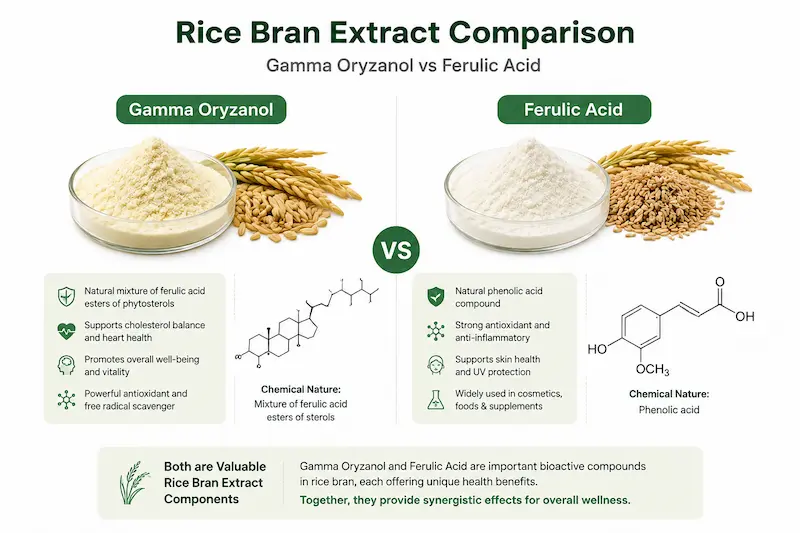
Ferulic acid (4-hydroxy-3-methoxycinnamic acid) is a phenolic acid found throughout the plant kingdom, but it is rarely present in a free, isolated form. In rice bran, it exists mostly bound to cell-wall polysaccharides and esterified to plant sterols. Commercial ferulic acid is produced either by alkaline or enzymatic hydrolysis of rice bran oil soap stock, or by hydrolyzing gamma oryzanol itself, followed by crystallization and purification into a fine, off-white crystalline powder[1,2].
Gamma oryzanol is not a single molecule but a complex mixture of steryl and triterpene alcohol esters of ferulic acid — mainly cycloartenyl ferulate, 24-methylenecycloartanyl ferulate, and campesteryl ferulate — which together account for roughly 95% of the mixture[3]. It occurs naturally in rice bran oil at about 1–2% concentration and is recovered during oil refining through solvent extraction, saponification, and crystallization[3].
Ferulic Acid
Small phenolic acid · water-dispersible at low pH · odorless pale-yellow to white crystalline powder · typical purity 98%–99% · widely used in food, beverage, supplement, and cosmetic applications.Gamma Oryzanol
Mixture of steryl ferulates · oil-soluble, essentially insoluble in water · white to off-white odorless powder · typical purity 90%–98% · primarily used in sports nutrition, lipid-management supplements, and specialty cosmetics.Chemical Relationship
The two ingredients are directly related: gamma oryzanol is essentially ferulic acid bonded to a sterol or triterpene alcohol. This is why gamma oryzanol converts, in part, back into free ferulic acid during digestion — animal studies tracking plasma ferulic acid after oral gamma oryzanol dosing confirm this conversion pathway[2]. In practice this means gamma oryzanol behaves as a slower-release, lipid-compatible carrier for ferulic acid's antioxidant activity, while purified ferulic acid delivers a faster, more concentrated, water-compatible dose.
Comparing Functional Benefits
Antioxidant Mechanism and Strength
Both compounds neutralize free radicals through their phenolic hydroxyl group, but they do so in different environments. Ferulic acid's smaller, more polar structure allows it to act quickly in aqueous and interfacial systems, and its radical-scavenging capacity is well documented in food and beverage matrices. Gamma oryzanol's bulky triterpene component makes it more lipophilic, positioning it to protect fats, oils, and cell membranes from oxidation over a longer time course[4,6]. Recent interfacial-activity research shows that ferulic acid and gamma oryzanol contribute to lipid oxidation inhibition through distinct mechanisms tied to their differing polarity, which is why many formulators combine both rather than choosing one exclusively[6].
Metabolic and Lipid-Management Effects
Gamma oryzanol has a longer track record in cholesterol and lipid-metabolism research. It has been shown to reduce intestinal cholesterol absorption and support bile-acid-mediated cholesterol removal in animal models, supporting its use in heart-health and sports-recovery supplements[3,4]. Safety evaluations, including a 90-day oral toxicity study in rats, support its use at typical supplemental intake levels[5]. Ferulic acid, by contrast, is more frequently studied for general antioxidant and anti-inflammatory support rather than lipid metabolism specifically.
Skin and Cosmetic Performance
In topical use, ferulic acid is prized for stabilizing vitamin C and vitamin E in serums — a widely cited dermatology study found that adding ferulic acid to a vitamin C/E solution roughly doubled the combination's photoprotective effect against UV-induced skin damage[7]. Gamma oryzanol is also used in sunscreens and brightening formulations for its ability to intercept UV rays and protect skin lipids from oxidation, but its oil solubility generally directs it toward oil-phase or emulsion systems rather than water-based serums.
| Evaluation Criteria | Ferulic Acid | Gamma Oryzanol |
|---|---|---|
| Solubility | Dispersible in water at alkaline pH; soluble in ethanol | Oil-soluble; virtually insoluble in water |
| Typical Purity | 98%–99% | 90%–98% |
| Primary Action | Fast-acting antioxidant, UV/vitamin C-E stabilizer | Lipid antioxidant, cholesterol metabolism support |
| Best-Fit Formats | Water-based serums, tablets, effervescent powders, beverages | Softgels, oil-based capsules, sports nutrition blends, oil-phase cosmetics |
| Regulatory Familiarity | Common food additive/antioxidant status in most markets | Established nutraceutical ingredient, especially in Asia-Pacific |
| Typical Dose Range | 250–500 mg/day (supplements); 0.5%–1% (topical) | 100–300 mg/day (supplements) |
Application Scenarios in B2B Procurement
Choosing between the two — or specifying a blend — should follow the product format and the benefit story you are building for the end consumer.
Dietary Supplements & Tablets: Ferulic acid's crystalline, water-dispersible form integrates easily into tablet and effervescent formats and pairs well with vitamin C for antioxidant stacks. Gamma oryzanol is a long-standing staple in sports-nutrition softgels and capsules targeting lipid metabolism and recovery.
Functional Foods & Beverages: Ferulic acid's food-additive familiarity and water compatibility make it suitable for fortified drinks, bakery antioxidant systems, and clean-label preservation. Gamma oryzanol's oil-phase affinity fits fortified oils and lipid-based functional foods.
Cosmetics & Personal Care: Ferulic acid is a go-to stabilizer and booster in vitamin C/E serums, brightening essences, and sunscreens. Gamma oryzanol appears in oil-based sun-care, anti-aging creams, and hair-care formulations where lipid protection matters.
Pharmaceutical & Nutraceutical Preparations: Both ingredients support precise dosing formats; suppliers offering HPLC-verified purity, batch-specific certificates of analysis, and third-party lab retesting simplify regulatory submissions for either ingredient.
Making the Choice: A Decision Framework
A structured evaluation against your product's real requirements avoids an "either is fine" default that can lead to reformulation later.
- Formulation medium: water-based system → ferulic acid; oil-based or encapsulated system → gamma oryzanol.
- Marketing claim: antioxidant/skin-brightening/UV story → ferulic acid; cholesterol/lipid metabolism/sports-recovery story → gamma oryzanol.
- Target market familiarity: gamma oryzanol has stronger recognition in Japan, Korea, and Southeast Asia; ferulic acid has broader global food-additive acceptance.
- Budget and dosage economics: compare cost-per-effective-dose rather than cost-per-kilogram, since typical use levels differ between the two ingredients.
| Business Priority | Recommended Ingredient |
|---|---|
| Vitamin C/E serum or sunscreen booster | Ferulic Acid |
| Cholesterol/lipid-support softgel | Gamma Oryzanol |
| Clean-label beverage antioxidant | Ferulic Acid |
| Sports nutrition recovery blend | Gamma Oryzanol |
| Combined broad-spectrum antioxidant claim | Ferulic Acid + Gamma Oryzanol blend |
Supplier & Sourcing Insights for Bulk Procurement
Ingredient performance is only half the sourcing decision — supplier reliability determines whether that performance shows up consistently, batch after batch.
| Supplier Attribute | What to Verify | WEHENGFOOD Standard |
|---|---|---|
| Certifications | ISO, HACCP, Kosher, Halal, non-GMO status | Full certification package available on request |
| Purity Verification | HPLC assay, batch-specific COA | Third-party lab retesting on every batch |
| Minimum Order Quantity | Flexibility for R&D trials vs. bulk runs | Sample sizes to full-container bulk supply |
| Traceability | Farm-to-extract documentation | Full supply-chain visibility |
| Technical Support | Formulation and stability guidance | Dedicated R&D support team |
Conclusion
Ferulic acid and gamma oryzanol come from the same rice bran source and share an antioxidant core, but they are not interchangeable. Ferulic acid's water compatibility and fast antioxidant action suit beverages, tablets, and vitamin C/E cosmetic systems, while gamma oryzanol's lipid affinity and cholesterol-metabolism research base make it the stronger fit for softgels, sports nutrition, and oil-phase skin care. Many premium formulations use both, pairing fast- and slow-acting antioxidant mechanisms in the same product. Whichever direction fits your brief, working with a supplier that can provide verified purity, full documentation, and formulation support will determine how reliably that choice performs at scale.
FAQ
Is gamma oryzanol the same thing as ferulic acid?
No. Gamma oryzanol is a mixture of ferulic acid esters bound to plant sterols and triterpene alcohols. Free ferulic acid is a smaller, standalone phenolic acid. Gamma oryzanol partially breaks down into ferulic acid during digestion, but the two have different solubility and use profiles.
Can ferulic acid and gamma oryzanol be used together in one formulation?
Yes, and many antioxidant and sports-nutrition products do combine them to cover both a fast-acting, water-compatible antioxidant (ferulic acid) and a slower-release, lipid-protective component (gamma oryzanol).
Which ingredient is better for a cosmetic sunscreen formulation?
Ferulic acid is more commonly used in water-based vitamin C/E serums for its documented photoprotective boost, while gamma oryzanol is better suited to oil-phase sun-care formulations where lipid solubility matters.
Source Verified Ferulic Acid & Gamma Oryzanol in Bulk
WEHENGFOOD supplies HPLC-verified ferulic acid and gamma oryzanol extracted from food-grade rice bran, with full COA, ISO/HACCP/Kosher/Halal certification, and flexible order quantities from sample to full-container volumes. Our R&D team can advise on concentration, solubility system, and application format for your formulation.
Request a Free Sample & QuoteReferences
- Xu, Z., & Godber, J.S. (1999). Purification and identification of components of γ-oryzanol in rice bran oil. Journal of Agricultural and Food Chemistry, 47(7), 2724–2728.
- Fujiwara, S., Noumi, K., Sugimoto, I., & Awata, N. (1982). Mass fragmentographic determination of ferulic acid in plasma after oral administration of gamma-oryzanol. Chemical & Pharmaceutical Bulletin, 30(3), 973–979.
- Rungratanawanich, W., Abate, G., & Uberti, D. (2020). Pharmacological profile of γ-oryzanol: Its antioxidant mechanisms and its effects in age-related diseases. In Aging (pp. 201–208). Elsevier.
- Juricic, H., Cuccioloni, M., Bonfili, L., Angeletti, M., Uberti, D., Eleuteri, A.M., Abate, G., & Cecarini, V. (2025). Biochemical, biological, and clinical properties of γ-oryzanol. Antioxidants, 14(9), 1099.
- Moon, S.-H., Kim, D., Shimizu, N., Okada, T., Hitoe, S., & Shimoda, H. (2017). Ninety-day oral toxicity study of rice-derived γ-oryzanol in Sprague-Dawley rats. Toxicology Reports, 4, 9–18.
- Lin, F.H., Lin, J.Y., Gupta, R.D., Tournas, J.A., Burch, J.A., Selim, M.A., Monteiro-Riviere, N.A., Grichnik, J.M., Zielinski, J., & Pinnell, S.R. (2005). Ferulic acid stabilizes a solution of vitamins C and E and doubles its photoprotection of skin. Journal of Investigative Dermatology, 125(4), 826–832.