Product Introduction
What Is PDRN?
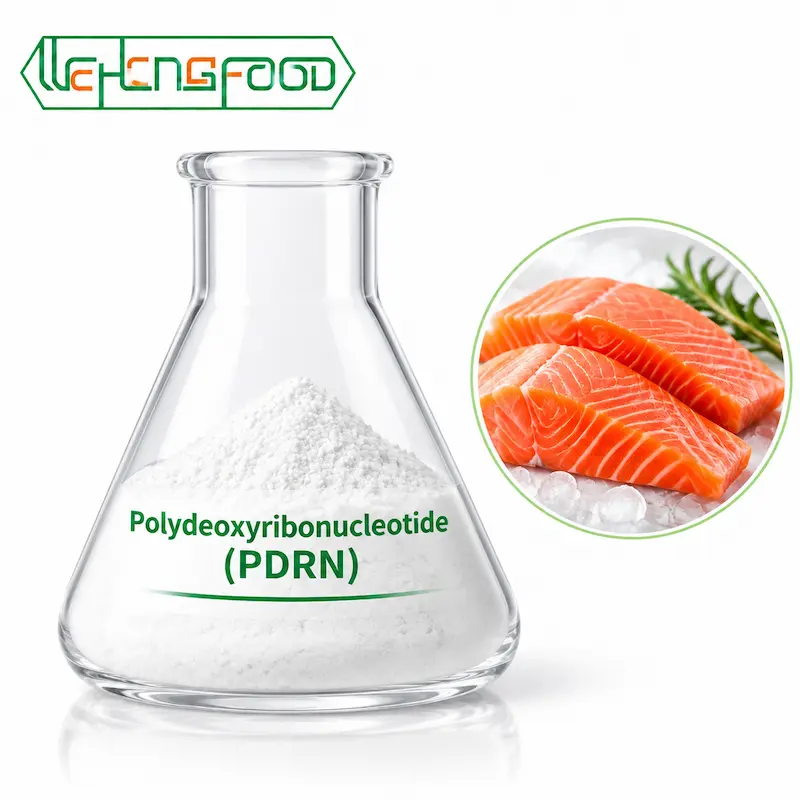
If you are asking “what is PDRN,” the PDRN meaning is simple: Polydeoxyribonucleotide is a DNA-derived mixture of polynucleotide fragments. The molecule is built from the four DNA bases: adenine (A), guanine (G), cytosine (C) and thymine (T). It keeps the linear, double-helix-based structure of natural DNA, and its average molecular weight is typically 50–1,500 kDa. Larger polynucleotide (PN) grades, at ≥1,500 kDa, are used where film-forming and long-lasting surface care are needed.
Traditionally, salmon PDRN is extracted from the milt (reproductive cells) of male salmon. Compared with plant sources, salmon DNA offers high bioactivity and good biocompatibility with human skin. PDRN has a long history in European regenerative medicine. Korean aesthetic dermatology then made it popular after 2015, and since 2024 it has become one of the fastest-growing active ingredients in PDRN skincare.
As a China PDRN manufacturer, supplier and exporter, we supply PDRN in several forms to fit different regulations, claims and consumer preferences. We offer salmon-derived, recombinant and plant-derived PDRN, and we run quality control from raw-material traceability through to finished-batch release.
Product Range
| Type | Source / Form | Highlights |
|---|---|---|
| Salmon PDRN powder | Salmon extraction, purity ≥95% | Molecular-weight bands from 300–1,500 bp can be customized |
| Salmon PDRN liquid | Polyol solution, 1,000–10,000 ppm | Ready to add to water-based systems |
| PN (polynucleotide) solid | Purity ≥90% | Excellent film-forming performance, used as an instant barrier and long-wear care carrier |
| Ultra-low molecular weight PDRN | Enriched below 200 kDa | Designed for fast skin penetration and instant soothing |
| Oil-soluble PDRN | 1,000–10,000 ppm | Made for oil-phase and anhydrous formulas |
| DNA-Zinc / DNA-Magnesium / DNA-Calcium | Nucleic acid + mineral ion | Zinc for oil control and scalp care, magnesium for sensitive and sun-stressed skin, calcium for oral-care concepts |
| Recombinant PDRN | Engineered-strain fermentation | Animal-free and sequence-designed, with tight batch-to-batch stability |
| Vegan plant-based PDRN | Plant sources, 2,000–3,000 ppm nucleic acid | Suited to vegan and clean-beauty claims |
| Lacto-PDRN | Probiotic fermentation, 5,000 / 10,000 ppm | Positioned for calming, repair and anti-wrinkle claims |
Custom services include molecular-weight customization (for example 850 kDa), multi-molecular-weight blends and dual- or multi-nucleotide complexes.
Certificate of Analysis
TEST ITEMS | STANDARD CODE | RESULTS |
Status | White to pale yellow powder | Conform |
Appearance of 0.5% aqueous solution | Colorless to pale yellow clear solution | Conform |
Identification | UV: Ratio of absorbance at 260 and 280 nm: 1.6–2.0 | 1.9 |
pH Value (1% aqueous solution) | 5.0–9.0 | 6.3 |
Loss on drying | ≤20.0% | 3.3% |
Assay (dry goods) | ≥90.0% | 110.2% |
Molecular weight | ≤400 kDa | Conform |
*Lead | ≤10 mg/kg | Conform |
*Cadmium | ≤5 mg/kg | Conform |
*Arsenic | ≤2 mg/kg | Conform |
*Mercury | ≤1 mg/kg | Conform |
Aerobic bacterial count | ≤1000 CFU/g | <100 CFU/g |
Molds and Yeast Count | ≤100 CFU/g | <100 CFU/g |
Thermotolerant coliform bacteria | Negative/g | Not detected |
*Staphylococcus aureus | Negative/g | Not detected |
*Salmonella | Negative/25g | Not detected |
*Pseudomonas aeruginosa | Negative/g | Not detected |
Functions and Usages
Key Functions and Benefits
The question behind most searches for PDRN benefits is how it works on skin. In an ex vivo human skin model with UV-induced aging, proteomic and immunofluorescence results pointed to two main pathways:
- Calming and anti-inflammatory support. PDRN acts on the adenosine A2A receptor and raises NFKBIE expression, which dampens NF-κB signaling. Inflammation-related markers such as IL-6, CCL14 and PTGS1 dropped in the treated tissue.
- Collagen support and anti-wrinkle care. PDRN also engaged the TGF-β/SMAD and PI3K/AKT pathways, which are linked to collagen and fibronectin synthesis. Lower MMP-1 expression suggests less matrix breakdown, which helps skin remodeling.
In practical formulation terms, this translates into the following claims:
- Skin repair and regeneration: supports the skin’s own recovery after stress.
- Barrier support and hydration: a good partner for PDRN hyaluronic acid and ceramide systems.
- Anti-wrinkle and firming: works well with peptides and PDRN collagen concepts.
- Soothing and redness care: suited to sensitive-skin lines.
- Brightening support: studies report an inhibitory effect on melanin production.
- Scalp and hair care: used in hair-density and anti-hair-loss concepts.
Reference use levels from supplier testing (cosmetic claims):
| Claim | Tested level | Test type |
|---|---|---|
| Repair | 0.1% / 0.01% | In vivo and in vitro |
| Barrier | 0.1% | In vitro |
| Moisturizing | 0.001% | In vitro |
| Anti-wrinkle | 0.1% | In vivo and in vitro |
| Firming | 0.1% | In vivo and in vitro |
| Soothing | 0.005% | In vitro |
| Redness | 0.1% | In vitro |
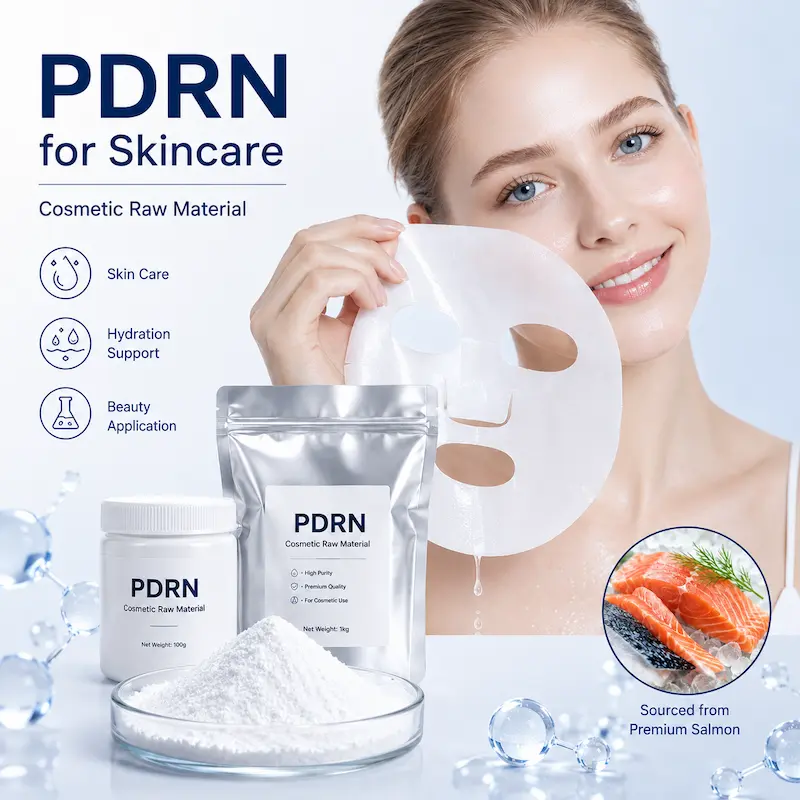
The powder is compatible with any water-based system, so it works across toners, lotions, essences, creams, masks and cotton pads.
Applications
1. Cosmetics and personal care
- PDRN serum and PDRN cream: the core formats for barrier repair, anti-aging and glow. Pairing PDRN with hyaluronic acid or peptides is the usual route to the best PDRN serum results.
- PDRN mask and PDRN eye patch: an easy way to deliver nucleic acids in concentrated, short-contact treatment steps.
- PDRN eye cream: supports the delicate eye area with firming and soothing claims.
- PDRN mist and spray: low-molecular-weight grades suit lightweight, fast-absorbing formats.
- PDRN stick and balm: PN-based film-forming grades suit portable, touch-up formats.
- Capsule cream and ampoule-style products: good for premium, high-concentration positioning.
- Sun care and base makeup: PN works as a functional carrier in repair-oriented sunscreens and skincare-makeup hybrids.
- Scalp serums and hair products: zinc-based and plant-derived grades target oil control and thinning concerns.
2. Professional aesthetics and medical devices
Higher-grade PDRN and PN are used in injectable skin boosters, post-procedure recovery after light- or laser-based treatments, wound dressings and chronic-wound care. These applications require grades that meet medical-device regulations, and some consumers also associate PDRN with in-clinic PDRN microneedling routines.
3. Pharmaceutical and food-related research
Lower-molecular-weight nucleic acid fragments are being explored for eye lubrication, cartilage support, digestive health and immunity-related nutrition.
Factory
Package
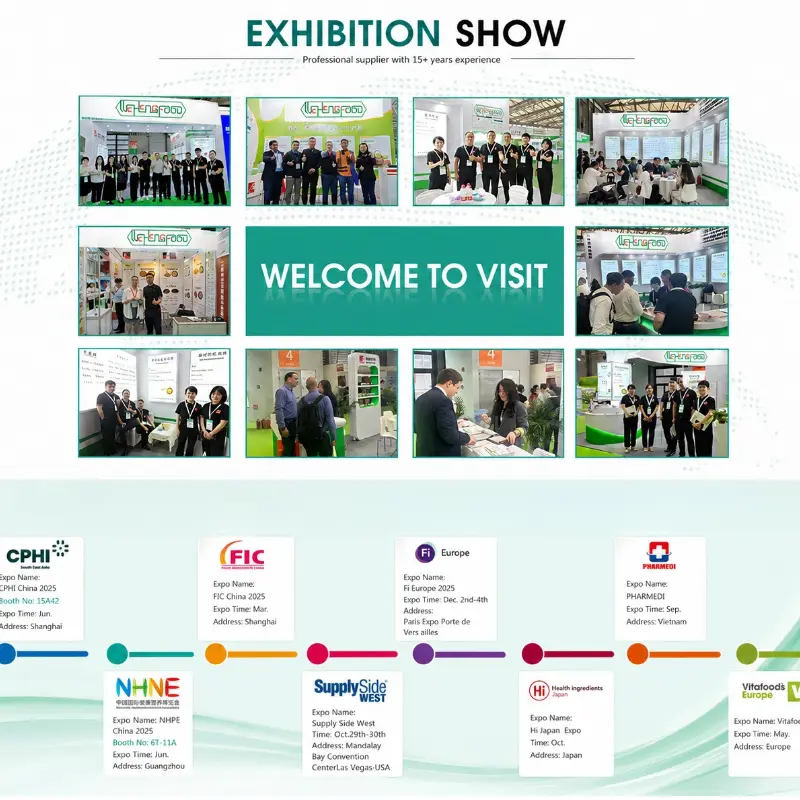
Exhibitions
FAQ
Q1: What is PDRN and what is it made from?
PDRN stands for polydeoxyribonucleotide. It is a mixture of short DNA fragments built from the four DNA bases (adenine, guanine, cytosine and thymine), with an average molecular weight of about 50–1,500 kDa. Traditionally, salmon PDRN is extracted from the milt of male salmon, because salmon DNA is highly bioactive and compatible with human skin. Today, PDRN can also come from recombinant fermentation, plant sources (vegan PDRN) and probiotic fermentation (lacto-PDRN). That gives brands an option for each claim, regulatory market and consumer preference.
Q2: What are the main benefits of PDRN in skincare?
The main PDRN benefits are skin repair, barrier support, hydration, firming, soothing and brightening. In an ex vivo human skin study with UV-induced aging, PDRN reduced the inflammation markers IL-6, CCL14 and PTGS1 by inhibiting NF-κB signaling. It also activated the TGF-β/SMAD and PI3K/AKT pathways, which are linked to collagen and fibronectin synthesis, and it lowered MMP-1, an enzyme that breaks down skin structure. This is why PDRN skincare products are positioned for anti-wrinkle, calming and skin-recovery claims.
Q3: What is the difference between PDRN and PN (polynucleotide)?
The difference is mainly molecular weight and function. PDRN has an average molecular weight of 50–1,500 kDa and is valued for penetration and repair. PN is larger, at 1,500 kDa and above, and has excellent film-forming properties. It builds a thin protective layer that gives instant barrier support and long-lasting care. Many brands use PDRN in PDRN serum, PDRN cream and PDRN mask formulas, and PN in sunscreens, base makeup and stick or balm formats.
Q4: Which cosmetic formats can PDRN be used in, and at what level?
PDRN is water-soluble and works in toners, essences, lotions, creams, masks and cotton pads. Popular formats include PDRN serum, PDRN eye cream, PDRN eye patch, PDRN mist, PDRN stick and capsule creams. For oil-based or anhydrous formulas, oil-soluble PDRN is available. In supplier testing, effective levels for different claims ranged from 0.001% to 0.1%, for example 0.001% for moisturizing, 0.005% for soothing and 0.1% for repair, anti-wrinkle and firming. Final dosage should be confirmed in your own formula and stability tests.
Q5: How do I choose between salmon, recombinant and vegan PDRN?
Choose based on your target claims and market:
- Salmon PDRN offers the natural DNA structure and is the most established option.
- Recombinant PDRN is animal-free with a designable sequence and excellent batch-to-batch stability, suitable for brands that want consistency and a modern, biotech story.
- Vegan PDRN (plant-derived) meets vegan and clean-beauty requirements and suits markets with strict ingredient standards.
If you need a specific molecular weight, a multi-molecular-weight blend or an ultra-low-molecular-weight grade, custom specifications are possible.
Q6: Are you a China PDRN manufacturer and supplier, and do you offer custom specifications?
Yes. We are a China PDRN manufacturer, supplier and exporter offering salmon, recombinant, plant-based and probiotic-derived PDRN, as well as PN and DNA-mineral grades. Each batch is traceable from raw material to release. We support custom molecular weights, concentrations from 1,000 to 10,000 ppm and water-soluble or oil-soluble forms. Samples and technical documents are available through the inquiry form on this page.