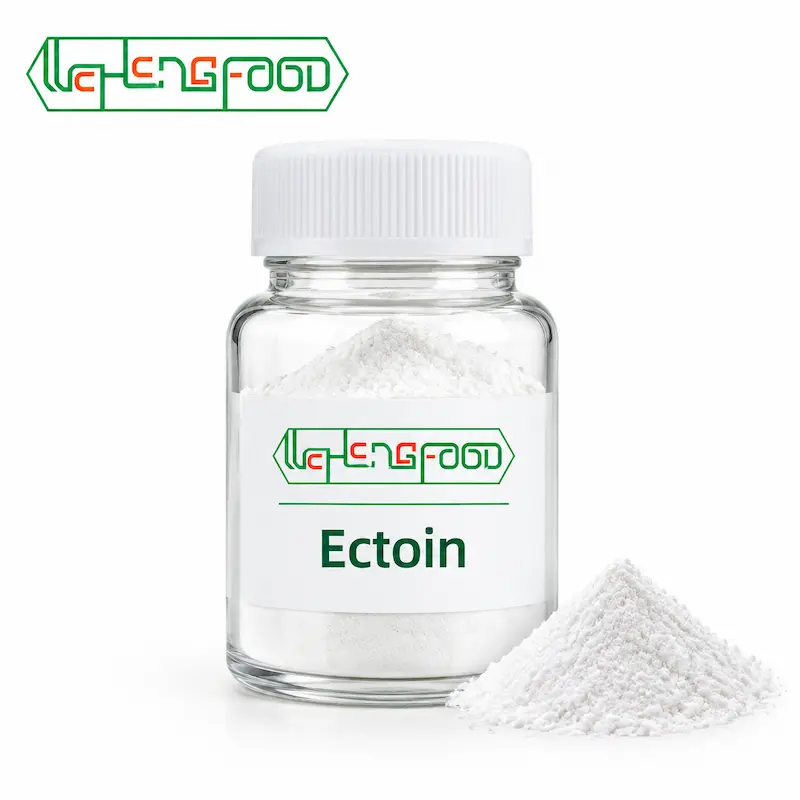
Product Introduction
Ectoin, also known by its INCI name Tetrahydroxypyrimidine Carboxylic Acid, is a natural amino acid derivative originally identified in halophilic (salt-loving) bacteria and now produced industrially through fermentation technology. Known as an “extremolyte,” Ectoin is synthesized by microorganisms to survive extreme environmental stress — heat, cold, drought, extreme pH, high pressure, high salinity, and radiation. When formulated into skincare and personal care products, this same protective capability translates into powerful hydration, cell protection, and skin barrier support.
As a leading China-based supplier, distributor, and manufacturer of cosmetic-grade Ectoin, we offer high-purity (≥99%) Ectoin powder with stable, batch-consistent quality for global formulators — from small R&D orders to bulk industrial supply.
How Ectoin Works — The “Water-Bridge” Mechanism
Ectoin’s protective effect comes from its unique molecular structure, which strongly attracts and organizes water molecules into an ordered hydration shell around itself. This “water bridge” then surrounds and coats cell membranes, proteins, and other biomolecules — stabilizing their structure without directly binding to them. This non-invasive, physical protection mechanism is what allows Ectoin to shield skin cells and skin barrier lipids from external stressors such as UV exposure, pollution, dryness, and temperature extremes.
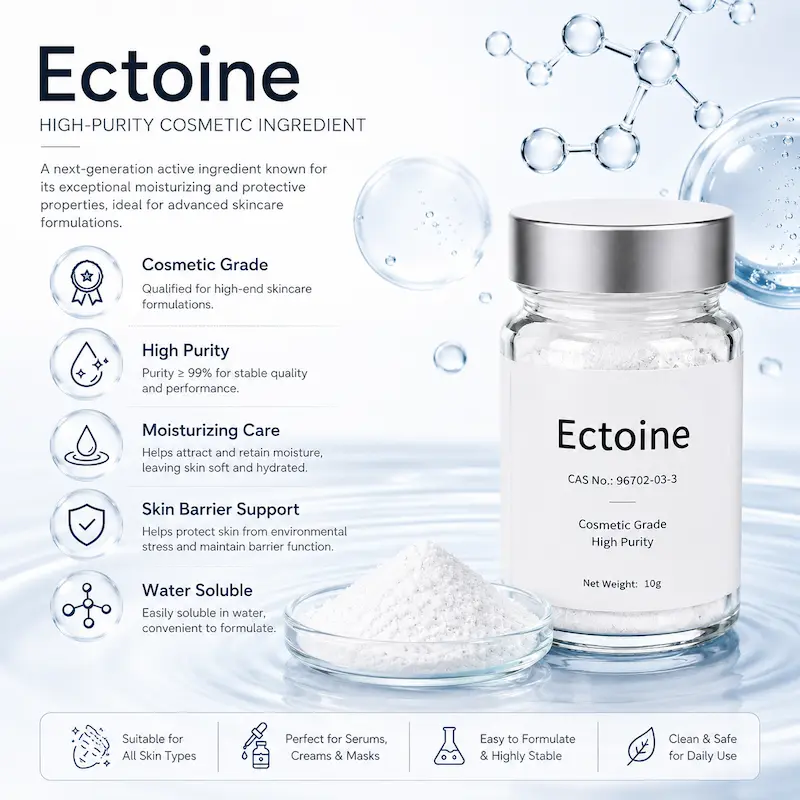
Certificate of Analysis
Test Item | Specification | Result |
Appearance | White powder | Conform |
Identification | The retention time of the main peak of the solution should be consistent with the retention time of the main peak of the reference solution. | Conform |
Purity | ≥99% | 100.0% |
Assay (Hydroxyectoine) | ≤1% | Conform |
pH(2% solution) | 6.0~8.0 | 6.31 |
Transparency | ≥98.0% | 99.75% |
Specific rotation | +139º ~ +145º | +142.4° |
Chloride | ≤0.05% | Conform |
Water | ≤0.5% | 0.22% |
Residue on ignition | ≤0. 1% | 0.05% |
Formaldehyde | <5ppm | Not Detected |
Ethanol | ≤100ppm | <10ppm |
Methanol | ≤10ppm | Not Detected |
Heavy metals | ≤10ppm | Conform |
Pb* | ≤2ppm | Conform |
As* | ≤2ppm | Conform |
Cd* | ≤5ppm | Conform |
Hg* | ≤1ppm | Conform |
Cr* | ≤5ppm | Conform |
Sb* | ≤1ppm | Conform |
Ni* | ≤10ppm | Conform |
Total bacteria count | ≤100 cfu/g | <10 CFU/g |
Mold and Yeast | ≤10 cfu/g | <10 CFU/g |
Thermotolerant coliform bacteria | Absent/g | Not Detected |
S. aureus | Absent/g | Not Detected |
Pseudomonas aeruginosa | Absent/g | Not Detected |
Escherichia coli | Absent/g | Not Detected |
Conclusion | Comply with Specifications. | |
Functions and Usages
Functions
Long-Lasting Moisturization
Unlike many humectants that provide only short-term, surface-level hydration, Ectoin penetrates into the epidermis and helps repair the skin’s own water-retention system. Clinical testing shows skin treated with 0.5%–2.0% Ectoin sustains significantly higher water content over 8 weeks, and even 7 days after discontinued use, hydration levels remain roughly 1.5x higher than untreated skin — addressing the “1+1>2” synergy gap left by low-molecular-weight hyaluronic acid alone.
Skin Barrier Repair & Cell Membrane Protection
Ectoin coats and stabilizes the lipid bilayer of skin cells, reducing membrane damage from external irritants and limiting the release of inflammatory mediators, which in turn helps lower inflammatory cytokine expression in the skin.
UV Damage Repair
Ectoin has been shown to protect Langerhans cells (key immune cells in the epidermis) from UV-induced damage, helping preserve the skin’s normal immune surveillance and barrier function under sun exposure.
Anti-Wrinkle & Firming
In 4-week clinical studies using a 2% Ectoin formulation, skin surface roughness decreased by up to 52%, flaking/scaling reduced by up to 76%, smoothness improved, and wrinkle volume decreased by up to 23%.
Soothing & Anti-Irritation
Ectoin has demonstrated a calming effect comparable to mild corticosteroid treatment in clinical comparison studies on sensitive, irritation-prone skin, making it suitable for redness-prone and reactive skin formulations — without the side effects associated with steroid-based treatments.
Antioxidant Support
In vivo testing (zebrafish embryo ROS model) shows Ectoin measurably reduces reactive oxygen species (ROS) levels, contributing to its anti-aging and skin-protective profile.
Applications
- Facial skincare: moisturizers, serums, essences, sheet masks, eye creams
- After-sun and soothing/repair products for sensitive, irritated, or UV-exposed skin
- Anti-aging and firming formulations
- Cleansing and personal care products (shampoos, body wash, baby care)
- Color cosmetics (foundations, BB/CC creams) for added hydration and comfort
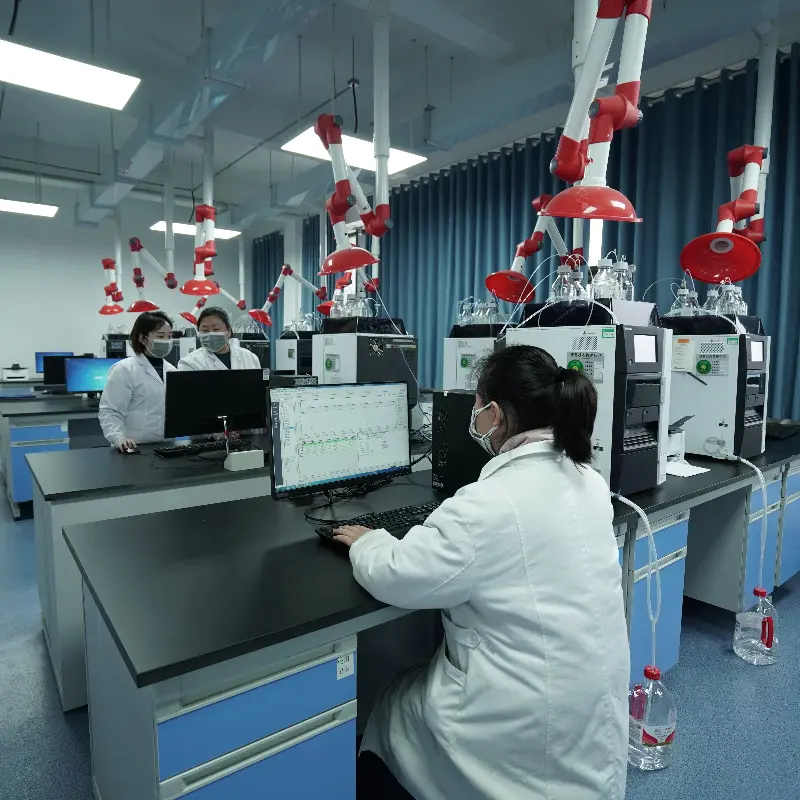
Factory
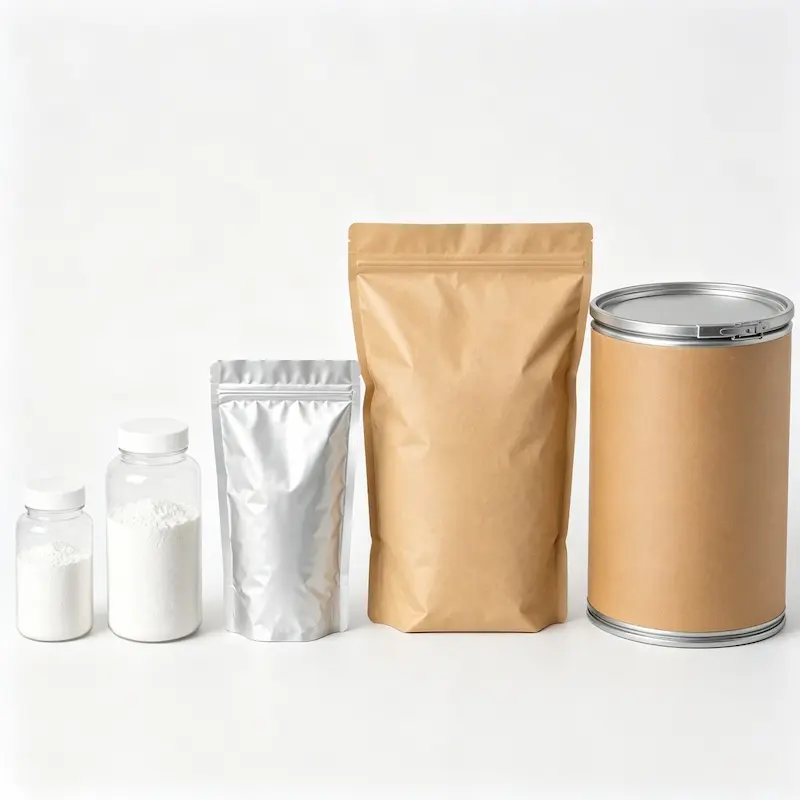
Package
Exhibitions

FAQ
Q1: What is the minimum order quantity (MOQ) for Ectoin, and can I buy directly from the manufacturer?
As a China-based manufacturer, supplier, and distributor of cosmetic-grade Ectoin, we offer a minimum order quantity (MOQ) of just 50g, making it easy to source small trial quantities for formulation testing before scaling up to bulk 1kg/25kg orders.
Q2: What is Ectoin and where does it come from?
Ectoin (INCI: Ectoin, CAS 96702-03-3) is a naturally occurring amino acid derivative first discovered in extremophilic (salt-tolerant) bacteria. It is now commercially produced through microbial fermentation, making it a biotechnology-derived, skin-identical protective molecule rather than a synthetic chemical.
Q3: What is the recommended usage level of Ectoin in cosmetic formulations?
Ectoin is typically recommended at 0.1%–7% depending on the desired effect: lower concentrations (0.5%–1%) are common in daily moisturizers, while higher concentrations (2%–5%) are used in targeted repair, anti-wrinkle, or soothing treatments.
Q4: How is Ectoin different from hyaluronic acid for hydration?
While hyaluronic acid draws and holds water at the skin’s surface, Ectoin works differently — it forms a molecular water shell that penetrates deeper into the epidermis and helps repair the skin’s underlying water-retention system, providing longer-lasting hydration that persists even after use is stopped.
Q5: Is Ectoin safe for sensitive skin?
Yes. Ectoin is widely used in dermatological and cosmetic formulations for sensitive and irritation-prone skin due to its gentle, non-binding protective mechanism. It has been studied as a steroid-free alternative for soothing skin irritation and redness.
Q6: How should Ectoin powder be stored, and what is its shelf life?
Ectoin is a white powder that is freely soluble in water. It has a shelf life of 3 years when stored in a cool, dry, light-protected environment in its original sealed packaging.