
Sodium Tripolyphosphate (STPP) in Turkish Doner Kebab: Function, Dosage & Processing Guide
WEHENGFOOD supplies bulk food-grade Sodium Tripolyphosphate (STPP) for doner kebab, shawarma, gyro, and other marinated or injected meat producers. For product specifications, samples, pricing, or bulk orders, please contact us at nancy@wehengfood.com.
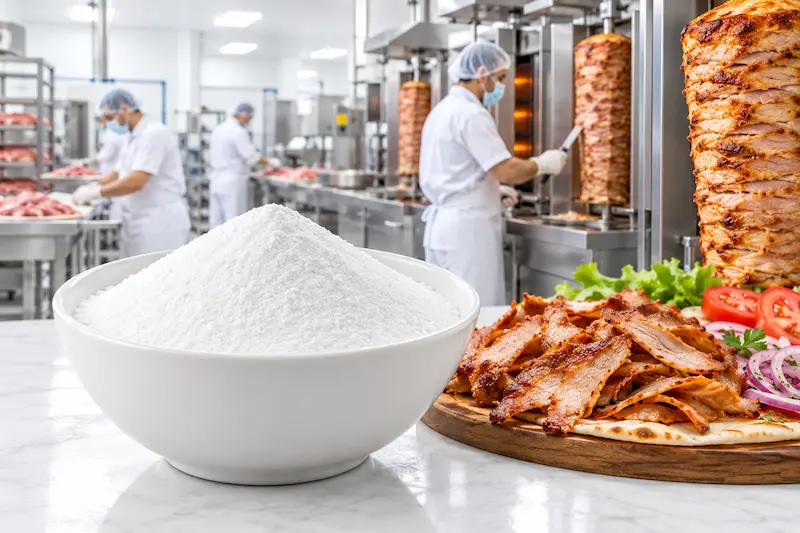
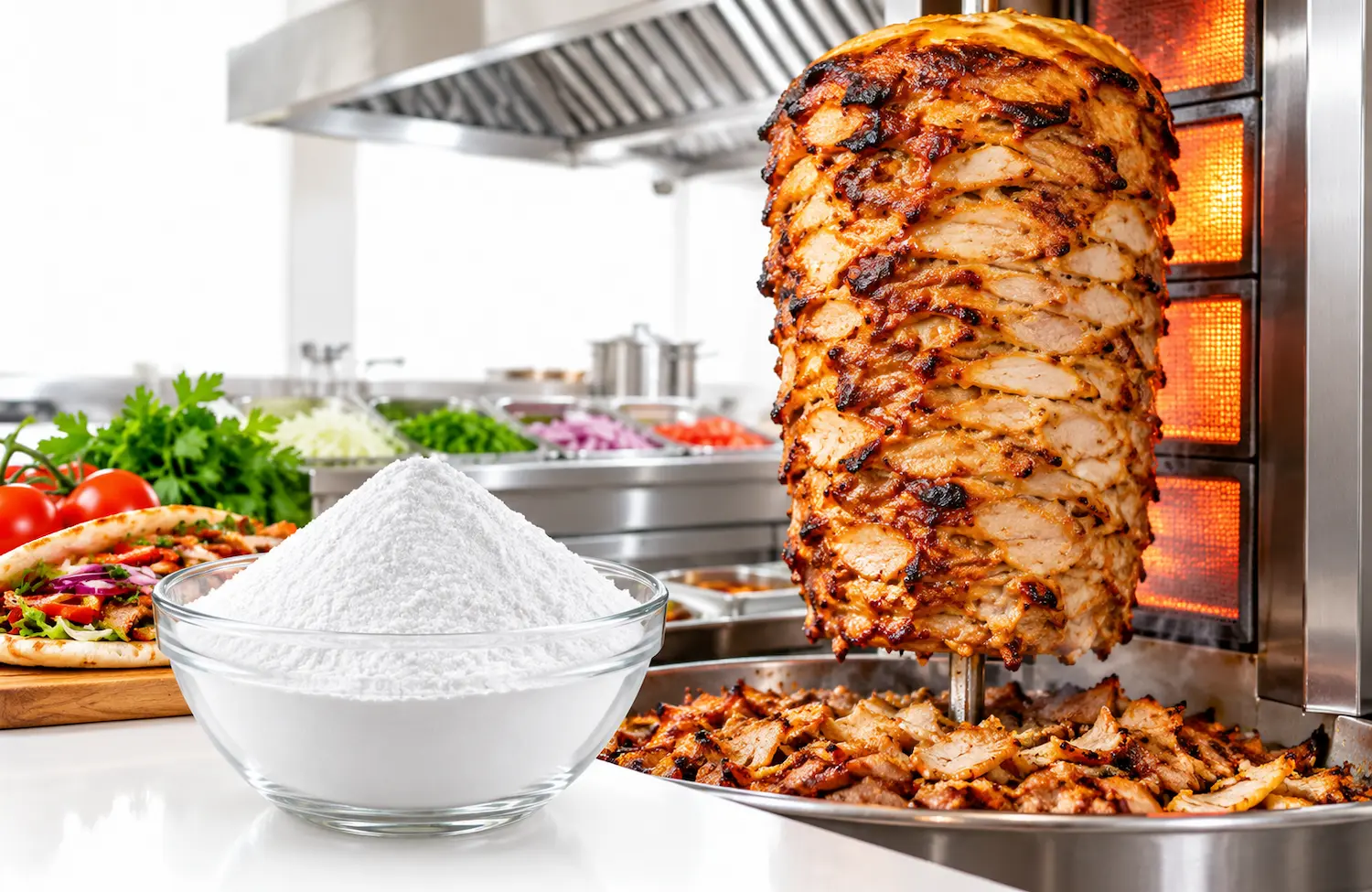
A good doner cone has to do two things that pull against each other: stay juicy through hours on a vertical grill, and still shave off in thin, cohesive slices instead of crumbling or drying at the edges. Salt and seasoning alone can't deliver both, especially with lean lamb, beef, or chicken. That is where sodium tripolyphosphate — better known in the trade as STPP, E451, or sodium triphosphate — earns its place on the ingredient list. If you have searched "what is sodium tripolyphosphate" or "sodium tripolyphosphate in food", this guide explains what it is, how it works in doner kebab, how much to use, and what to check when buying it in bulk.
What Is Sodium Tripolyphosphate (STPP)?
One Molecule, Several Names
Sodium tripolyphosphate (also called pentasodium triphosphate or sodium triphosphate; chemical formula Na5P3O10) is a white, free-flowing, water-soluble polyphosphate salt. In food it is identified as E451(i) in the EU numbering system and is widely used in meat, poultry, and seafood processing. Its 1% solution is mildly alkaline, which is a large part of what makes it useful in meat[1].
The food-industry meaning of STPP is not the same as the detergent-industry one. Food-grade STPP is manufactured and tested to much tighter purity limits (arsenic, fluoride, heavy metals, water-insolubles) than technical grade, and only food-grade material should ever go into a meat formulation.
How STPP Works in Doner Kebab
Raw meat sits close to its isoelectric point — the pH at which muscle proteins carry the least net charge and hold the least water. STPP shifts that balance in four ways at once:
Without Phosphate
Meat pH stays near 5.5–5.8, myofibrillar proteins bind little water, and moisture is lost as purge during resting and as drip during roasting — leaving a drier, crumblier cone that slices unevenly.With STPP
A small upward pH shift, plus binding of calcium and magnesium ions, loosens the protein network so it can hold more water and bind meat pieces together — giving higher yield, juicier slices and a more cohesive cone[1][3].- Raises pH: moves the meat further from its isoelectric point, which opens up more space for protein to bind water.
- Increases ionic strength with salt: together with salt, STPP helps solubilize myosin and actomyosin, creating the sticky protein film that glues kebab pieces and layers together[3].
- Chelates metal ions: binding free calcium, magnesium, and iron helps protein hydration and slows lipid oxidation, which supports flavor stability in frozen or chilled cones.
- Reduces cooking and drip loss: less water escapes during thawing, resting, and grilling, which protects both yield and eating quality.
Processing Steps: Adding STPP to Doner Meat
STPP is added during the marinade or brine stage, not at the end. A typical sequence for a doner cone looks like this:
| Step | What Happens |
|---|---|
| 1. Meat preparation | Lamb, beef, or chicken is trimmed, sliced, or coarsely minced and kept cold (typically 0–4°C) so protein extraction and food safety stay under control. |
| 2. Dissolve STPP | STPP is dissolved fully in cold water or brine first. Adding salt before the phosphate is dissolved can slow its solution, so most plants dissolve phosphate first, then add salt. |
| 3. Add seasonings | Salt, spices, onion, yogurt or oil-based marinade, and other flavorings are added to the brine once the phosphate is in solution. |
| 4. Mixing / vacuum tumbling | Meat and brine are mixed or vacuum-tumbled so the brine is absorbed evenly and salt-soluble protein is drawn to the surface. |
| 5. Resting / curing | The marinated meat rests chilled, giving the phosphate and salt time to work and the brine to equilibrate through the meat. |
| 6. Stacking & forming | Meat is stacked or pressed onto the skewer to build the cone, where the sticky protein film helps layers bind. Cones are then chilled or frozen. |
| 7. Roasting & slicing | The cone is cooked on a vertical rotisserie to a safe internal temperature and shaved to order. |
Dosage & Formulation Guide
Exact dosage depends on meat type, fat level, brine pick-up, and local legal limits, but the following ranges reflect typical starting points for doner and other marinated, vertically roasted meats:
| Component | Typical Dosage | Role |
|---|---|---|
| Sodium tripolyphosphate (STPP) | 0.2%–0.5% of meat weight | Water binding, juiciness, yield, slice cohesion |
| Salt | Approx. 1.0%–2.0% of meat weight | Protein extraction, flavor, working with STPP on ionic strength |
| Added water / brine | Grade- and market-dependent | Carrier for STPP and seasoning; level must stay within local composition rules |
| Meat temperature during mixing | Approx. 0–4°C | Protects food safety and protein functionality |
| Resting time | Several hours to overnight, chilled | Lets STPP, salt, and brine distribute evenly |
Specifications: What to Check on a COA
A food-grade STPP batch should arrive with a certificate of analysis. Typical parameters to confirm (exact limits vary by grade and customer specification):
| Parameter | Typical Food-Grade Specification |
|---|---|
| Assay (Na5P3O10) | ≥ 94% |
| Total phosphate (as P2O5) | ≥ 57% |
| pH (1% solution) | 9.2–10.0 |
| Water-insoluble matter | ≤ 0.1% |
| Arsenic (As) | ≤ 3 mg/kg |
| Fluoride (F) | ≤ 10 mg/kg |
| Appearance | White, free-flowing powder or granules |
Particle size and dissolution speed matter in a plant setting: a fine, fast-dissolving grade is easier to handle in cold brine, while coarser grades suit dry-blend systems.
STPP vs Other Phosphates & Alternatives for Meat
STPP is the workhorse of meat phosphates, but buyers regularly compare it with related salts and with clean-label alternatives:
| Ingredient | Main Function in Meat | How It Compares with STPP |
|---|---|---|
| Sodium tripolyphosphate (STPP, E451) | Water binding, pH lift, protein extraction | Standard choice for yield and juiciness in doner, ham, and injected products |
| Sodium hexametaphosphate (SHMP, E452) | Strong metal chelation, sequestration | Longer chain; more often used in blends and seafood than as the lone water binder in doner |
| Sodium carbonate (soda ash) | Simple alkaline agent, raises pH | Lifts pH but does not chelate or help extract protein the way STPP does |
| Chitosan | Edible coating; antimicrobial / shelf-life support | Not a water binder; sometimes studied alongside phosphates in preservation. STPP is also used as the cross-linker in chitosan nanoparticles |
| Citrus fiber / starch blends | Clean-label water holding | Phosphate-free label option, usually with a different texture profile |
Regulatory & Labeling Notes (E451)
Phosphates are regulated food additives. In the EU, E450–E452 are authorized for defined food categories with maximum levels expressed as P2O5[4], and EFSA has set a group acceptable daily intake for phosphates, expressed as phosphorus[2]. Codex also lists phosphates in its General Standard for Food Additives[5]. Limits, permitted categories, and rules for traditional-style döner differ from one country to another, so always confirm the maximum level and labeling requirement (E451 or "sodium tripolyphosphate") with your local authority before finalizing a formulation.
Sodium Tripolyphosphate Uses Beyond Doner Kebab
Doner is one of the most visible applications, but the same water-binding and chelating behavior makes STPP useful across food processing.
Shawarma, Gyro & Kebab Meats: chicken, lamb, and beef cones and skewers where juiciness and slice cohesion are critical.
Injected & Tumbled Meats: ham, bacon, and chicken breast brines, where STPP improves yield and reduces purge.
Sausages & Meatballs: better bind and bite in emulsified and coarse-ground products.
Seafood: shrimp, fish fillets, and surimi, where it limits drip loss during freezing and thawing.
Noodles & Processed Cheese: texture improvement in noodles and use as part of emulsifying-salt systems in processed cheese.
Sodium Tripolyphosphate Suppliers: Sourcing Insights for Bulk Procurement
Consistent doner yield depends as much on supplier quality control as on the spec sheet. When comparing sodium tripolyphosphate suppliers, check the following:
| Supplier Attribute | What to Verify | WEHENGFOOD Standard |
|---|---|---|
| Food-Grade Documentation | Batch COA with assay, P2O5, pH, arsenic, and fluoride | COA provided with every shipment |
| Solubility & Particle Size | Fast, clean dissolution in cold brine with no undissolved residue | Grade matched to brine or dry-blend use |
| Moisture Protection | Dry, sealed packaging to prevent caking in storage | Moisture-resistant packaging |
| Minimum Order Quantity | Flexibility for trial batches vs. full-container runs | Trial orders available through bulk container supply |
| Technical Support | Dosage and process guidance for your meat type | Dedicated support for doner and marinade formulations |
Conclusion
Sodium tripolyphosphate (STPP, E451) solves a practical problem for doner producers: it helps lean meat hold water through marinating, freezing, and hours on the rotisserie, while building the protein bind that lets a cone slice cleanly. Used at a modest dose, dissolved correctly in cold brine, and kept within local legal limits, it improves yield, juiciness, and consistency. Choosing a supplier that documents purity on every batch and can advise on dosage is what keeps results consistent at scale.
FAQ
What is sodium tripolyphosphate and is it the same as sodium triphosphate?
Yes. Sodium tripolyphosphate (STPP) is also called sodium triphosphate or pentasodium triphosphate (Na5P3O10). In food it is labelled E451(i) in the EU and is used mainly to improve water retention and texture in meat, poultry, and seafood.
How much STPP is used in doner kebab?
A common working range is 0.2%–0.5% of the meat weight, dissolved in cold brine before the salt is added. The legal maximum varies by country and food category, so confirm the limit that applies to your market.
What is the difference between STPP and sodium hexametaphosphate in meat?
STPP is the standard water binder because it raises pH and supports myofibrillar protein extraction. Sodium hexametaphosphate is a longer-chain polyphosphate with strong metal-chelating ability, more often used in phosphate blends or seafood than as the main water binder in doner.
Can sodium carbonate replace STPP in doner meat?
Not fully. Sodium carbonate raises pH, but it does not chelate metal ions or help extract protein the way STPP does, so water retention and slice cohesion are usually weaker.
Source Sodium Tripolyphosphate in Bulk
WEHENGFOOD supplies COA-verified Sodium Tripolyphosphate (STPP) for doner kebab, shawarma, and processed meat manufacturers, with consistent purity, clean dissolution, and flexible order quantities from trial batches to full-container bulk supply. Our team can help you set a starting dosage for your meat type and process.
Request a Free Sample & QuoteReferences
- Feiner, G. (2006). Meat Products Handbook: Practical Science and Technology. Woodhead Publishing — chapters on phosphates and water binding in meat products.
- EFSA Panel on Food Additives and Flavourings (2019). Re-evaluation of phosphoric acid–phosphates – di-, tri- and polyphosphates (E 338–341, E 343, E 450–452) as food additives. EFSA Journal, 17(6), 5674.
- Petracci, M., Bianchi, M., Mudalal, S., & Cavani, C. (2013). Functional ingredients for poultry meat products. Trends in Food Science & Technology, 33(1), 27–39.
- Regulation (EC) No 1333/2008 of the European Parliament and of the Council on food additives, and its Annex II list of permitted additives.
- Codex Alimentarius. General Standard for Food Additives (GSFA), CODEX STAN 192-1995 — provisions for phosphates.