
Carrageenan in Compound Jelly Powder: Formulation, Function & Production Process
WEHENGFOOD supplies bulk food-grade Carrageenan for jelly, pudding, and compound jelly-powder manufacturers. For product specifications, samples, pricing, or bulk orders, please contact us at nancy@wehengfood.com.
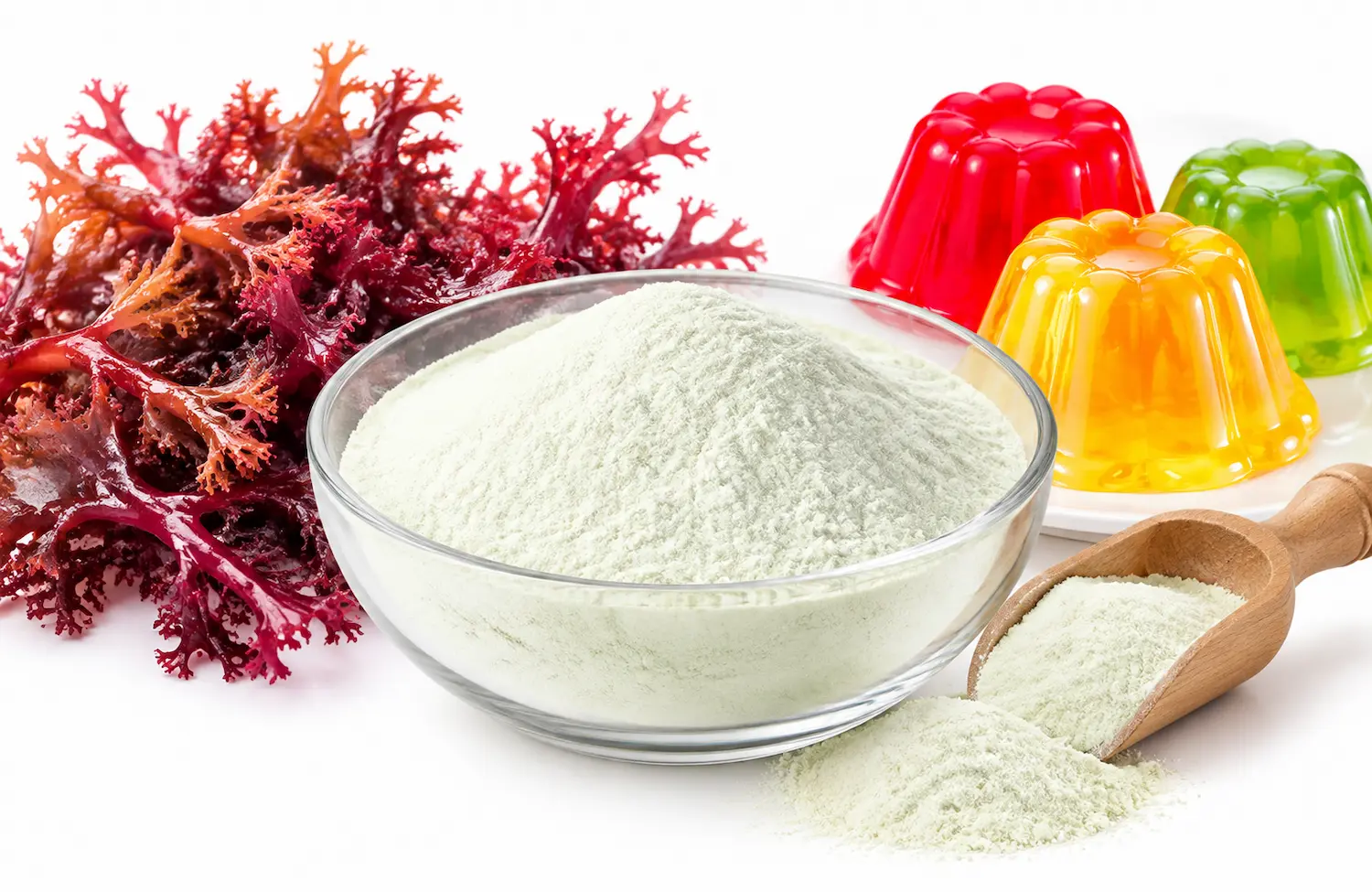
Pure carrageenan is a powerful gelling agent, but very few jelly cups on the shelf are made with carrageenan alone. What manufacturers actually buy and use is compound jelly powder — a pre-blended system where carrageenan is combined with potassium chloride, konjac flour, and sometimes other hydrocolloids so that the gel strength, elasticity, clarity, and water retention are all tuned together instead of adjusted one raw material at a time on the production floor. Understanding how that blend works, and why each co-ingredient is there, is the difference between a jelly that turns out consistent batch after batch and one that weeps, cracks, or gels unevenly.
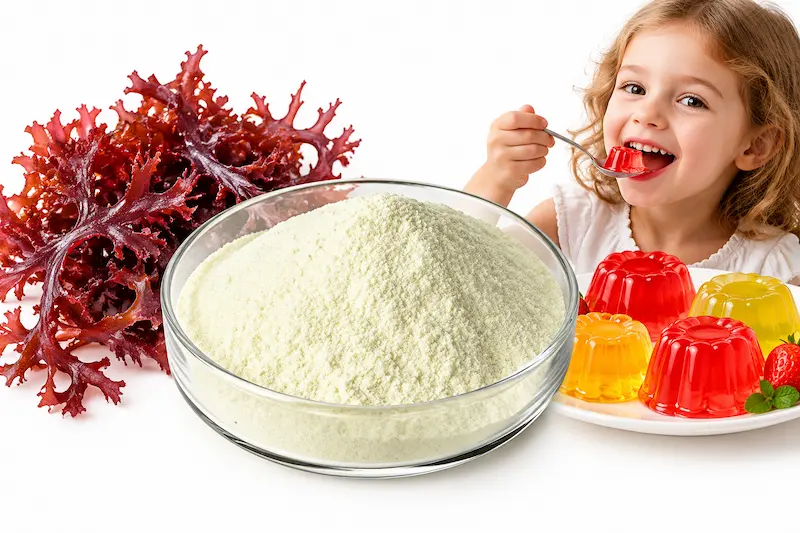
What Is Compound Jelly Powder?
From Raw Carrageenan to a Ready-to-Use Blend
Compound (blended) jelly powder is a formulated mixture built around carrageenan as the primary gelling agent, with potassium chloride (KCl) and konjac flour added to correct the two things pure kappa carrageenan is weakest at on its own: brittleness and syneresis (water weeping). Kappa carrageenan alone forms a gel quickly and firmly, but that gel tends to be short, brittle, and prone to releasing water over time — especially under the temperature swings a packaged cup jelly experiences in distribution. Blending in a small proportion of konjac flour introduces long, flexible glucomannan chains that interact with the carrageenan network, softening the brittle texture and giving the gel a smoother, more elastic bite while also improving water-holding capacity[1].
Potassium chloride plays a different, more technical role: potassium ions are the specific cation that triggers kappa carrageenan's helix-forming, gel-setting mechanism. Adding a controlled, food-safe amount of KCl directly into the powder blend means the gel strength target is baked into the formula itself, rather than left to depend on however much potassium happens to be present in the water or other ingredients used at the factory that actually cooks the jelly.
Carrageenan's Role
Supplies the gelling network itself — sets the base gel strength, the clean, glass-clear appearance, and the quick set-up time once the syrup cools.KCl + Konjac Flour's Role
KCl locks in a reliable, repeatable gel strength batch to batch; konjac flour softens brittleness and improves water retention so the finished jelly stays smooth and does not weep in the package.How Compound Jelly Powder Is Manufactured
Producing a stable compound jelly powder is a dry-blending operation, but getting a consistent finished gel from that powder depends on tight control at both the powder-formulation stage and the customer's own cooking process. A typical production and use sequence looks like this:
| Step | What Happens |
|---|---|
| 1. Raw material selection | Food-grade kappa carrageenan, potassium chloride, and konjac flour are selected and tested against target gel-strength and viscosity specifications before blending. |
| 2. Dry blending | Carrageenan, KCl, and konjac flour are dry-mixed to a uniform ratio, then typically pre-blended with a portion of sugar to prevent the fine carrageenan powder from clumping when it hits water. |
| 3. Hydration & dissolving | At the jelly manufacturer, the powder blend is dispersed into cold or warm distilled water under agitation, then heated so the carrageenan fully dissolves before the sugar syrup and acid are introduced. |
| 4. Syrup combination | Glucose syrup and the remaining sugar are combined with the dissolved carrageenan blend and brought to a boil, then held at a controlled temperature for a fixed hold time to fully hydrate the gum system. |
| 5. Acidification & flavoring | Once the batch has cooled to roughly 85°C, heat-sensitive ingredients — sweeteners, preservatives, flavor, and color — are added, followed last by the citric acid solution, added slowly with continuous stirring to avoid localized over-acidification that can weaken the gel. |
| 6. Filling & sterilization | The finished mix is filled into cups or pouches, sealed, and heat-sterilized (commonly around 85°C for roughly 15 minutes) before cooling and packing. |
Why Carrageenan Is the Gelling Backbone
Formulators keep building compound jelly powder around carrageenan because it delivers several qualities a cup-jelly or pudding line needs simultaneously:
- Fast, reliable set: kappa carrageenan gels on cooling in the presence of potassium ions, giving a predictable set point that suits continuous filling lines.
- Glass-clear appearance: a well-dissolved carrageenan gel is transparent, which is why it is the standard choice for the clear, glossy cup jellies consumers expect.
- Good water-holding when properly blended: paired with konjac flour, the finished gel resists syneresis far better than carrageenan used alone, keeping the jelly from weeping liquid in the package.
- Compatibility with a wide pH and sugar range: carrageenan-based blends tolerate the sugar, acid, and preservative levels typical of shelf-stable jelly and pudding formulas without losing gel integrity, provided acid is dosed correctly.
This is also why carrageenan is rarely sold into the jelly segment as a single raw material at scale — most manufacturers prefer to buy it as part of a pre-ratioed compound blend so the gel strength, texture, and water-holding behavior are already balanced before the powder ever reaches their kitchen.
Carrageenan Specifications: What to Check on a COA
Whether you are buying pure carrageenan to build your own compound blend, or sourcing a ready-made jelly powder, the certificate of analysis on the carrageenan itself should cover the following parameters:
| Parameter | Typical Specification |
|---|---|
| Appearance | Yellowish to white flowing powder |
| Particle size | 90% pass 120 mesh |
| Gel strength | > 800 g (grade-dependent) |
| Viscosity | ≥ 5.0 mPa·s |
| Loss on drying | ≤ 12% |
| Total ash content | 15–40% |
| Acid-insoluble ash | ≤ 1.0% |
| pH (1% solution) | 6–9 |
| Heavy metals (As / Pb / Hg / Cd) | ≤ 3.0 / ≤ 5.0 / ≤ 1.0 / ≤ 2.0 mg/kg |
| Microbiological | Total plate count ≤ 5,000 CFU/g; yeast & mould ≤ 300 CFU/g; E. coli and Salmonella absent |
Gel strength is the single most important number to match batch-to-batch if you are replicating an existing jelly texture — it is the practical proxy for how firm the finished product will be at a given dosage.
A Working Reference Formula for Cup Jelly
Exact ratios vary by target texture and mold type, but the following reference formula reflects a typical starting point for carrageenan-based compound jelly powder used in cup jelly production, with recommended dosing at 0.6–1.0% of total product weight:
| Ingredient | Usage Level |
|---|---|
| Distilled water | 70% |
| Sugar | 15% |
| Glucose syrup | 10% |
| Compound jelly powder (carrageenan blend) | 0.8% |
| Citric acid | 0.35% |
| Sodium citrate | 0.15% |
| Potassium sorbate | 0.02% |
| Sweetener (cyclamate) | 0.04% |
| Sweetener (acesulfame-K) | 0.04% |
| Flavor / color | To taste |
Carrageenan vs Other Jelly Gelling Agents
Carrageenan is one of several hydrocolloids used to gel jelly and pudding products, and each brings a different texture and process profile:
| Gelling Agent | Gel Texture | Clarity | Typical Jelly Use |
|---|---|---|---|
| Kappa carrageenan (compound blend) | Firm, elastic when blended with konjac flour | Glass-clear | Cup jelly, pudding, jelly candy |
| Agar | Very firm, brittle set | Slightly cloudy | Traditional jelly, mooncake filling |
| Gelatin | Soft, melt-in-mouth, elastic | Clear | Gummies, dairy desserts (not heat-stable) |
| Pectin | Spreadable to firm, requires sugar/acid balance | Clear | Fruit jams and jellies, low-sugar formulations |
| Konjac glucomannan (alone) | Chewy, rubbery, heat-stable | Slightly cloudy | Konjac jelly cups, mixed with carrageenan for texture |
Application Scenarios Beyond Cup Jelly
Cup jelly and pudding are the highest-volume use for compound carrageenan jelly powder, but the same gelling system is useful across several adjacent dessert and confectionery formats.
Fruit & Milk Pudding: the same carrageenan blend, at a lighter dosage, produces a softer, spoonable set suited to dairy and fruit-based puddings.
Jelly Candy & Gummies: higher-gel-strength carrageenan grades are blended into chewy candy formulations, often alongside starch, for a firmer bite than pudding-grade blends.
Bubble Tea Jelly Toppings: small-format carrageenan jelly cubes are cut for use as a topping ingredient, requiring a firmer, more heat- and shake-stable gel than a standalone dessert cup.
Plant-Based & Vegan Desserts: because carrageenan and konjac flour are both plant-derived, compound jelly powder is a straightforward gelatin substitute for vegan-labeled jelly and dessert products.
Supplier & Sourcing Insights for Bulk Procurement
Consistent jelly texture batch after batch depends as much on the carrageenan supplier's process control as on the spec sheet.
| Supplier Attribute | What to Verify | WEHENGFOOD Standard |
|---|---|---|
| Gel Strength Consistency | Batch-specific COA with gel strength, viscosity, and moisture | COA provided with every shipment |
| Compound Blend Capability | Ability to supply pure carrageenan or a pre-ratioed compound jelly powder blend | Both pure and customizable compound blends available |
| Heavy Metal & Microbial Control | Documented results for arsenic, lead, and microbiological limits | Full COA testing on every batch |
| Minimum Order Quantity | Flexibility for trial batches vs. full-container runs | Trial orders available up to full 20' FCL bulk supply |
| Technical Support | Formula matching for existing gel strength, clarity, or texture targets | Dedicated technical support for jelly formulation matching |
Conclusion
Carrageenan is what makes a jelly gel, but it is the compound blend — carrageenan working alongside potassium chloride and konjac flour — that makes a jelly reliable: firm enough to hold shape, elastic enough not to be brittle, and stable enough not to weep in the cup on the way to the shelf. Getting that balance right depends on both the ratio built into the powder and how carefully the cooking process is controlled, particularly the timing of acid addition. Working with a supplier that documents gel strength and can supply either pure carrageenan or a pre-ratioed compound jelly powder is what keeps jelly texture consistent at scale.
FAQ
Why is potassium chloride added to carrageenan jelly powder instead of just using more carrageenan?
Potassium ions are what trigger kappa carrageenan's gel-forming mechanism. A small, controlled dose of KCl in the powder blend gives a predictable, repeatable gel strength regardless of the mineral content of the water used at the customer's factory — simply adding more carrageenan does not reproduce this effect on its own.
What causes a carrageenan jelly to weep liquid after packaging?
This is syneresis, and it is most often caused by using carrageenan alone without a texture modifier like konjac flour, or by under-dosing the gum relative to the sugar and acid level in the formula. Blending in konjac flour, and confirming the citric acid is added only after the batch has cooled, are the two most effective fixes.
Can WEHENGFOOD supply a customized compound jelly powder ratio instead of standard blends?
Yes — pure kappa carrageenan and pre-ratioed compound jelly powder blends (with KCl and konjac flour) are both available, and the ratio can be adjusted to match a target gel strength, clarity, or texture profile supplied by the customer.
Source Carrageenan & Compound Jelly Powder in Bulk
WEHENGFOOD supplies COA-verified Carrageenan — as a pure ingredient or as a customized compound jelly powder blend — for jelly, pudding, and confectionery manufacturers, with consistent gel strength, documented heavy-metal and microbiological testing, and flexible order quantities from trial batches to full-container bulk supply. Our team can help match your current jelly texture or develop a custom compound ratio for your application.
Request a Free Sample & QuoteReferences
- Technical Data Sheet, Carrageenan (BLJB627BM). BLG Marketing & Sales Centre, Shanghai, 2025.
- Product specification and reference formula, Jelly Powder (果冻粉). Qingdao Dehui Marine Biotechnology Co., Ltd., GB 26687-2011.
- Necas, J., Bartosikova, L. Carrageenan: a review. Veterinarni Medicina, 58(4), 2013.
- Imeson, A. (Ed.). Food Stabilisers, Thickeners and Gelling Agents. Wiley-Blackwell, carrageenan and konjac glucomannan chapters.
- Codex Alimentarius / JECFA specifications for Carrageenan (INS 407).