Product Introduction
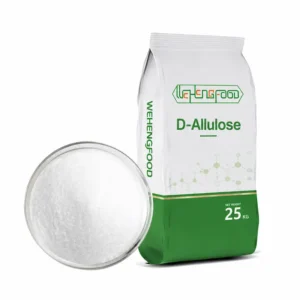
WEHENGFOOD is a professional China sodium erythorbate supplier, factory-direct exporter, and wholesaler. We supply food-grade sodium erythorbate directly from our China manufacturing partners to processors, distributors, and private-label brands worldwide. We handle sourcing, quality documentation, container loading, and export paperwork, so buyers deal with one team from inquiry to delivery.
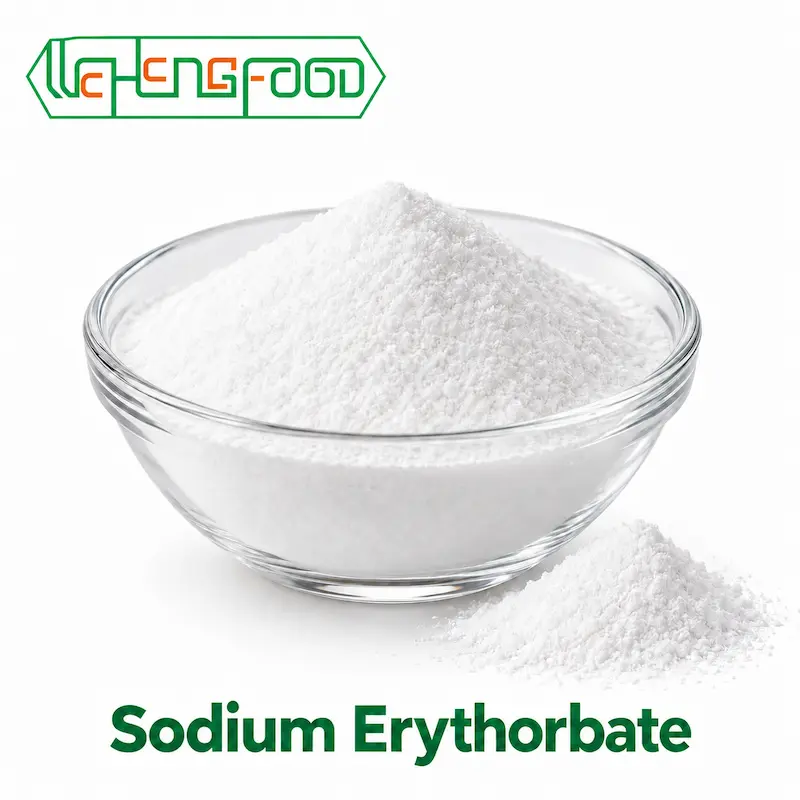
Sodium erythorbate is the sodium salt of erythorbic acid, a stereoisomer of ascorbic acid (Vitamin C). The two molecules have the same formula and nearly the same chemistry, and both are strong reducing agents. The difference is the spatial arrangement at one carbon, which is enough to remove almost all of the vitamin activity while keeping the antioxidant power. That is exactly why food manufacturers use it: it protects food from oxidation at a lower cost than sodium ascorbate, and it is not sold as a nutrient.
It appears on ingredient labels as sodium erythorbate, sodium isoascorbate, or E316. It is a white to slightly yellowish crystalline powder or granule, freely soluble in water, nearly odorless, with a mild salty-sweet taste at the levels normally used. Because it is the sodium salt, a solution is close to neutral, which makes it easier to handle in brines and doughs than the acidic form.
Certificate of Analysis
Appearance | White or slightly yellow crystalline granule or powder |
Colour solution | Clear and limpid |
Assay | 98.0% – 100.5% |
Identification | Positive reaction |
Specific rotation | +95.5 – +98.0 |
PH value | 5.5 – 8.0 |
Heavy metal | 10 PPM MAX |
Lead | 5 PPM MAX |
Arsenic (as As) | 3 PPM MAX |
Loss on drying | 0.08% MAX |
Oxalate | Pass test |
Particle size | 100% pass 40 mesh |
Gluten free | Free |
Mercury | 1 PPM MAX |
Key Functions
Color development and retention. In ham, bacon, sausages, and other cured products, it gives a more uniform and stable pink-red color. This matters most in sliced and packaged products, where color loss is the most common reason for returns and markdowns.
Faster curing. Because erythorbate accelerates nitrite reduction, cure time can be shortened in many processes, which helps throughput in plants running continuous smokehouses.
Lower residual nitrite. By driving the nitrite reaction to completion, it leaves less residual nitrite in the finished product. It is also widely used in bacon production because it inhibits the formation of nitrosamines during frying.
Flavor and aroma protection. In juices, soft drinks, and beer, it scavenges oxygen and slows the stale or oxidized notes that develop in storage.
Browning control. It extends the appearance life of fresh-cut produce, canned fruit, frozen fruit, and some seafood.
Synergy with other antioxidants. It works well alongside citric acid (which chelates metal ions that would otherwise catalyze oxidation), tocopherols, and rosemary extract in oils and fat-rich foods.
Applications in Detail
Cured and processed meat
This is the largest market for sodium erythorbate. It is added to brine for injected hams, to the batter for emulsified sausages, and to dry cure mixes. Typical use is in the range of 0.02%–0.05% of finished product weight, though permitted maximums differ by country and by product category. It is generally used together with sodium nitrite, and it should not be used on fresh meat to restore or mask color, which most regulators prohibit.
Beverages and beer
In juices, carbonated drinks, and tea beverages, it removes residual oxygen after filling and protects color and flavor. Brewers use it as an oxygen scavenger at the packaging stage, often as an alternative to sulfites. Dosage is usually low, on the order of tens of mg/L, and should be confirmed by trial in each recipe.
Fruit and vegetable products
Dissolved in a dip or wash, often with citric acid or calcium salts, it slows browning in fresh-cut apples, pears, potatoes, and lettuce. It is also used in canned and frozen fruit, jams, and pickled vegetables to hold color through heat processing and storage.
Seafood
Dips or glazes containing erythorbate help keep frozen fish and shrimp from darkening and slow the oxidative off-odors that develop during long cold storage.
Bakery
At very low levels, it acts as a dough improver. As a reducing agent it modifies gluten structure and can improve loaf volume and crumb in some flour systems.
Oils, fats, and fat-based foods
Erythorbate is water-soluble, so it is used in the aqueous phase of emulsions such as mayonnaise, dressings, and spreads, where it supports the oil-soluble antioxidants.
Sodium Erythorbate vs. Sodium Ascorbate vs. Erythorbic Acid
| Sodium Erythorbate | Sodium Ascorbate | Erythorbic Acid | |
|---|---|---|---|
| Vitamin C activity | Negligible | Yes | Negligible |
| Antioxidant and curing performance | Strong | Strong | Strong |
| Form | Neutral salt | Neutral salt | Acid |
| Relative cost | Lower | Higher | Lower |
| Best fit | Meat curing, beverages, general antioxidant use | Products that need a Vitamin C claim | Acidic systems, dip solutions |
Choose sodium erythorbate when you need antioxidant performance and color stability, and sodium ascorbate when the label or nutrition claim requires real Vitamin C.
Factory

Package
Exhibitions

FAQ
Q1: What is the minimum order quantity for Sodium Erythorbate?
Our standard MOQ is 1000 KG. If you only need a small quantity for testing, contact us at nancy@wehengfood.com or on WhatsApp, and we can arrange a sample.
Q2: Is Sodium Erythorbate the same as Vitamin C?
No. It is an isomer of ascorbic acid with almost no Vitamin C activity. It works as an antioxidant and color stabilizer in food, but it should not be labeled or marketed as a source of Vitamin C.
Q3: Is Sodium Erythorbate approved for food use?
Yes. It is permitted as E316 in the EU, is recognized as a food additive in the United States, and is permitted in China under national standards. Allowed categories and maximum levels vary by country, so check the rules of your destination market.
Q4: What dosage should I use in cured meat?
A common range is 0.02%–0.05% of finished product weight, used alongside nitrite. The best level depends on your cure formulation, process, and local regulations, so we recommend a small pilot batch before scaling up.
Q5: Can Sodium Erythorbate be used together with sodium benzoate in beverages?
It can, but with care. In acidic drinks exposed to heat, light, or trace metals, the combination of ascorbates or erythorbates with benzoates may contribute to benzene formation. Test your formula for stability, or discuss alternatives with us.
Q6: How should it be stored, and how long does it last?
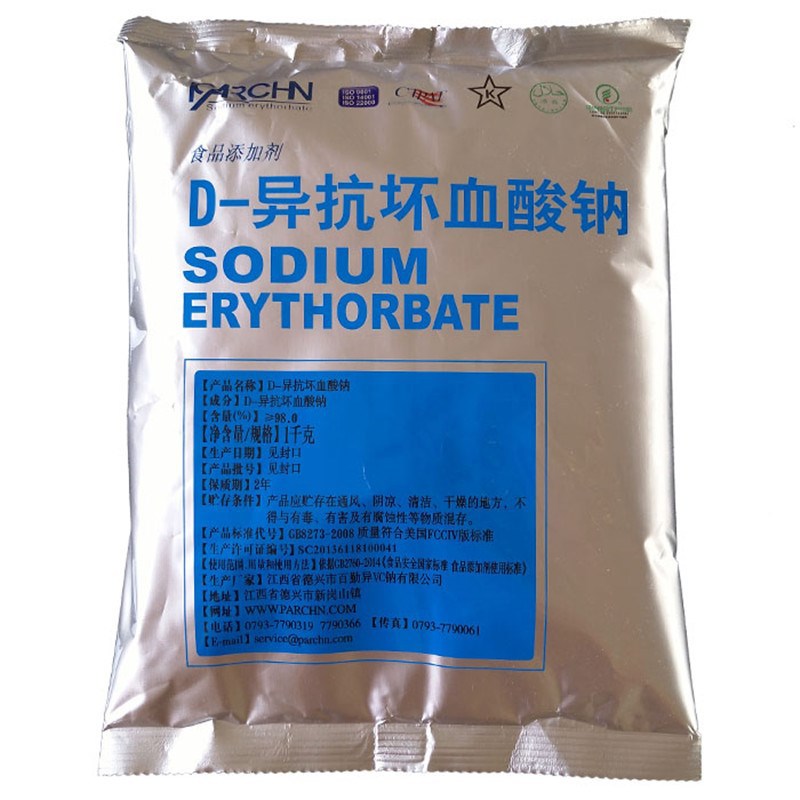
Store it in its original sealed packaging in a cool, dry, dark place. Under these conditions the shelf life is 2 years. Once opened, reseal tightly to protect it from moisture and air.