Product Introduction
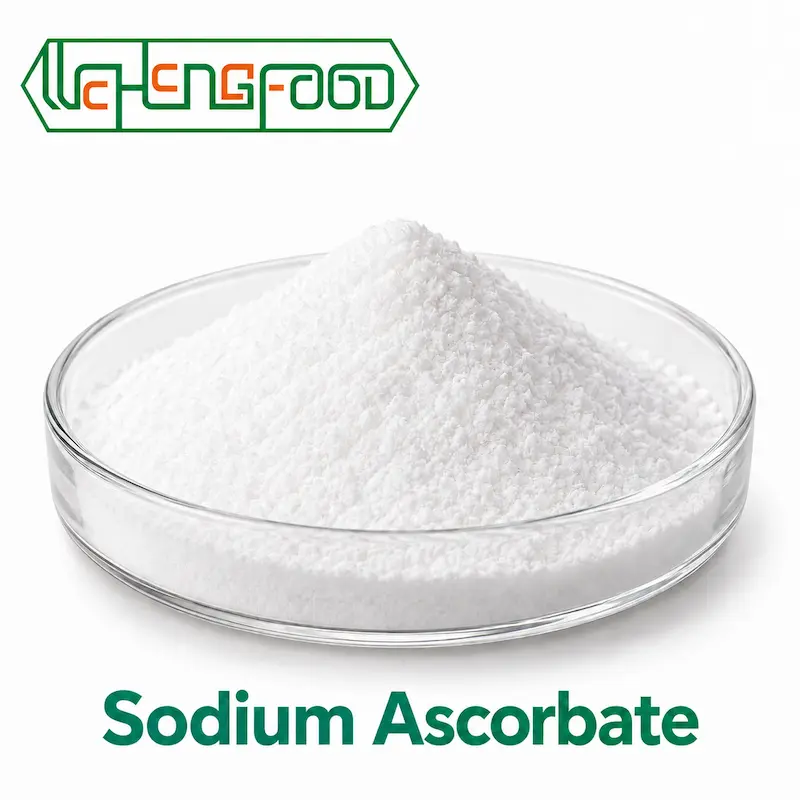
Sodium Ascorbate (E301) is the sodium salt of L-ascorbic acid, the most widely used form of vitamin C. It is a white, crystalline, freely water-soluble sodium ascorbate powder that provides the same vitamin C activity as ascorbic acid in a buffered, near-neutral form. A 10% solution has a sodium ascorbate pH of about 7.0–8.0, whereas ascorbic acid is distinctly acidic. This makes it gentler for acid-sensitive formulations and a common choice for buffered vitamin C products.
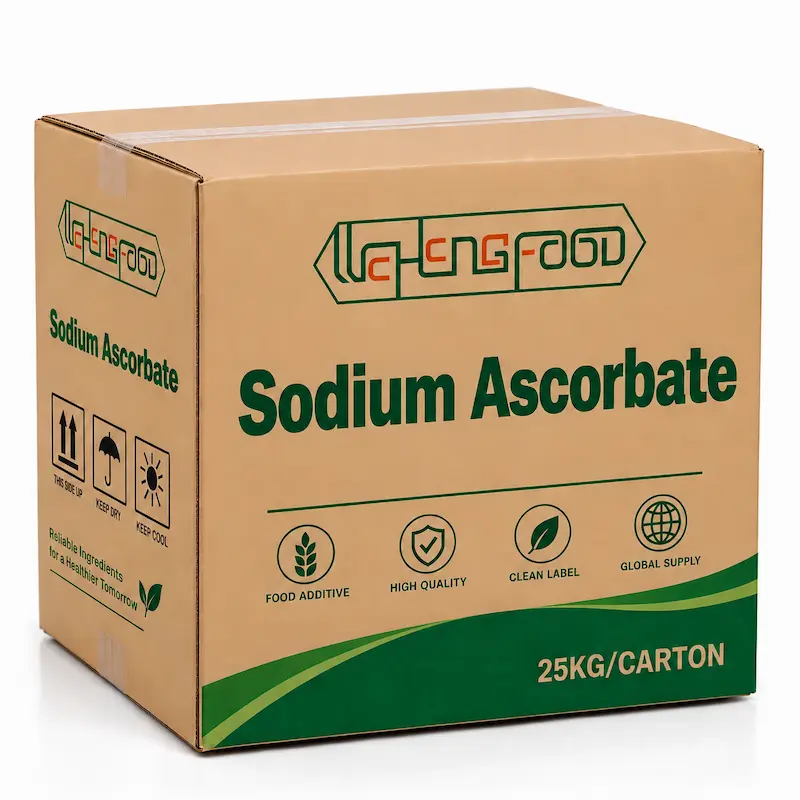
As a China manufacturer, supplier and exporter of sodium ascorbate, WEHENGFOOD supplies consistent, food-grade and supplement-grade material to food processors, nutraceutical brands, beverage producers and distributors worldwide. We offer competitive sodium ascorbate wholesale prices with full documentation (COA, MSDS, specification sheet) and flexible packaging for bulk and private-label buyers.
What Is Sodium Ascorbate? Is It Vitamin C?
Yes. Sodium ascorbate is a form of vitamin C. It is a mineral salt of ascorbic acid, formed when ascorbic acid is neutralized with sodium. In the body it delivers ascorbate just as ascorbic acid does. The main differences are chemical:
| Feature | Sodium Ascorbate | Ascorbic Acid |
|---|---|---|
| Chemical nature | Sodium salt (buffered) | Free acid |
| Taste | Mild, slightly salty | Sour |
| pH (10% solution) | ~7.0–8.0 | ~2.0–2.5 |
| Typical use | Cured meats, buffered vitamin C, acid-sensitive blends | Beverages, bakery, general acidulant/antioxidant |
| Sodium contribution | ~11% sodium by weight | None |
Ascorbic acid vs sodium ascorbate: choose ascorbic acid when acidity is wanted or harmless, and sodium ascorbate when you need a neutral pH, a milder taste or better compatibility with sensitive ingredients.
Calcium ascorbate vs sodium ascorbate: calcium ascorbate suits low-sodium positioning, while sodium ascorbate offers higher solubility and is the standard for meat curing and many solutions. We can also advise on magnesium ascorbate and calcium ascorbate alternatives for your formulation.
Certificate of Analysis
Item | Specification | Result | Testing Method |
Appearance | White Powder | Complies | Visual |
Odor | Characteristic | Complies | Organoleptic |
Taste | Characteristic | Complies | Organoleptic |
Sieve Analysis | 100% pass 80 mesh | Complies | 80 mesh screen |
As | 2.0 mg/kg Max. | Complies | ISO 17294 ICP/MS |
Pb | 2.0 mg/kg Max. | Complies | ISO 17294 ICP/MS |
Hg | 0.1 mg/kg Max. | Complies | EN 13806 AAS |
Cd | 1.0 mg/kg Max. | Complies | ISO 17294 ICP/MS |
Microbiological
Item | Specification | Result | Testing Method |
Total Plate Count | 10000 cfu/g Max. | Complies | GB 4789.2 |
Yeast & Mould | 300 cfu/g Max. | Complies | GB 4789.15 |
E. Coli | Negative | Complies | GB 4789.3 |
Salmonella | Negative | Complies | GB 4789.3-2016 |
Staphylococcus aureus | Negative | Complies | GB 4789.3-2016 |
GMO Status | Non GMO | Complies | / |
Key Functions of Sodium Ascorbate
- Powerful antioxidant: scavenges free radicals and oxygen, slowing oxidation, rancidity and browning, which extends product shelf life.
- Buffered, gentle vitamin C source: supplies vitamin C with a near-neutral pH, suitable for people and formulas that do not tolerate acidic products well.
- Cure accelerator and color stabilizer in meat: speeds up nitrite conversion to nitric oxide, develops and keeps the pink cured color, and helps limit nitrosamine formation in cured meats.
- Color and flavor retention: helps keep fruits, vegetables, juices and processed foods looking fresh and tasting right.
- Nutritional fortification: raises the vitamin C content of foods, beverages and supplements.
- Reducing agent and stabilizer: protects active ingredients and other vitamins in blends and solutions from degradation.
- Dough conditioner: improves gluten strength and dough handling in some bakery applications.
Applications and Uses of Sodium Ascorbate
1. Meat and Seafood Processing
Sodium ascorbate is the standard cure accelerator in ham, bacon, sausages and other cured meats. It stabilizes color, improves cure uniformity and extends shelf life. It also helps keep fresh fish and seafood from discoloring.
2. Dietary Supplements and Nutraceuticals
A leading ingredient for vitamin C powder, capsules, tablets and effervescent products, especially buffered or “non-acidic” vitamin C formulas. It is widely used in sodium ascorbate with zinc immune-support blends and multivitamin premixes. It is also a common choice for liposomal vitamin C and other advanced delivery formats.
3. Beverages and Liquid Products
Dissolves quickly for sodium ascorbate solution applications such as functional drinks, juices, sports drinks and ready-to-mix powders. It acts as both a fortifier and an antioxidant against color and flavor loss.
4. Bakery, Fruit and Vegetable Products
Prevents browning in cut or processed fruit and vegetables, and strengthens dough in baking.
5. Pharmaceutical and Health Products
Used as a vitamin C source and antioxidant stabilizer in oral solutions, tablets and other preparations.
6. Cosmetic and Personal Care
A water-soluble vitamin C source for skin-care formulations where a more neutral pH is preferred. Related derivatives such as tetrahexyldecyl ascorbate are used where oil solubility is needed.
7. Animal Nutrition
Used as a stable vitamin C source and antioxidant in selected feed and pet products.
Factory

Package
Exhibitions

FAQ
Q1: What is sodium ascorbate used for?
Sodium ascorbate is used as an antioxidant and color stabilizer in cured meats, beverages and processed foods, and as a buffered vitamin C source in dietary supplements, pharmaceuticals and cosmetics.
Q2: Is sodium ascorbate the same as vitamin C?
Sodium ascorbate is a salt form of vitamin C. It provides the same vitamin C activity as ascorbic acid but is non-acidic and milder in taste, with a near-neutral pH.
Q3: What is the difference between ascorbic acid and sodium ascorbate?
Ascorbic acid is acidic and sour with no sodium. Sodium ascorbate is buffered (pH about 7.0–8.0), has a milder taste and contains sodium. Sodium ascorbate is preferred for meat curing and acid-sensitive formulas.
Q4: What is the pH of sodium ascorbate?
A 10% aqueous solution of sodium ascorbate typically has a pH of about 7.0–8.0, much closer to neutral than ascorbic acid.
Q5: What is the sodium ascorbate price, and what is the MOQ?
Price depends on grade, order quantity and packaging. As a China sodium ascorbate manufacturer and supplier, WEHENGFOOD offers competitive factory pricing and flexible MOQ. Contact us at nancy@wehengfood.com or via WhatsApp for a quote.
Q6: Do you supply COA, samples and private-label packaging?
Yes. We provide a COA and MSDS with every shipment, samples on request, and custom packaging for distributors and brand owners.